

“To have a great idea, have a lot of them.”
-Thomas Edison
Edison said that about inventing.
I think it’s the most important idea anyone could have written about investing, but nearly none of the pros run money like this.
You can’t just wake up and stumble on a ten-bagger. Well maybe some people can, but the odds of you picking 8 stocks and those being the biggest winners are quite low.
The great winners rarely look special the day we buy them, and the names we’re most convinced of can disappoint just as often as throwaway positions.
You need to audition a lot of stocks. Those that seem good enough, you can give them a shot in your portfolio. The research mechanism is quite dull, going through dozens and dozens of duds, finding something you like, buying it, only to realize you shouldn’t own it and be back where you started.
It’s a big part of the job.
It usually goes something like this:
A stock or an idea catches my eye. Maybe it’s a stock chart. Maybe it’s an insider transaction. Could also be a line in the FT about a shortage, a subsidy, a rule change, or whatever. Sometimes it’s my wife buying the same things again and again.
If there is a narrative that holds, decent financials, a valuation which isn’t too horrendous, and a chart which is agreeing with us, then I’m willing to build a small position.
The edge isn’t in finding ideas. We all come across a good idea sometimes. Heck I could throw darts at a list and come up with a good stock idea. It’s what you do with the position when it starts to work, and what you do with it when it just doesn’t work.
Because this is the part people get exactly backwards.
When the thesis keeps playing out as you anticipate, and the price validates, you don’t just sit on it, you add. Then you add more.
You let a position which you started out at 1% grow to 3% then 5% then 10%, and if it runs to 15% by itself, whatever.
That’s how you get to the concentration which all the greats tell you is required to generate alpha.
Everything in the human nature fights this, which is why so few do it.
The ego wants to book the win and feel smart, so it sells the thing that’s working.
It’s Klipp’s paradox. You gotta love to lose, hate to win. But humans love to win and hate to lose.
So the pull the flowers and water the weeds.
Human nature can’t stand being wrong, so it doubles down on the thing that’s failing.
You need to learn to invert that mindset. Love to lose and hate to win.
What does that mean?
If you love to lose, you’re quick to realize your losses and move on. If you hate to win, you’re in no rush to cash in those gains (and instead add fuel to the fire).
And in the pursuit of alpha you need to be willing to look far and wide. Sometimes I have a theme I want to express, like the Hormuz disruption I wrote about on Monday, the ageing America theme I wrote on Tuesday, or the rearmament theme I wrote about on Wednesday.
But then I come across a lot of stocks that just don’t fit anywhere. These are the misfits.
This article is about them, and I’ve got quite a few to introduce you to.
One's a trucker, one's an insurer nobody wanted, one runs the plumbing behind shareholder votes. And a few more oddballs.
Nothing ties them together except that each one, on its own, made me stop and look twice, and I liked what I saw.
One of the picks I’ll An insurer nearly everyone had written off, which was bad at underwriting for years and then all of a sudden became good. It came off a screen of ugly financials reaching new highs.
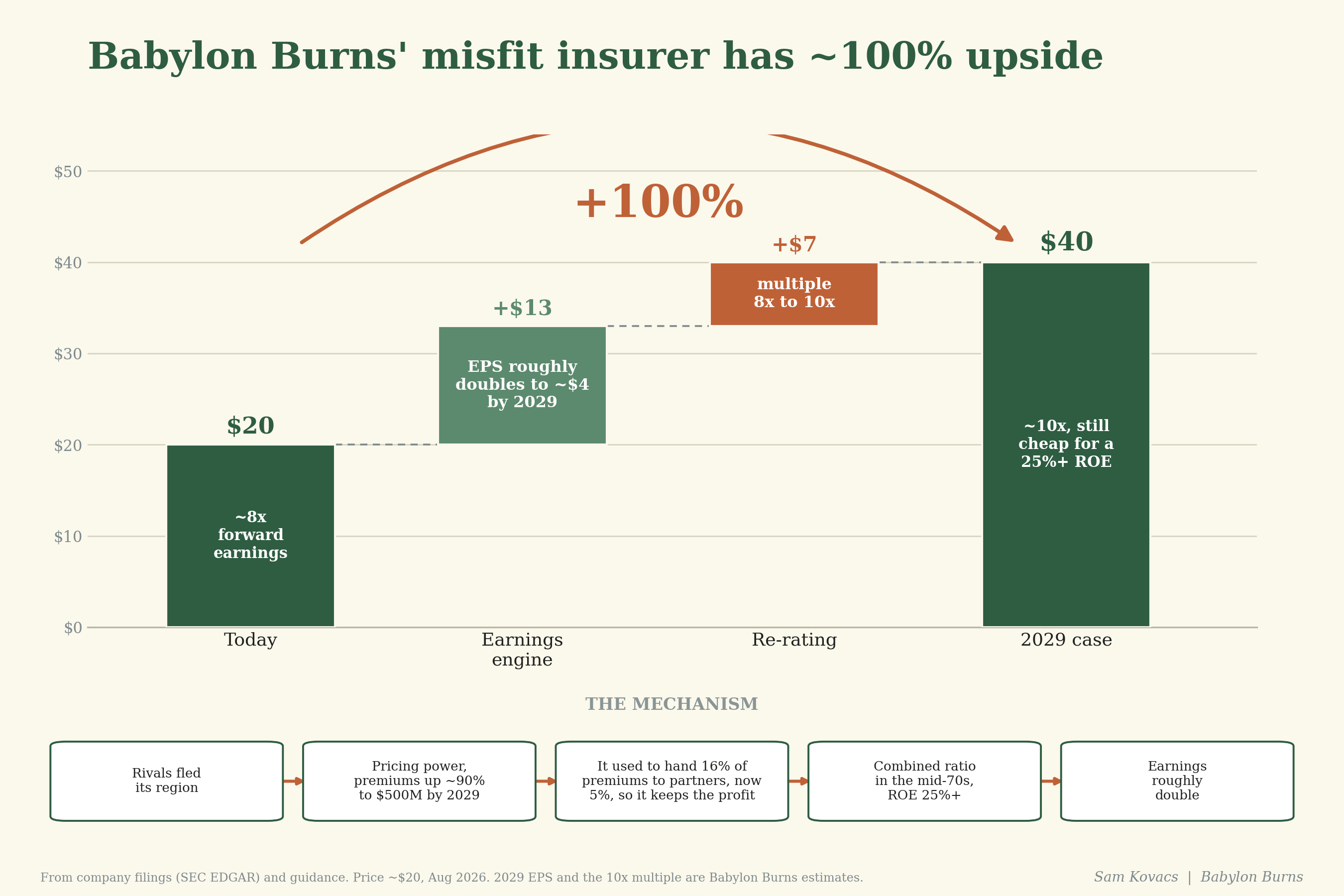
If it keeps plugging, this could be an easy double in coming years. It just posted a record quarter, and the market has re-rated it but not nearly enough.
I’ll spell it out to you below, along with a handful of other picks which top off our portfolio.
Plus if you join now, you can use the days ahead to catch up on the 4 other reports where I shared my full portfolio.
This is an amazing time to join Babylon Burns at the discounted rate of $299.
Nothing about my method is difficult or a secret.
Edison gave the concept away in a sentence, and Richard Dennis said you could print his trading rules in the newspaper and no one would follow them.
Audition wide, kill most ideas cheaply, press the few that work until they’re too big for comfort.
Find alpha or die tryin’.
I’ll run you through these positions rapidly as I’ve done for the past week, which will then give you a full review of the current positions in the portfolio. In coming weeks I’ll add and remove positions as time goes by, and you’ll be notified here and through the web-application.
Some of these updates will be lighter than I had anticipated, but quite frankly as we’re approaching the end of this first week, I’m a little smoked from all the work that has been done. I nonetheless want to cover these names so you can finish the week with the entire portfolio.
PayPal ($PYPL).
Position size: 2%
Stop loss: $50
Ten years ago, if you paid for something online without typing in your card number, you were almost certainly clicking PayPal. It was THE button.
Then Apple built its own button, and Shopify built one, and a dozen one-click checkouts showed up that didn’t exist back when PayPal had the field to itself.
The stock has fallen more than 80% from its 2021 peak. It’s climbed off its early-2026 lows since, but it still trades at a fraction of its former self, and the market still treats it as a decaying business.
Top line is growing at 5% which isn’t explosive, and it retires 12% of its shares, which is being done at 11x earnings.
The branded checkout, the yellow button, is the high-margin heart of the whole company, and it has been losing market share, although still growing.
The frame which is presented suggests that if this keeps going, no amount of financial engineering saves you. You’re just buying back the shares of something that’s shrinking.
But the thing is, PayPal throws off more than six billion dollars of cash a year, and it’s spending about six billion a year buying its own stock, retiring the share count out from under a price that assumes the thing is dying.
That’s about 12% of the shares being retired a year.
There’s a new CEO and a $1.5bn of cost cuts incoming. And it still has a beautiful network: more than 400 million accounts, consumers on one side and merchants on the other. Apple can build a better checkout option. In fact I use Apple pay so much, if it’s there that’s what I want by default because it’s native to my hardware. Both can exist.
I had mostly forgotten about Paypal to be honest. I don’t think I looked at the price chart since the pandemic when I decided it wasn’t for me.
But recently, I was getting a watch serviced by an independent watchmaker, and he suggested I pay him by Paypal.
I thought PAYPAL?? And looked up the stock, and saw this beautiful chart:
On the daily chart, you can see it gapping up to and blasting through it’s downwards wedge on the latest news of Stripe and Advent making an offer for $60.5 per share which management suggested was inadequate given their execution plan.
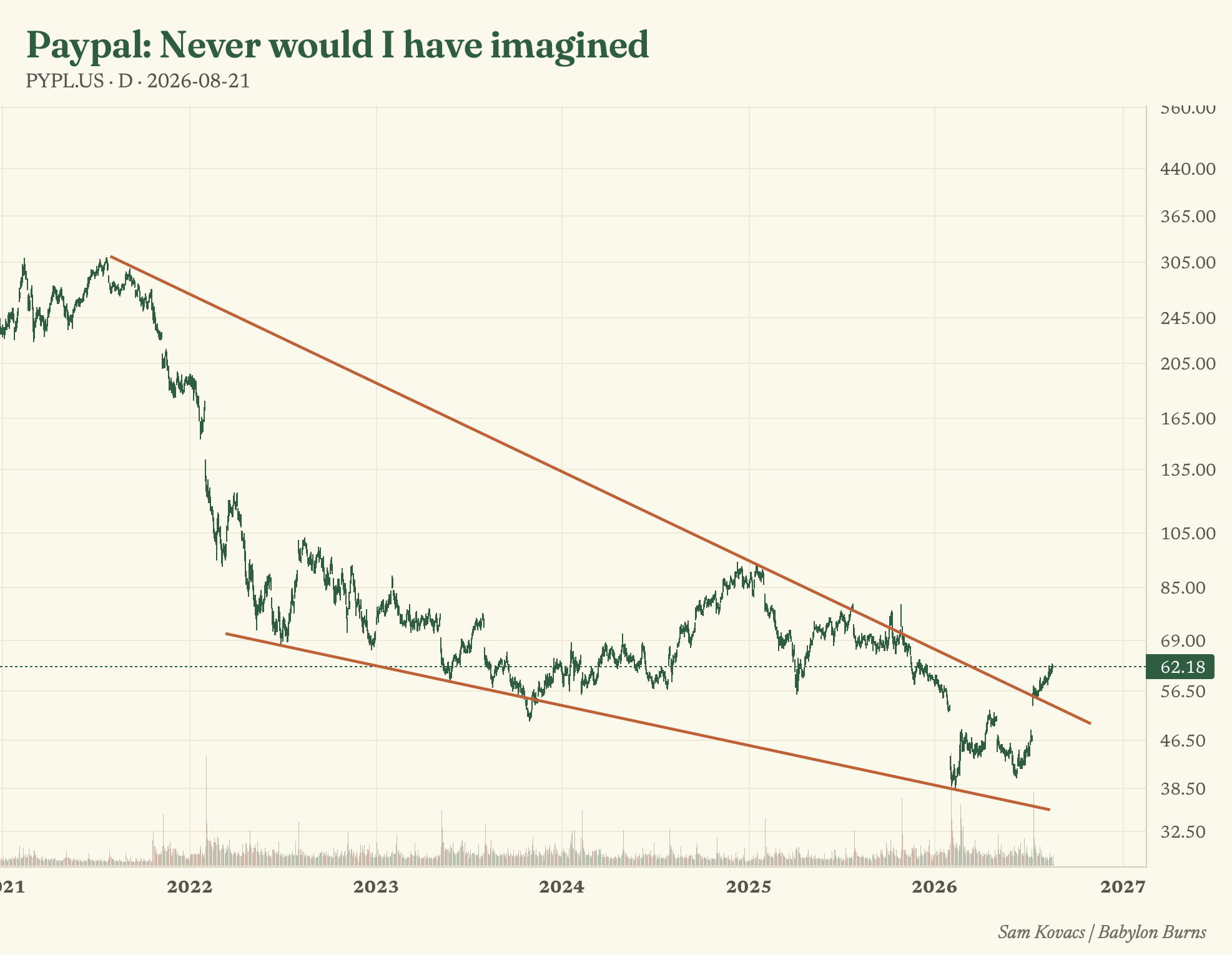
This has brought speculation that Paypal might see a bidding war and others making offers, which could drive the price higher. If I were management, I definitely wouldn’t sell a business that is still growing, although slowly, which I can just engineer through a 12% stock buyback at 11x earnings.
Maybe Paypal gets another takeover bid, maybe its self-help story is enough. Either way I’m in and I got a stop at $50 if it comes back down.
