


There was a time when we had statesmen who wanted the public to know the truth and who defended what was right morally. Those times are gone.
As Abraham Lincoln once said:
No man has a good enough memory to make a successful liar.
On September 19, Admiral Brad Cooper said U.S. forces had helped move more than one billion barrels of crude oil through the Strait of Hormuz “in the last couple of months”.
This isn’t up for interpretation, it is spoken word for word in a video.


A billion barrels in approximately two months implies an average above 16 million barrels a day.
But put that claim alongside CENTCOM’s earlier announcements and the arithmetic becomes considerably more demanding.
The final three weeks would have to average approximately 32 million barrels a day.
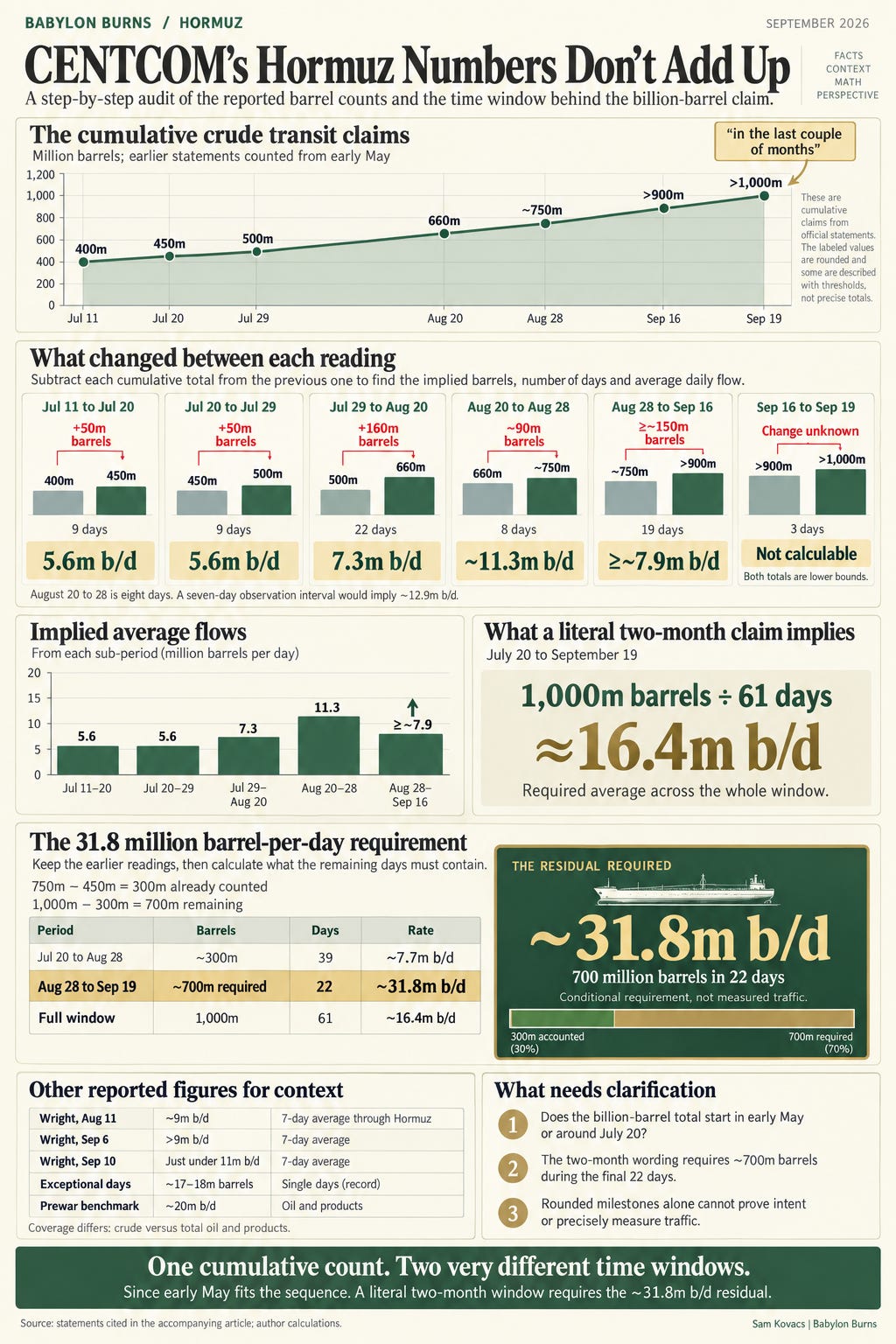
I checked the work on the GOVERNMENT supplied numbers, and the math doesn’t math.
If you value the truth, and you want an analyst who is honest about the situation, not managing a narrative, and who is only seeking to find out the truth and help individuals profit from what is a really messed up situation, then enter your email below.
It helps me more than you know, and I’ll share a mix of free and paid content to help you navigate the economy, geopolitics and make money in this market.
Breaking down CENTCOM’s numbers.
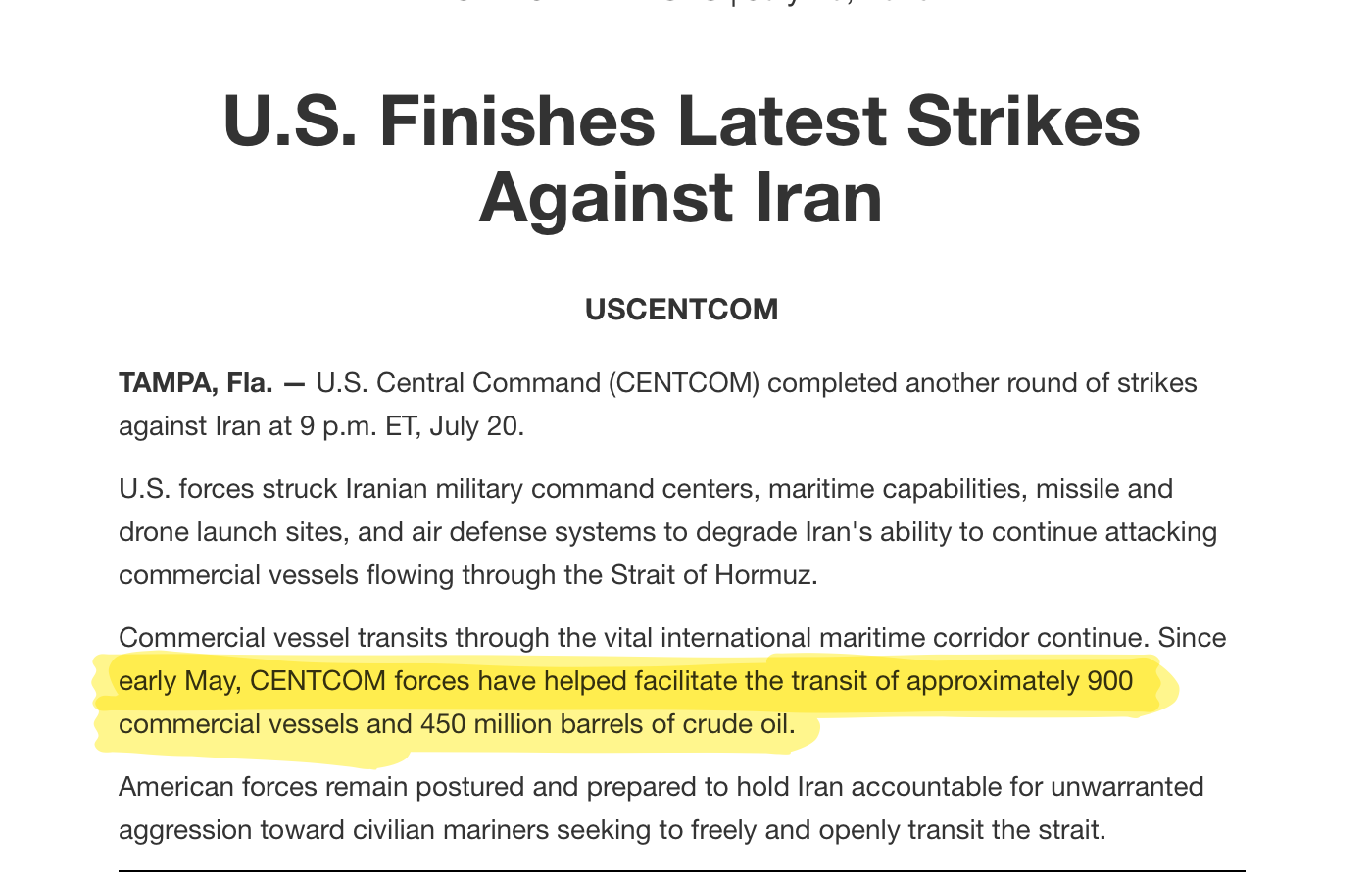
On July 20, CENTCOM reported that its forces had helped facilitate approximately 450 million barrels of crude oil since early May. I will link to everything so you can check for yourself. (CENTCOM release.)
On August 28,Cooper’s update: the vessels assisted by American forces had carried nearly 750 million barrels.

Think of those cumulative totals as odometer readings: subtract the earlier reading to find what moved in between.
750 million − 450 million = approximately 300 million barrels.
July 20 to August 28 is 39 days. The implied average over that interval is therefore:
300 million ÷ 39 = approximately 7.7 million barrels a day.
Keep those 300 million barrels in mind.
Now return to September 19.
Cooper described more than one billion barrels moving in approximately two months. Use July 20 to September 19: 61 days, with a dated CENTCOM reading at the beginning.
Under that reading, the 61-day window must contain at least one billion barrels.
Yet CENTCOM’s earlier figures account for only about 300 million during its first 39 days.
That leaves:
1,000 million − 300 million = approximately 700 million barrels.
And there are only 22 days left, from August 28 to September 19.
700 million ÷ 22 = approximately 31.8 million barrels a day.
The two-month average hides the extraordinary acceleration needed to make it work.
The final 22 days must average roughly four times the rate implied for the preceding 39.
Those are the barrels Cooper’s wording requires. Where are the daily figures showing that acceleration?
Before the Strait of Hormuz was impaired, 20 million barrels made their way through per day.
For their numbers to work, you need 22 uninterrupted days at 150% of prewar traffic.
That is a period when VLCCs were blown up by mines, missiles, and traffic was only moving through a thin Omani corridor.
A billion barrels since when?
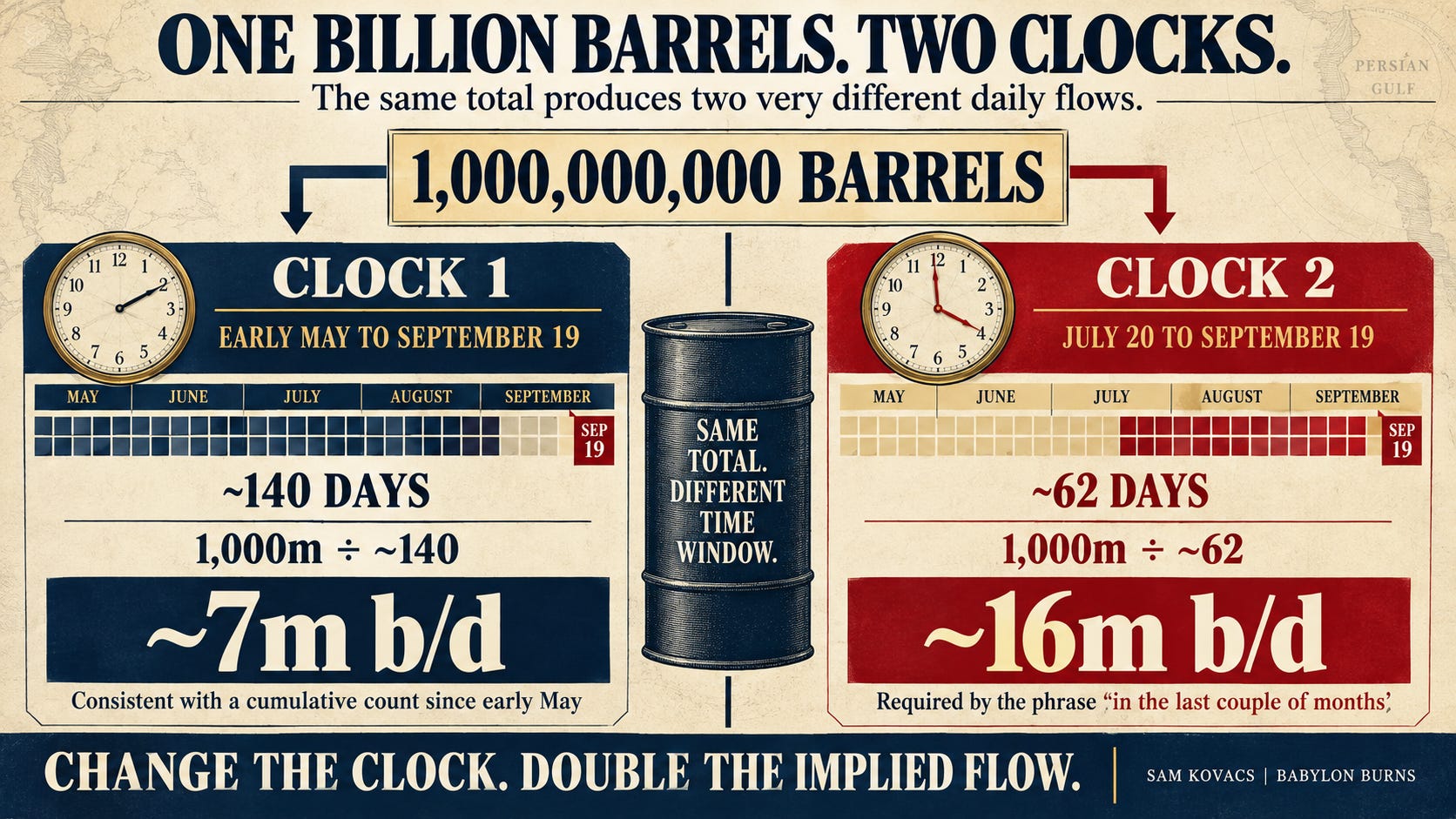
There is a straightforward possible explanation: the billion-barrel figure was the latest milestone in the cumulative count that began in early May.
The problem is that the choice of words was deliberate to imply that it was in the past couple of months, which people extrapolated to the last 60 days, which as I believe I demonstrated above, is untrue..
That would follow naturally from the earlier readings:
450 million. Nearly 750 million. More than one billion.
Using one billion as an approximate total, early May to September 19 gives an average near 7 million barrels a day.
Compress the period to approximately two months and that becomes more than 16 million barrels a day.
Of course this is night and day, it’s the difference between 70% back to pre war conditions and half of pre-war flow
Anyone who understands anything about oil markets understands the difference between a 3-4mbpd gap and a 10 mbpd gap.
The cumulative would suggest 11mbpd coming out in the past 22 days, possible, although on the higher end.
A higher sustained flow means more supply reaching the market, less pressure on inventories and a weaker case for scarcity pricing.
If the billion-barrel count begins in early May, CENTCOM should correct the time description.
If it begins around July 20, the earlier readings leave approximately 700 million barrels requiring an explanation in the final three weeks.
CENTCOM should publish the starting date and the daily totals behind the announcement.
If one billion barrels genuinely moved in approximately two months, show where the remaining 700 million barrels fit.
Until then, the claim should not be treated as evidence that Hormuz flows have returned anywhere close to normal.
You don’t get to conveniently “slip up” and have all the stenographers on X and in the media repeat it without checking the work.
The public deserves better.
Patience is required, this conflict isn’t resolved, flows haven’t recovered nearly anywhere near to where they want you to believe.
And even if the flow is recovering somewhat, the inventories have been fundamentally impaired.


Patience is required through October.
As Nietzsche would say:
I am not upset that you lied to me, I am upset that from now on I can’t believe you.
And like Yogi Berra would say:
It ain’t over ‘til it’s over.
As Babylon Burns, we’ll light the cigars.
If you enjoyed this article, please consider subscribing below by hitting the button. Babylon Burns is an honest, individual, uncorruptable publication by myself Sam Kovacs, as I seek out the truth and how to profit from it.