

The fiscal writing is on the wall for the US. They will never stop spending, and the money is headed somewhere clear. Follow the numbers and a brilliant trade is uncovered in today’s article:
Since 1901, the United States federal government has collected more income than it has spent in only 31 years.
8 of those, came in a single stretch between 1920 and 1930.
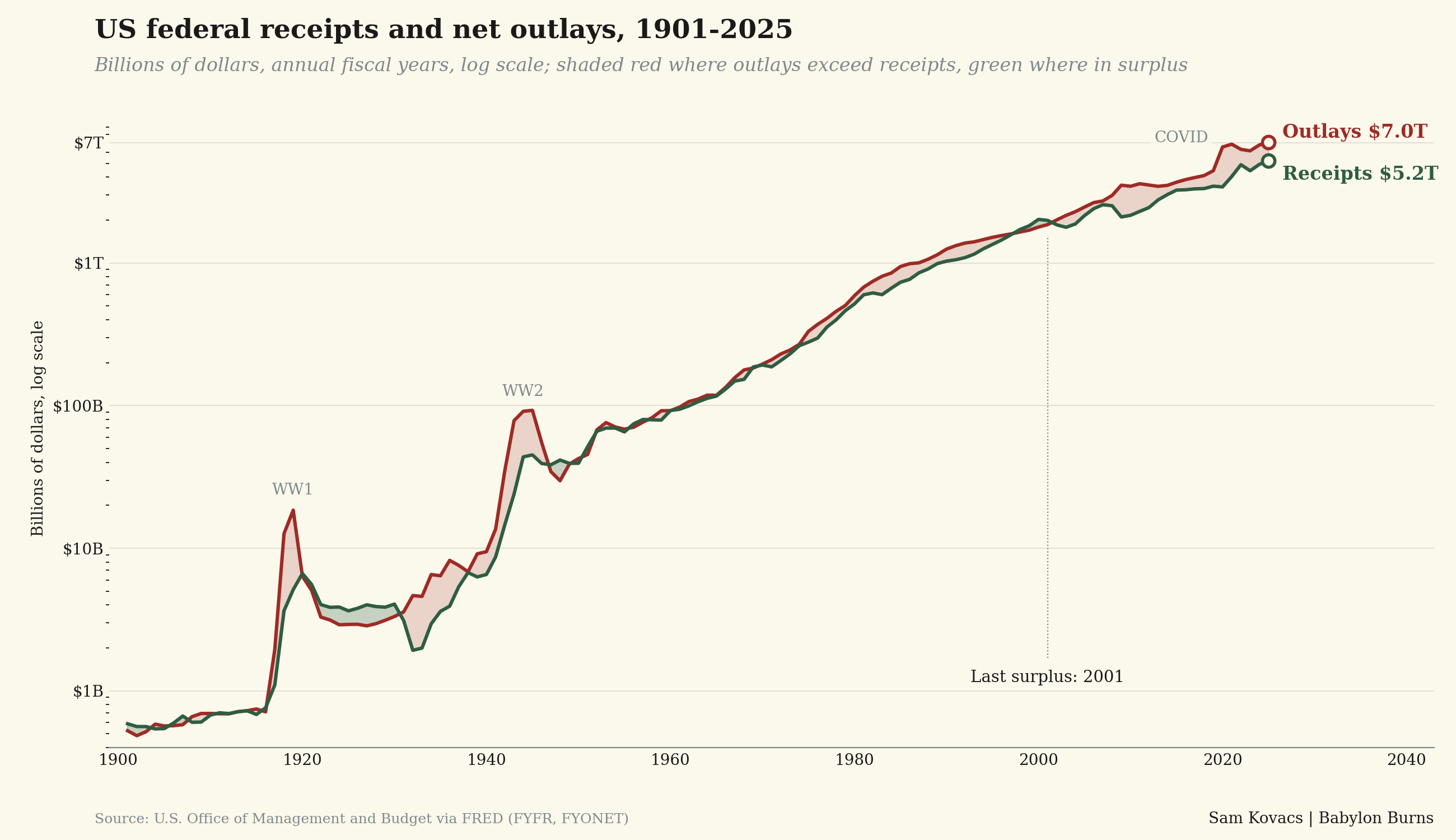
Since 1960, there have been only 5 surplus years.
The last time was in 2001, and I was in primary school. In 2025, the government brought in $5.2tn and spent $7tn, a gap of $1.8tn in a year with no recession, no war and with unemployment at a very low level.
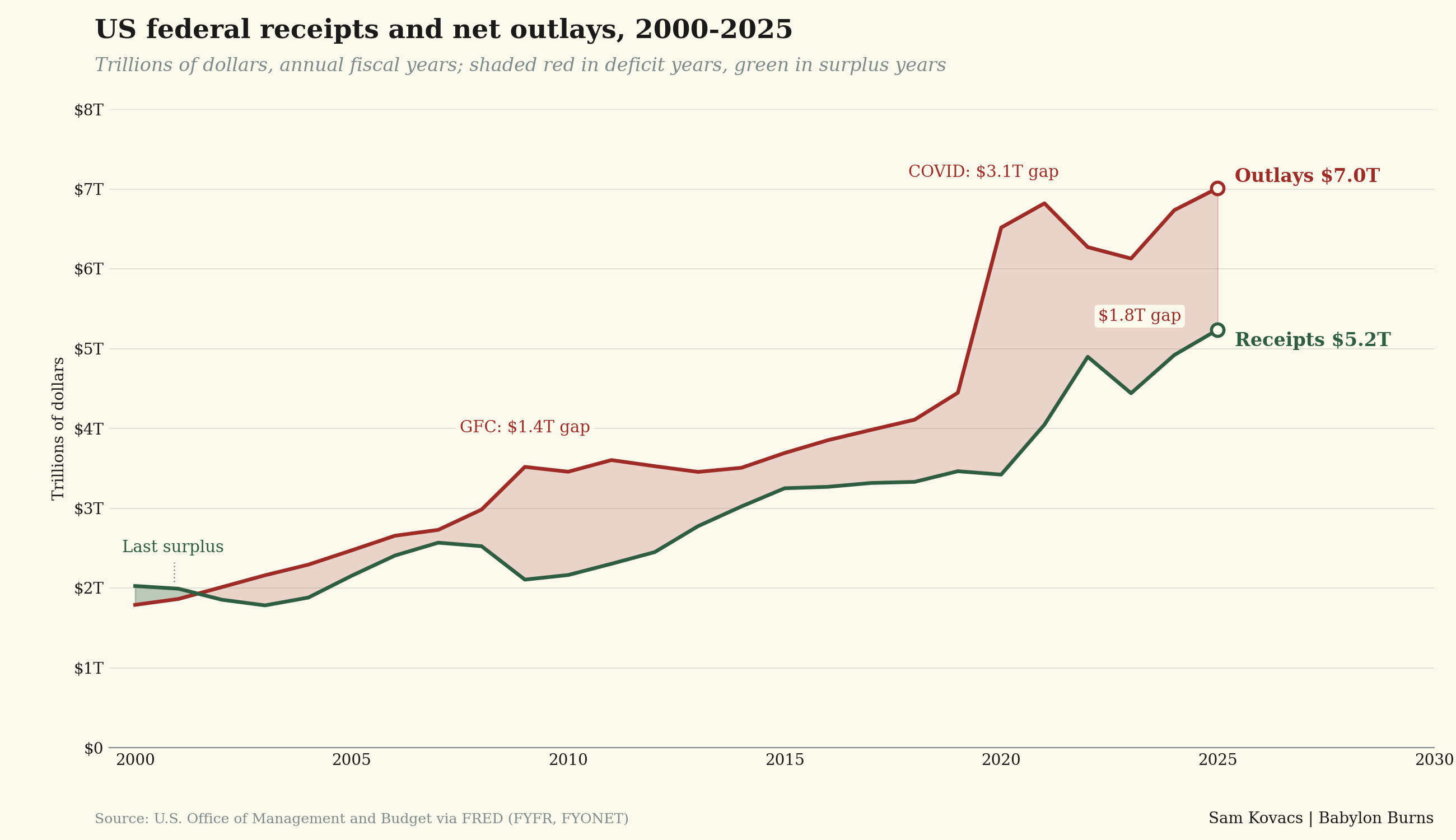
You must realize that this is now the default operating model of the US government and it will continue to be for the foreseeable future.
I wrote about why this won’t reverse in detail in my first article on Substack (“They sold you a dream and you bought it wholesale”).
But it comes down to this: For most of the postwar era, the expenses > income arrangement was tolerable because GDP growth carried the extra debt load that the deficit caused.
Gross federal debt peaked at 119% of GDP in 1946 and fell to 31% by 1981, A 35 year deleveraging which was achieved while still running net-deficits during the period.
But that escape has become less viable as real growth averaged 4% in the 50s and 60s, 3% in the 80s and 90s, and 2% since the financial crisis.
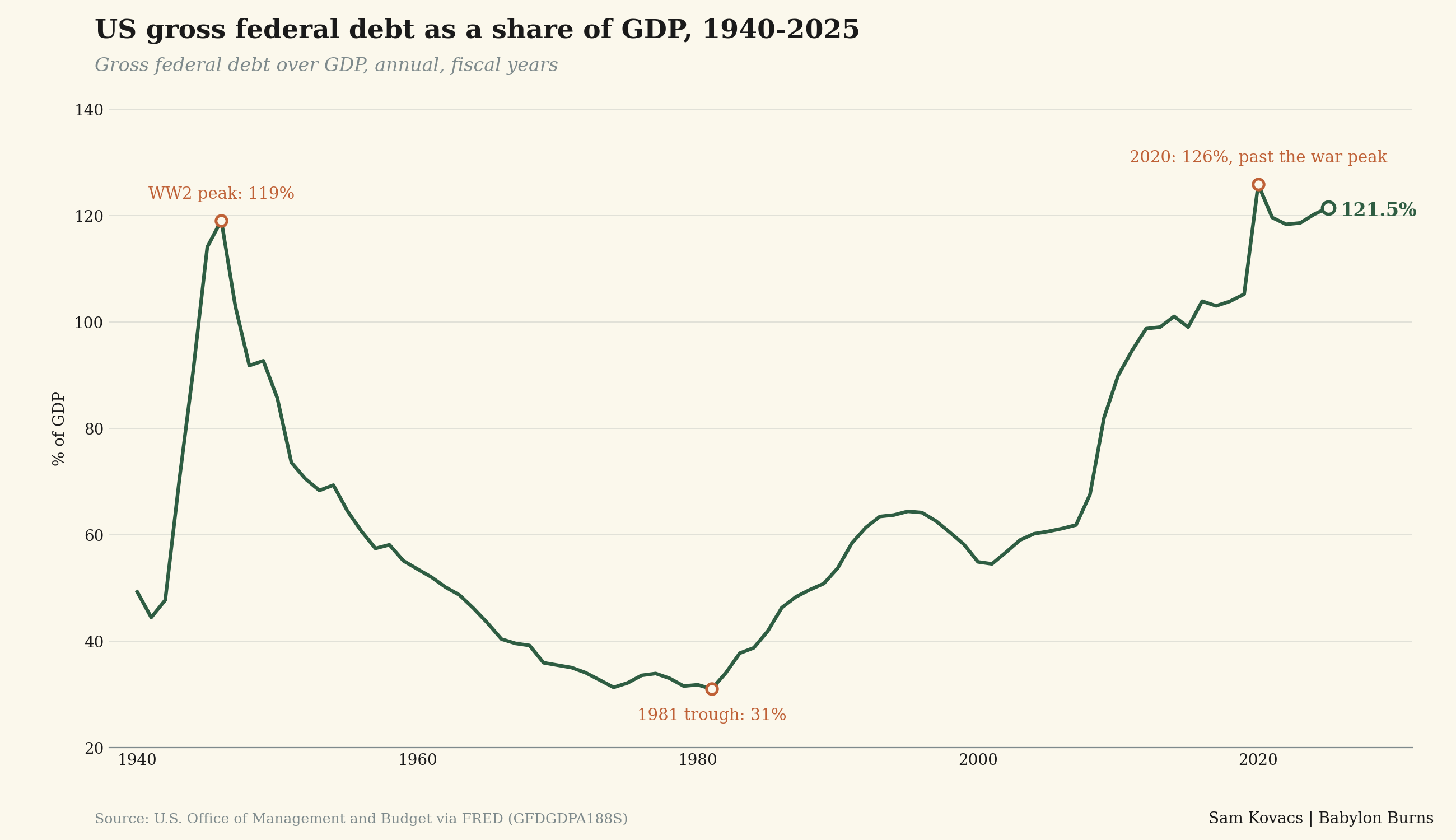
Meanwhile the debt ratio has crossed its WWII peak in 2020, and after a small reprieve, is once again knocking on the door of its ATH.
The last time the ratio was this high, it got there as a consequence of a war, and it took 3 decades of financial repression to bring it back down.
As you know, overextend sovereigns have 3 exits: default, austerity, and debasement. I’ve made the argument in the past that there will be more debasement, as default isn’t an option for the US and there is no political will for austerity.
Today we will be looking at a different angle: If there will be no austerity, who will be the beneficiaries, and how do we express that as a trade?
(This is a stock idea I presented on George Noble’s “best stock idea” conference this week, he is still selling the replay to it if you want to check out the other 14 speakers’ ideas too).
Old people want their entitlements!
The Department of Government Efficiency launched 19 months ago in January 2025, with a stated target of identifying $2tn in spending cuts, with America’s richest man at the helm.
Its charter expired on the 4th of July, with only $215bn in savings claimed, which is about $0.11 on the dollar. Furthermore it’s a figure which couldn’t be verified and might have been optimistic. That’s not the point.
The point is: over the same period, Federal debt by several trillion dollars.
It was a doomed effort. 60% of Federal spending is mandatory, written into law, and a task force could never cancel these entitlements.
So even when there was political will to attempt government efficiency, the needle wasn't moved in any significant way, and there are no realistic paths to resolving this.
Why?
The answer lives in the constituency of voters in the US. In the 1964-1966 election cycle, voters over 65 cast 15% of the American ballots.
In 2020-2022, they cast 27.8% of the ballots.
It is quite easy to project where this is going in 20 years, as everyone who is already born is already born.
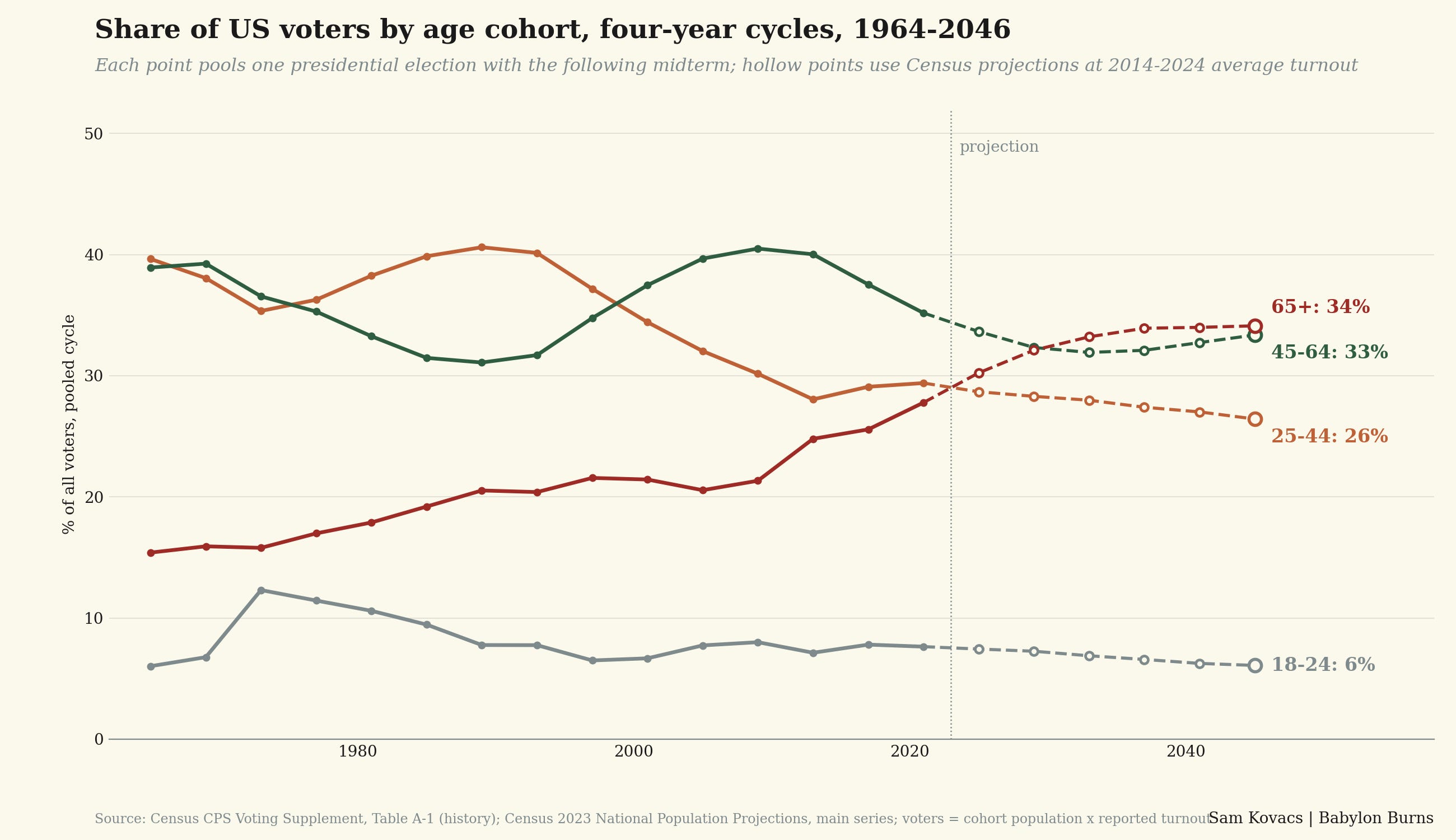
By the mid 2040s, over 65s will cast 1/3rd of the votes. Over 45s will be 2/3rds.
Singapore’s founding PM, Lee Kuan Yew saw this exact configuration and its problems coming over 3 decades ago.
In a 1994 Foreign Affairs interview, he argued that the one person, one vote was a British system inheritance which didn’t provide the optimal outcomes for a democracy.
He suggested that citizens between 40 and 60, which were raising families, should carry 2 votes each, on the grounds that a parent votes for the future as well as the present.
He assessed that elderly voters were troublesome, as an aging electorate would grow “tempted to pressure” governments for subsidies and assistance, regardless of the long-term cost to the state.
The United States is now well underway to living LKY’s nightmare. An ageing electorate will not vote for austerity, and politicians will have to be ever more considerate towards their needs, as their weight in the ballot-box continues to rise.
So where does the money go?
The most obvious destination for transfers to elderly people is healthcare.
Old people are like old airplanes ( I wrote an article on old airplanes), they need more maintenance.
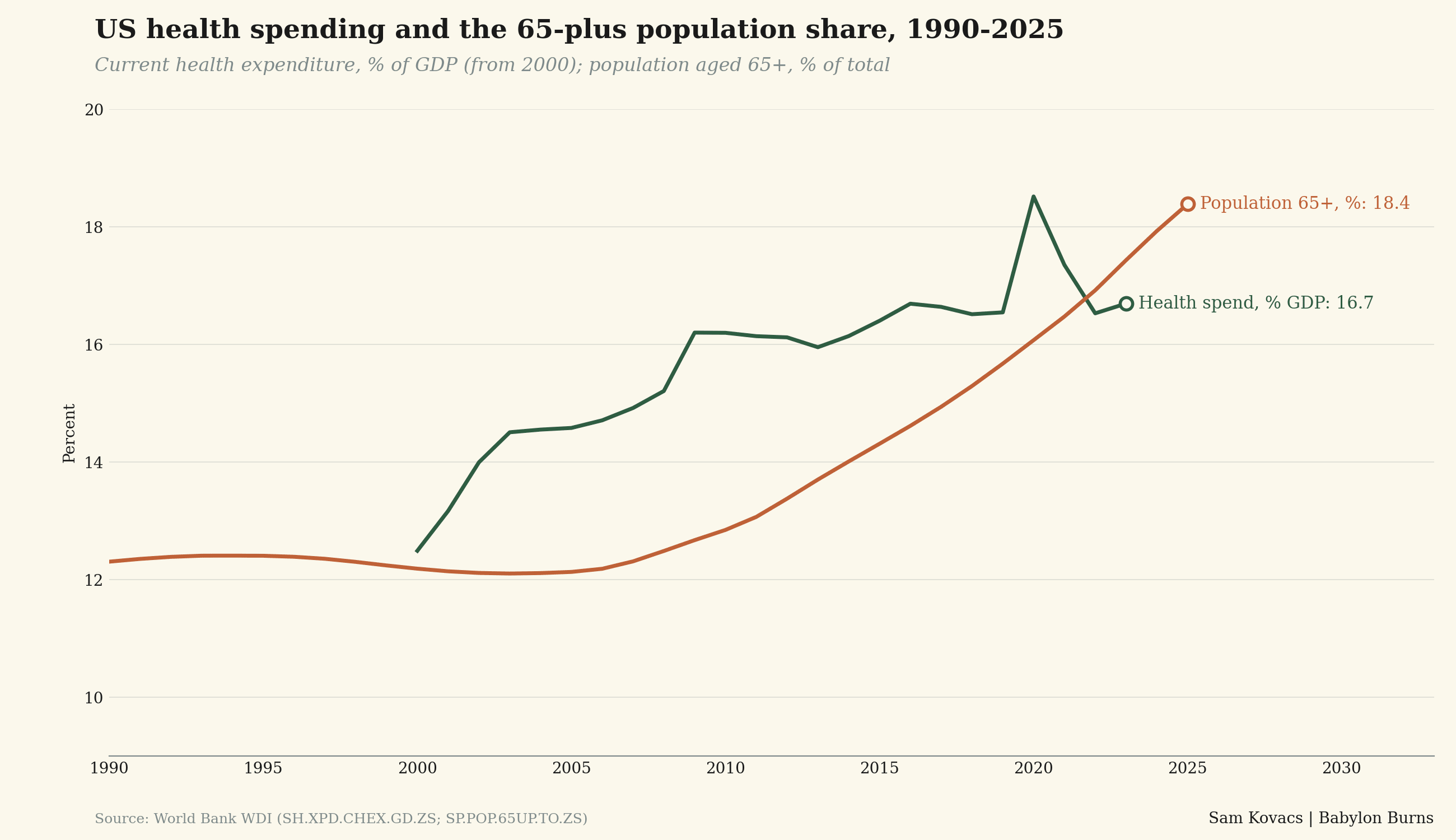
Unsurprisingly over the past 25 years, as the percentage of the population over 65 has increased, so has the percentage of GDP which is spent on healthcare in the US.
Spending on care is mandated by law, as mentioned above, and it is compounding. It’s a simple line item where visible demography paths become easy fiscal arithmetic.
This leaves the state with one single lever: to provide the same care, but cheaper.
This is a lever that the federal government has been pulling for 4 decades. How do they achieve it?
It’s quite simple. Care in a hospital is more expensive than care at home. In 1981, home and community-based care was 1.1% of Medicaid’s long-term care.
This level crossed 50% in 2013, and currently is around 64%.
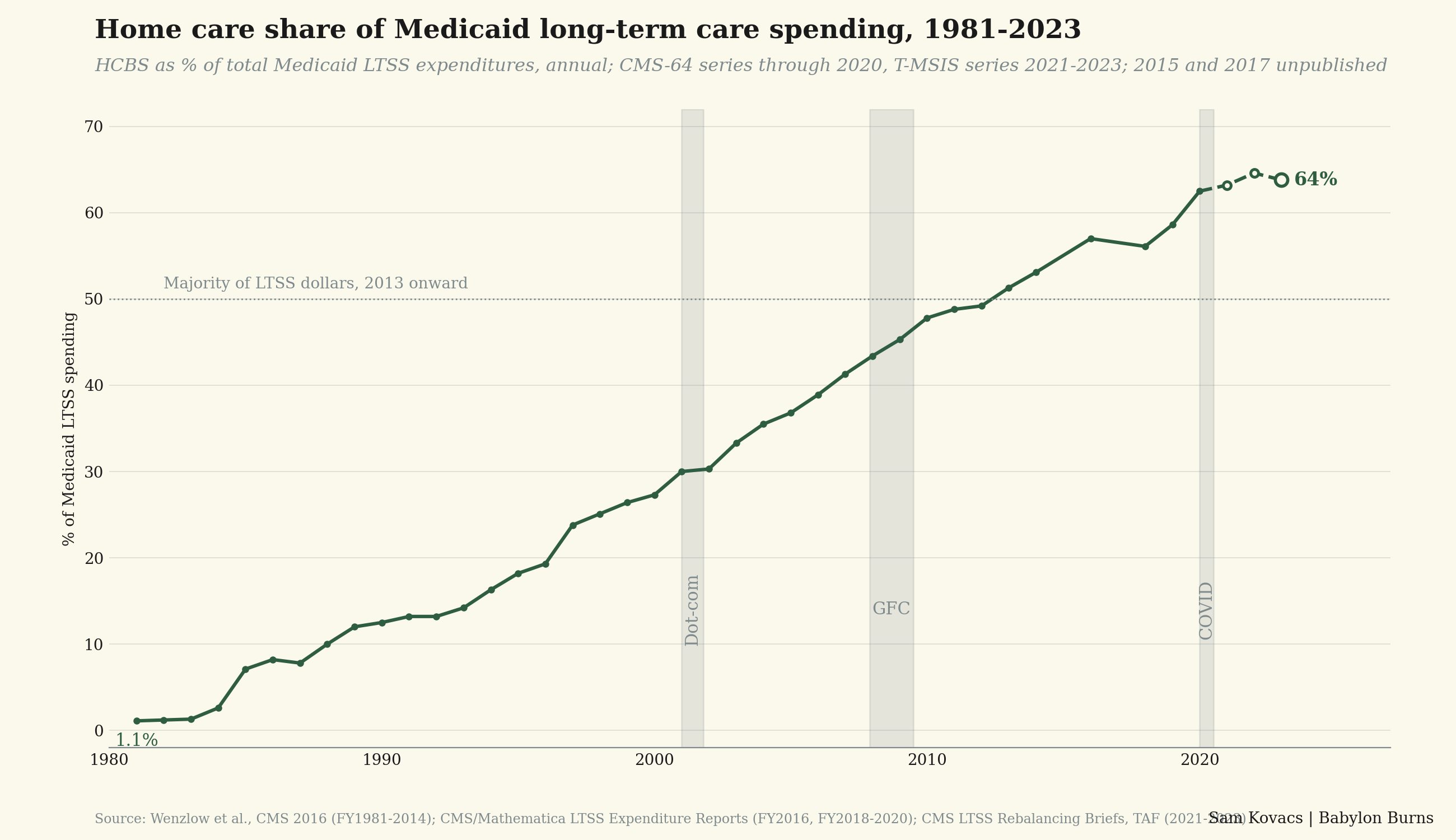
The fact that there is fiscal pressure due to the deficits will continue to accelerate this transition.
Care and benefits are promised to people. They continue to cost more. There will continue to be an effort to shift as much of this as possible to home-based and community-based care.
“But Sam, what about the cuts to Medicaid?”
The 2025 Budget Reconciliation Act cut $911bn from federal Medicaid financing over the next decade.
The response was to discount everything with Medicaid revenue, as if the cuts would fall evenly across the board.
A cut of this side (which will be within a total which keeps growing by the way) is a search for bloated fat. There are some clear rules concerning what can be cut: a focus on able-bodied optional adult services.
There is however, one subset of services which cannot be touched either legally or politically, and it lives at the other end of the spectrum of the oldies which we said will continue driving the overall number up.
Because that’s what people don’t understand about the cuts. They’re not cuts. They’re a reduction in projected growth. Federal Medicaid outlays in 2035 will still be meaningfully higher in nominal dollars than they are today.
And one area where they will not cut, is medically complex children.
And in particular, private duty nursing for Medicaid children.
Legally, the EPSDT mandate of 1989 obligates every state to cover all necessary treatment for eligible children. It’s a benefit which cannot be deleted.
Politically and morally, at a committee hearing, you’re not getting anyone vote to unplug our sick children while simultaneously increasing how much we’re spending on grandpa.
And given that states have to cover medically complex children, they would much further like that care to be administered at home, as it costs 10x less than in a hospital.
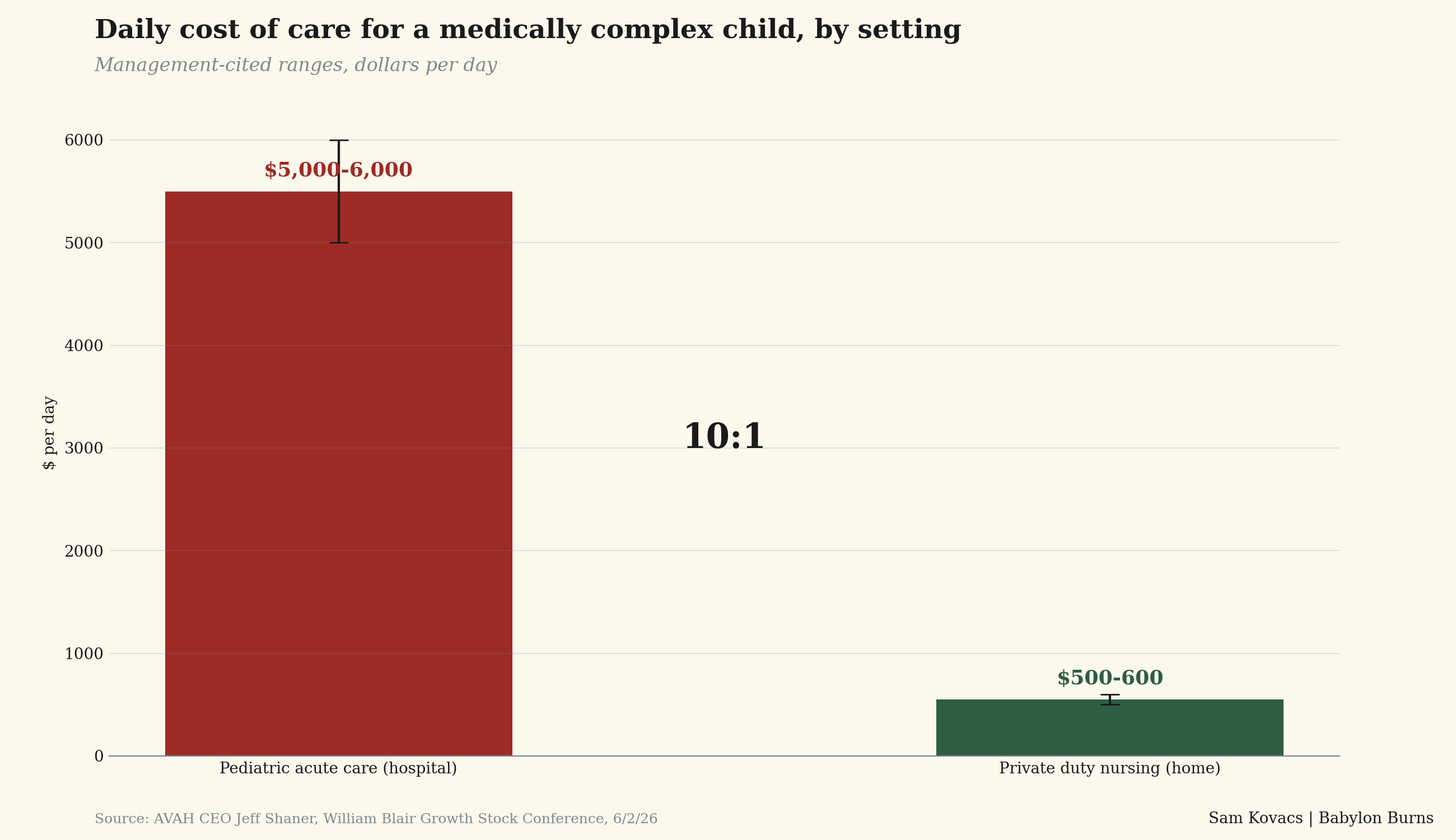
Which leads us straight into today’s stock pick.
(This one stays free in full. If you enjoy it, subscribe below to get the next one.)
Introducing Aveanna Health (AVAH)
Aveanna Health is the national platform for the exact niche discussed above: skilled nursing, in homes, for ventilator and technology dependent children, paid almost entirely by Medicaid.
It effectively sits at the intersection of all of the forces described above. It is one of the transfers the state cannot and will not stop paying.
The sorting process of what stays in Medicaid and what doesn’t always spares this demographic, at the very same time that the fiscal stress accelerates the substitution towards home care.
And as I will lay out below, you’ll come to realize that there are 3 sources of growth which the market has totally discounted in this name:
a caregiver labor pool which is finally loosening after a shortage which nearly bankrupted this business.
a contracted shift of volume towards premium rate payers that do not depend on further state reevaluation (even though, further state reevaluation is also likely)
and a transfer of enterprise value from the creditors to shareholders as the business continues to delever.
In a nutshell that’s the thesis.
Aveanna runs the same transaction, 46 million times per year: a nurse enters the home of a medically fragile child, the nurse costs a wage, the government program pays a rate, and the company keeps the spread.
In fiscal 2025, the rate was $43.39 per household, the cost was $30.56, leaving $12.83 of spread across 46.1mn hours of care.
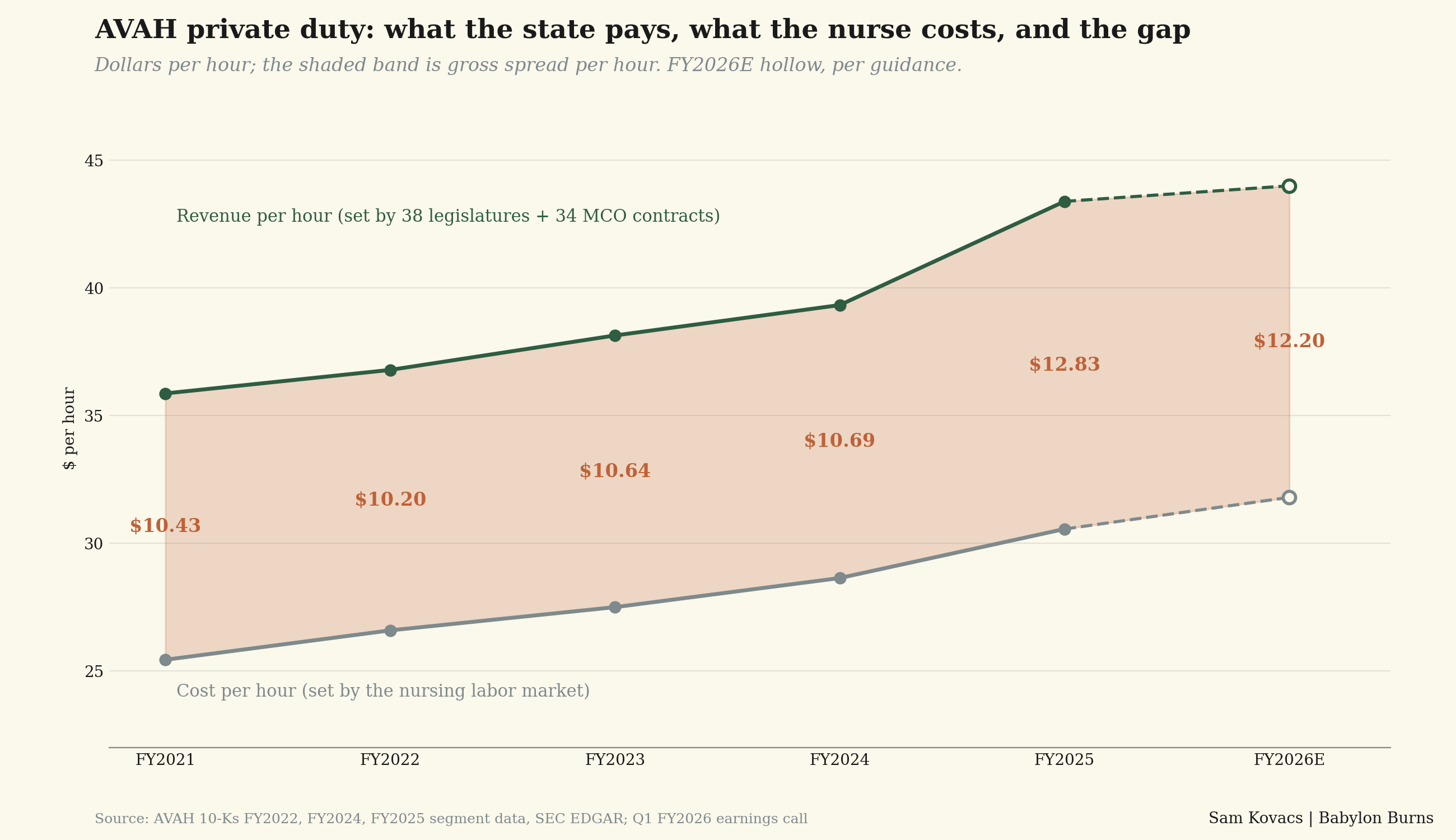
So it is clear to see that Aveanna as a business has significant operational leverage with nursing costs and program rates competing in a tug of war for margin.
Now imagine that the 2017 private equity merger which created this company levered this thing 11x with debt.
When the post-pandemic wage inflation forced the cost line up 4.6% in 2022 vs frozen state rates which only increased at 2.6%, the spread compressed by $0.23, and hours stalled as the reimbursement couldn’t fund competitive wages. This was enough to tank EBITDA by 30%, and for the equity to fall by 94% from its $12 IPO to $0.67.
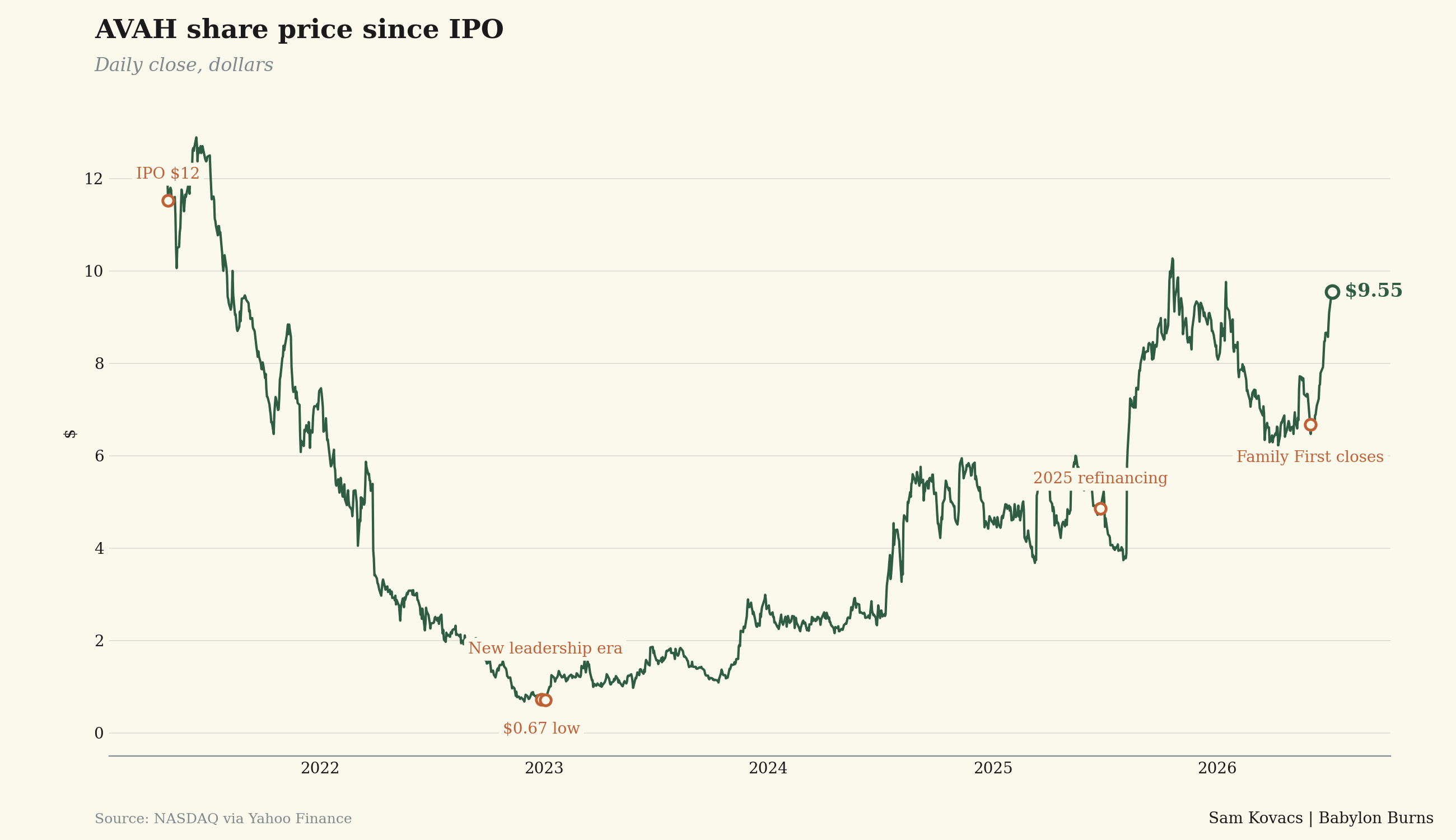
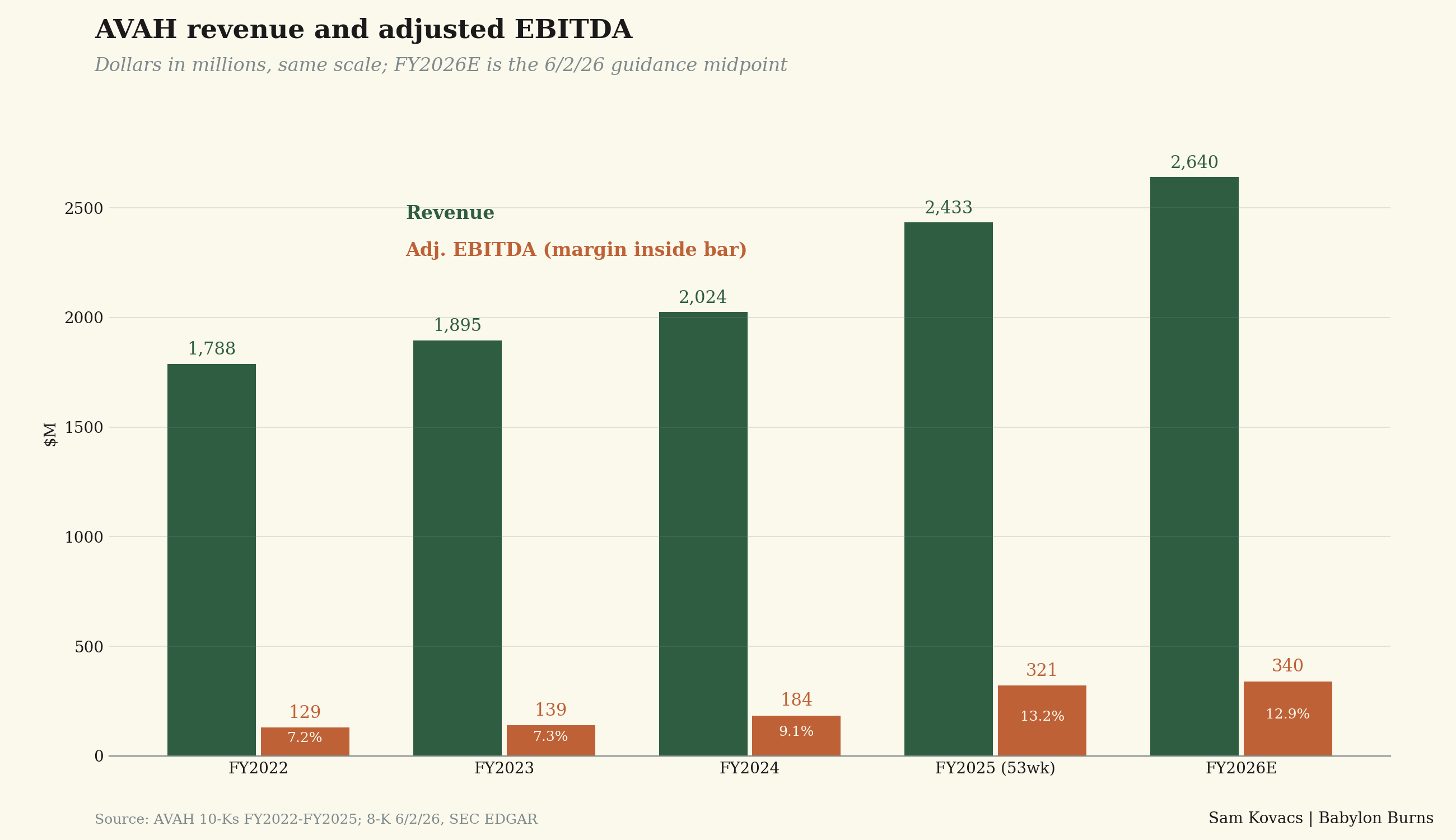
Management spent the next 2 years campaigning statehouses, and finally in fiscal 2025, the rates increased by 10%, the spread was up $2, and EBITDA shot up 75%.
The combination of operating and financial leverage gives this stock a beta of 1.9x and this isn’t going away.
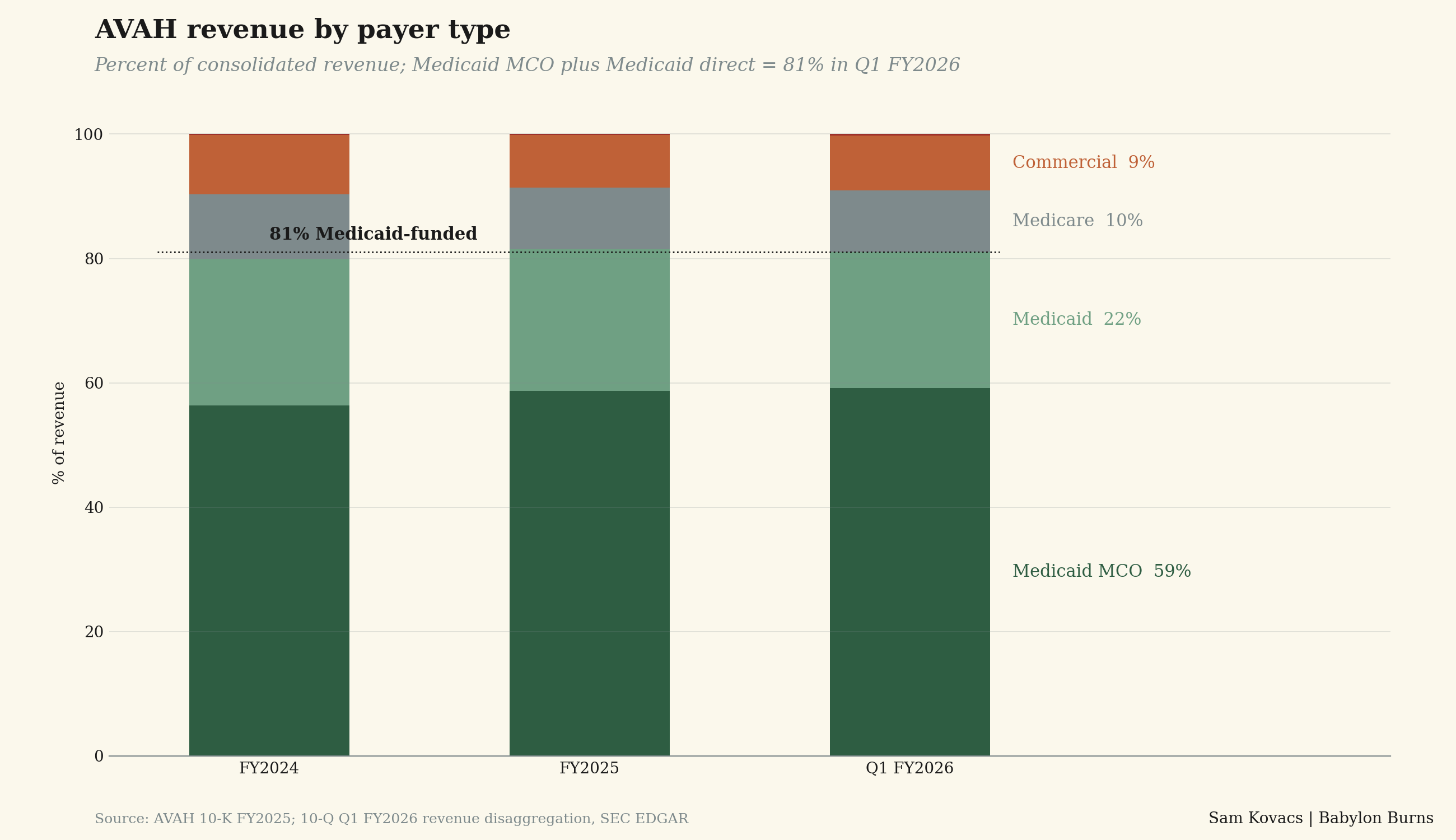
The company’s revenue base is a fiscal transfer in pure form (with a modifier which I’ll explain later). Medicaid managed organizations supply 59% of revenue, direct state Medicaid is another 22%, Medicare is 10% (through a small adult home health segment which isn’t related to the thesis), and commercial insurance is 9%.
The business is spread over 38 states with concentration in Texas, Pennsylvania, California and following the June acquisition of Family First, a new fourth pillar in California.
Capex is $18mn per year against $2.6bn of revenue. This is an asset light business where the assets are the people, and the liabilities are still the private equity' era’s $1.48bn of floating debt rate.
The two levers
The recovery from the 2023 lows has ran on 2 distinct levers which are important to understand, as one of them will not provide the tailwinds which it has during the past couple of years.
The legislative lever is mostly exhausted here. Years of state-rate campaigns have produced double digit reimbursment increases, but as management informed us during the May earnings call, we should expect a stable rate environment with cost-of-living adjustments, with fewer state-rate wins expected.
In other words income will move with costs, and there won’t be a meaningful widening of the spread from here. In fact it is guided at $12.2 this year vs $12.83 last year.
The first quarter was the last year of the level change rerating, with 25% organic EBITDA growth vs only about 5% organic growth for the full year.
The second lever however, is still in play and offers a very attractive ramp in spreads.
Most Medicaid children are managed by capitated insurers, who receive a fixed payment per member and then eat the cost of care.
For that insurer’s economics, a child in a hospital bed is an economic nightmare. On the other hand, that same child staffed at home is a negligible expense.
But in a market where the number of available home nurses is the bottleneck, these payers are willing to pay more than the base Medicaid schedule to get a staffing priority.
Aveanna sells preferred payer contracts which give a staffing priority against rates 25% to 30% above the base schedule.
Now to be clear, the problem isn’t that there aren’t enough nurses, it’s that Aveanna is competing with what hospitals are paying for them. With hospital net hiring halved, and the hospital bid having collapsed after the pandemic induced squeeze, the marginal nurse is attainable to Aveanna.
Only a national platform like Aveanna can give a payer a staffing guarantee, which gives it a moat on which it can grow.
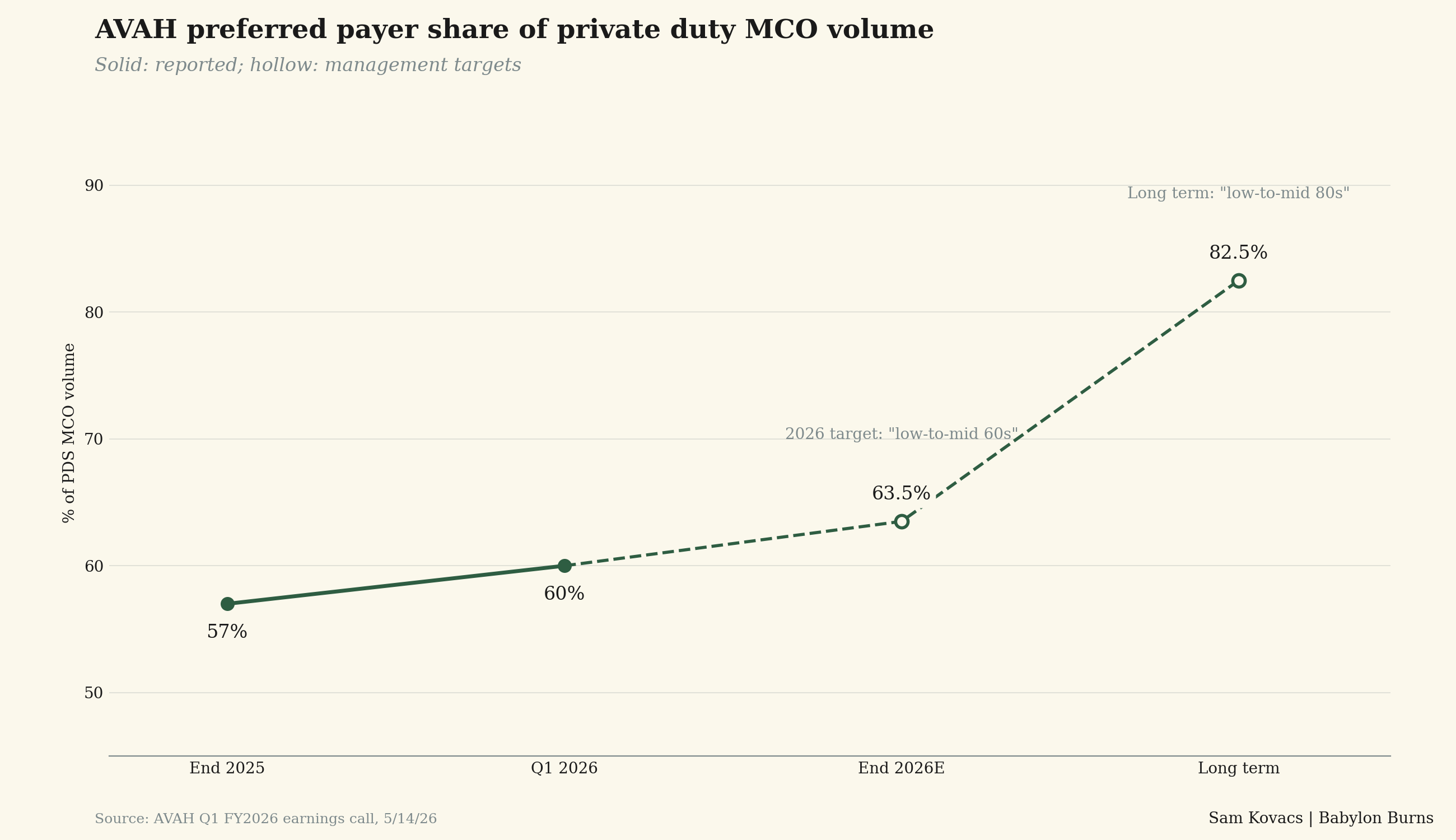
These preferred agreements covered 57% of the private duty managed care volume in Q4 2025, 60% in Q1 this year, and a management stated long-run destination to 80%.
This means that without including any volume growth, we can expect a contribution to income growth without any state intervention.
But here’s the thing: volume is UP and will continue to be.
Hours of care went from 37.9mn in 2021 then sequentially 38.5, 39.8, 41.6 and then 46.1mn in 2025.
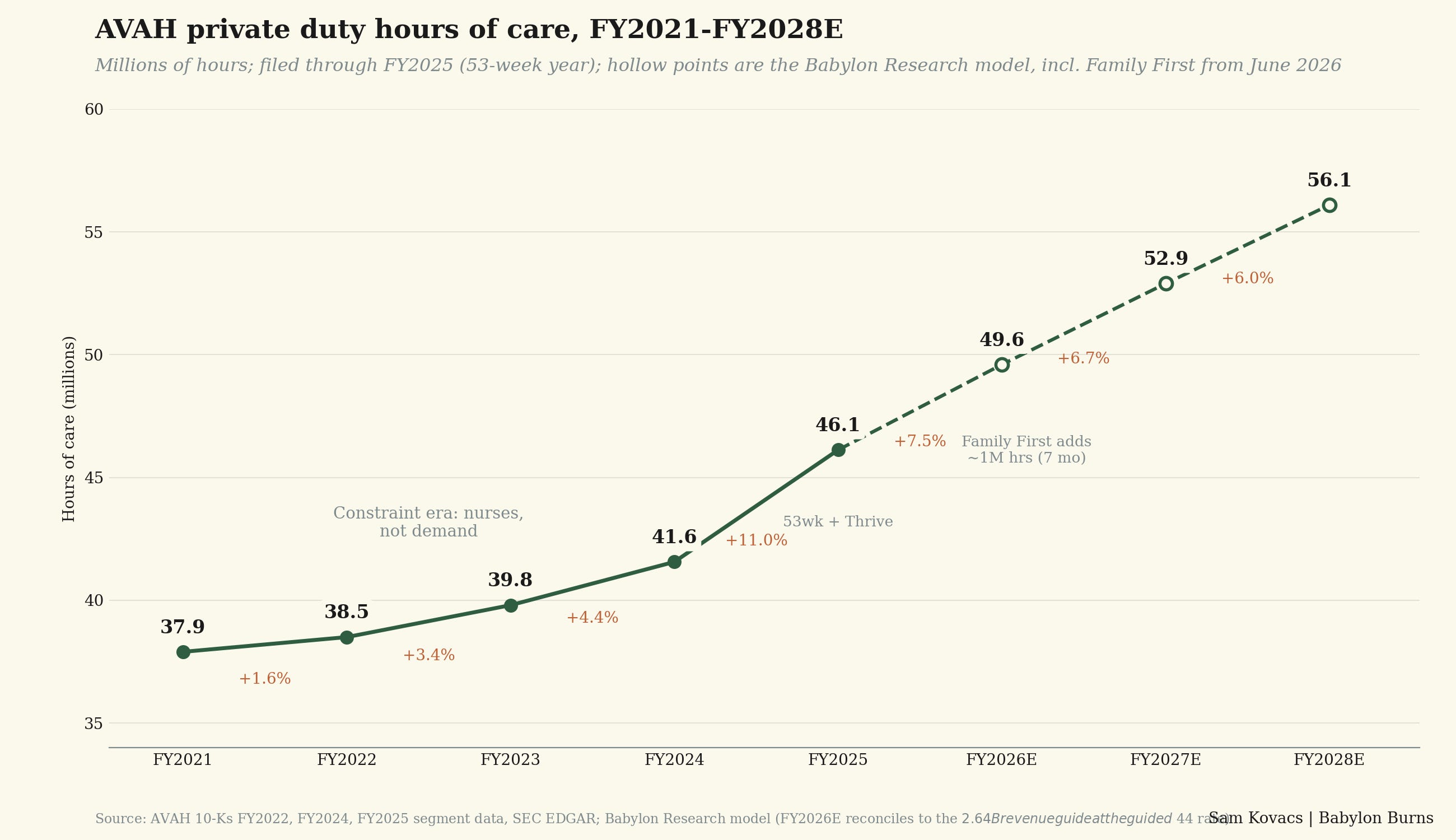
With over 220,000 new RN licenses now minted annually against a hospital bid whose travel premium has fallen by more than a third, and Family First contributing roughly a million hours across its first seven months, I model high single digit organic volume in fiscal 2027 and 2028.
The risks to the model
Now all of this sounds good, but there is a risk to the model, and it depends on whether states decide to underfund the rate. While states cannot deny children the benefit, they can choose to underfund the rate. Cutting from where rates are currently is unlikely as it is politically explosive, but freezing can be rational for a while.
At a typical 60% federal match, cutting a dollar of nursing saves the state $0.4 today, while the 10:1 hospital tail costs amount to $4 later only if the unfilled hour of nursing care turns into institutional days down the line.
At the margin, the sad truth is that it usually turns into an unpaid mother staying at home instead, which weighs down the asymmetry in favor of freezing the rates.
The post pandemic cycle showed that the cycle went: freeze, crisis, correction, in that order.
If wave inflation resurges, the live political risk is that we once again see a freeze into rising costs squeeze Aveanna.
Thankfully, the current cycle is unusually well protected against both forms. Texas has no session until January 2027, its rates are appropriated law through August 2027, and its own Medicaid agency has quantified pediatric nursing underfunding at 21%, pre-drafting the case for the next increase.
Florida has a proposed 1.3 % squeeze on managed care capitation, not the schedule itself. This is marginal as payers are moving towards the preferred payer model anyway.
Pennsylvania's contractors report 27% of authorized nursing hours unfilled every month, the strongest rate-increase predicate in any state.
California just rejected its proposed home care cuts.
So I don’t see a big swing risk here, and the transition towards preferred payers further softens the impact of the states’ decisions here.
What is assumed by the current share price
So far we have a great story. And a great story is usually part of an investment.
The remaining two pillars are valuation and the technicals. Is it a good investment on paper? And does the tape agree?
My favored approach to valuation is to reverse engineer what must be assumed by the market for today’s price to be fair.
I found out donkey’s years ago in business school that DCF models were only as good as the inputs, and that the inputs usually weren’t any good.
At $9.09 per share, the equity is worth about $2.bn, and adding $1.4bn of net debt brings enterprise value to $3.4bn.
After converting EBITDA to FCF and making adjustments for stock compensation, capex, working capital, we get a business which yields about $210mn per year.
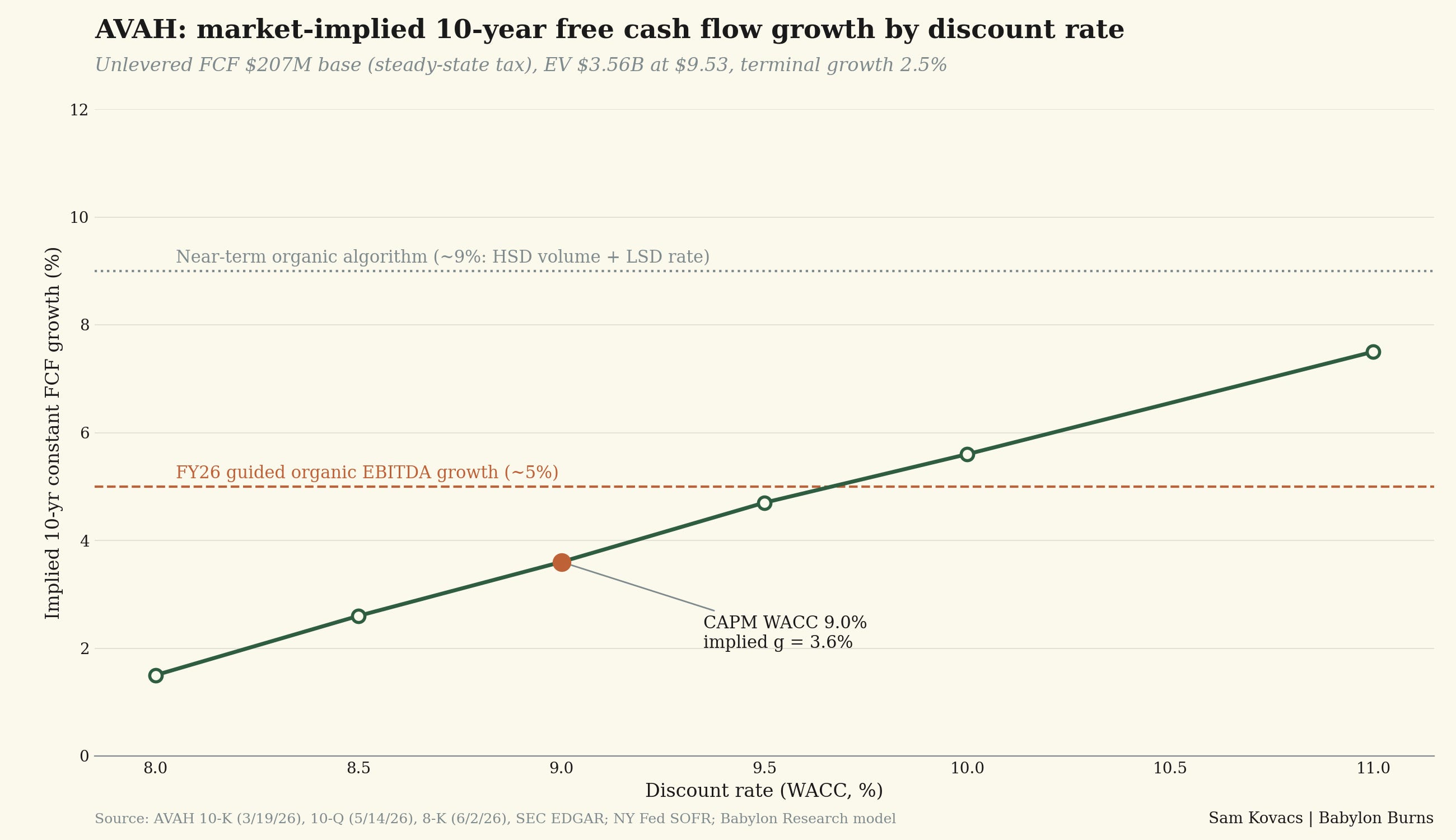
If we solve for the growth required that justifies the EV at a 9% cost of capital, then the market is requiring 3.6% annual growth for a decade, and 2.5% thereafter. At a 10% WACC it requires 5.6% growth.
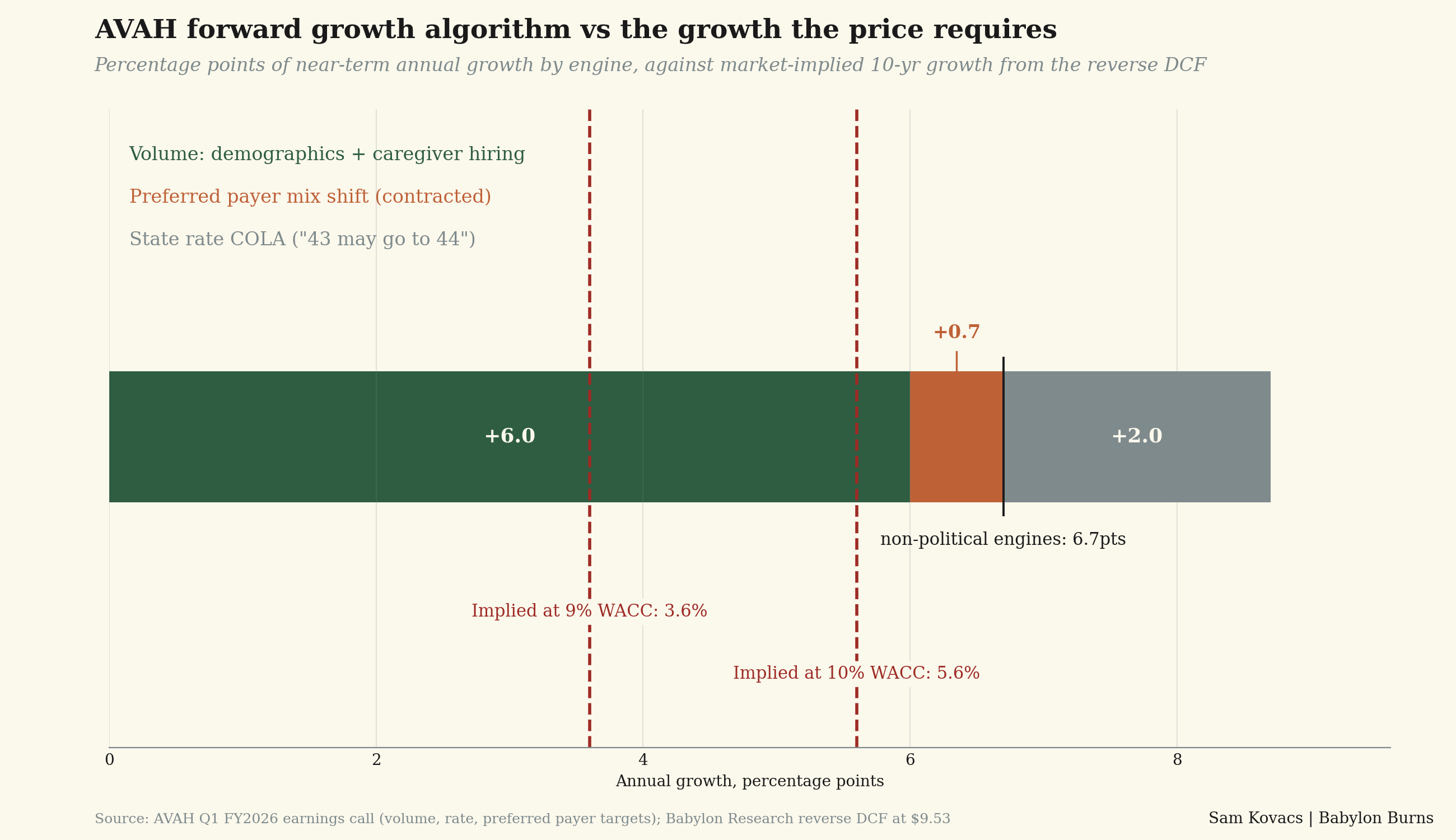
But my back of the envelope math suggests that volume alone should contribute about 6 points of growth, the transition to preferred payer agreements should add another 0.7. State cost-of-living adjustments like contribute another 2 points.
This gets us to somewhere in the 8.5-9% growth. most of that does not depend on political risk and is mechanical.
And all of that is at the EV level, not the shareholder level, which is where equity investors sit.
At the 2022 low, shareholders owned 9% of this enterprise, with creditors due the rest.
Today the equity slice is up to 59%. By fiscal 2028 it will be 71%.
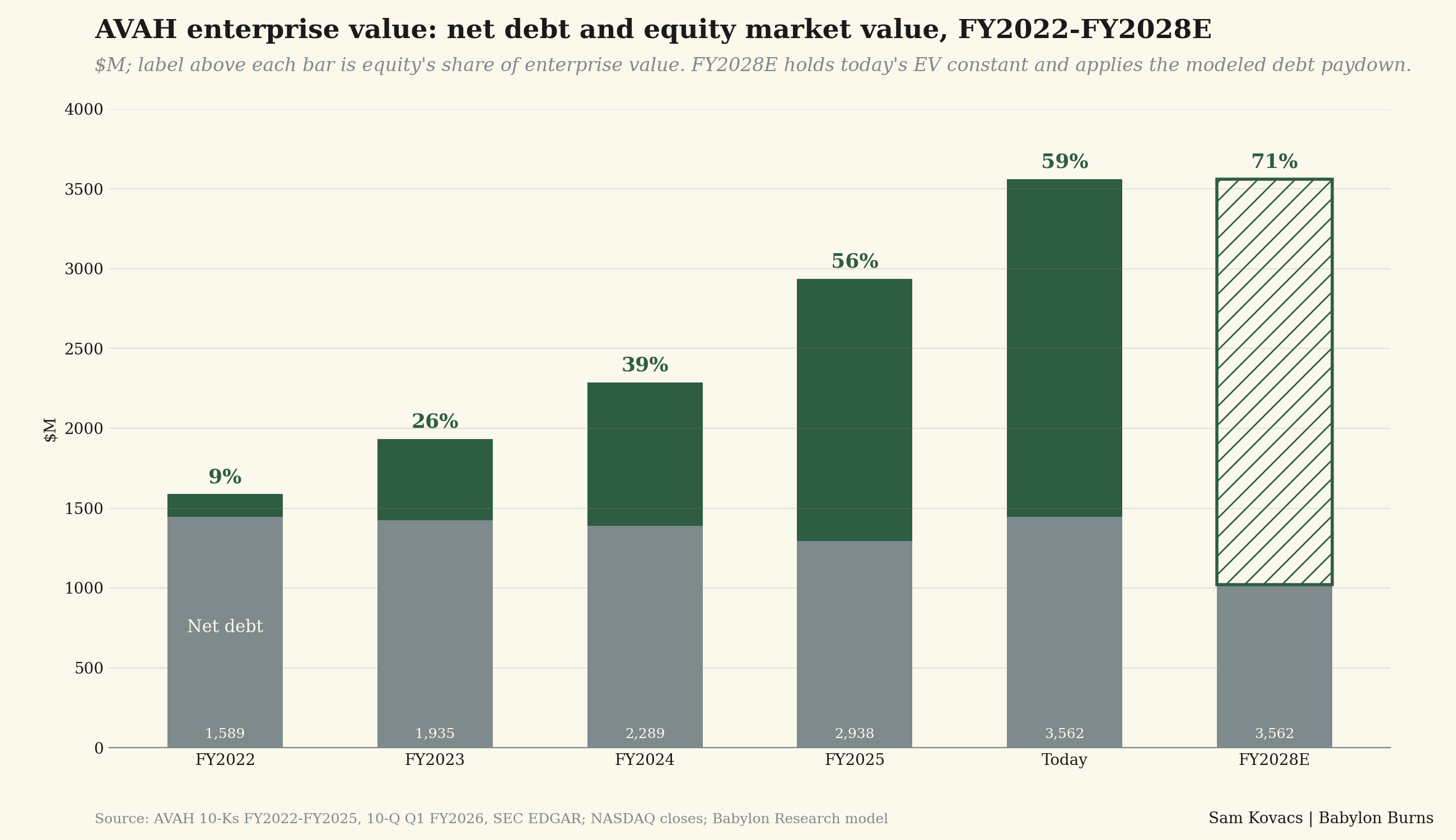
Even if EV didn’t grow (it would), the transfer from debt-holders to equity holders should rerate the stock to the tune of 20% over the coming years.
In a bear case where state rates get cut, margins erode, and the market requires a punitive 13.5% discount rate, the shares would be worth $6.98. In management’s base case the shares should be worth $13.5 today. In a bull case with prefered payer penetration reaching 80% faster than planned, shares would be worth about $19.
At $9.09 today, the market is over-indexing the bear case, when the baseline math suggests the situation is in fact much better.
The chart
There is good and bad in $AVAH’s chart.
As I might have made clear by now, I will be using technical analysis to validate entries into good narratives. Why? Because even if it is not perfect, that it is as much an art as a science, it is better than doing nothing.
We want to invest with the trend, we want to have rules that allow us to be wrong, we want to infer information from the buyers and sellers of the stock that give us an extra data point in making our decision.
The first obvious point with the AVAH chart is that it has been in a solid uptrend since 2024.
That trend is intact, and has been tested multiple times. The only time it was breached was a shake-out before the stock drove up 50% in a single week. So the trend is fundamentally on our side.
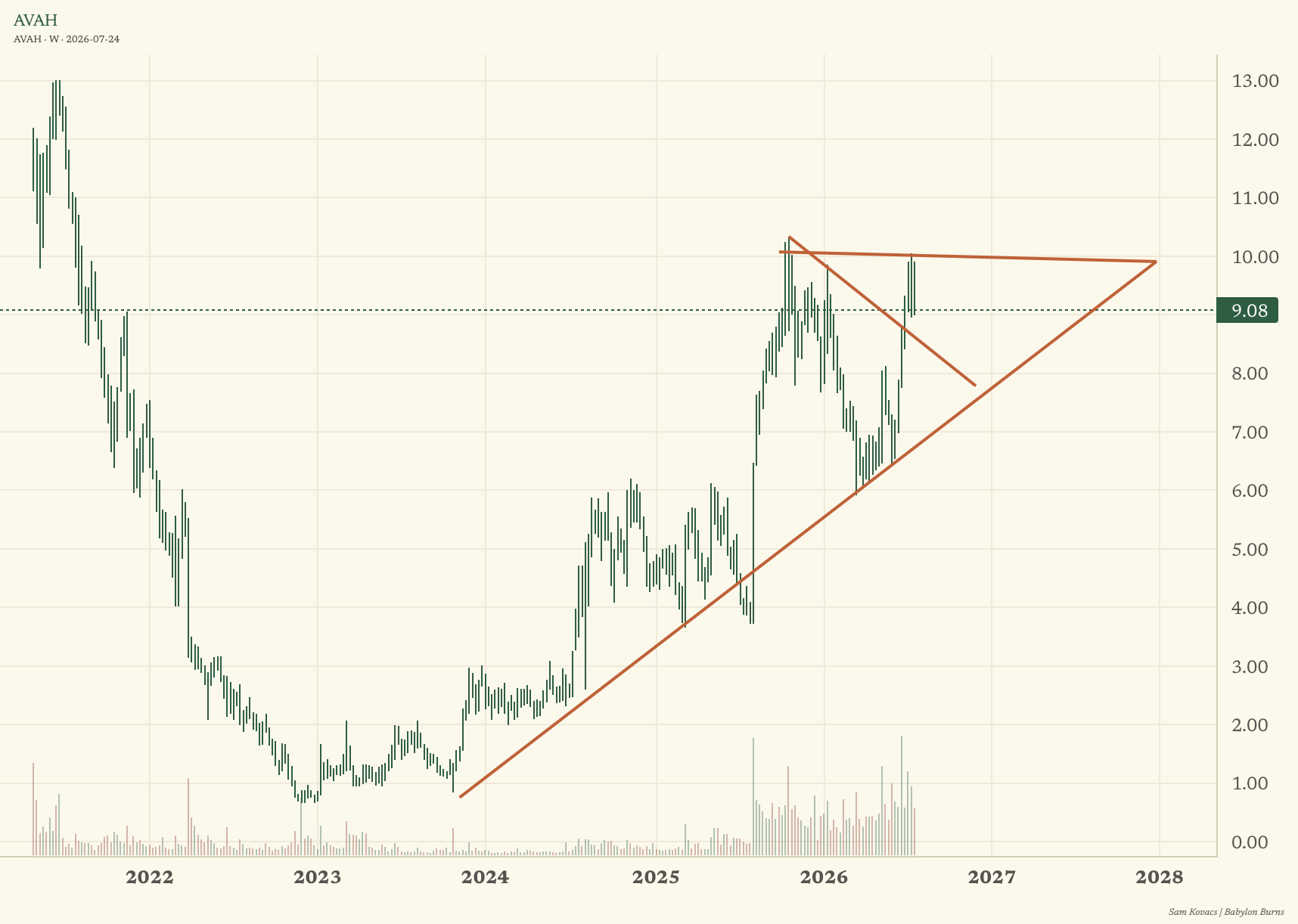
Where it gets a bit more complicated, is that despite the general movement upwards, it has now failed to break through the $10 level and stay there twice.
This creates a horizontal level at a psychologically important price which needs to be breached for the thesis to work out.
This means there is the potential for a sideways grind all the way through 2027 before the market realizes the upside which is rendered possible from the analysis above.
In these situations, we face a dilemma where we would actually prefer the stock above $10 than below as an entry.
The way I approach these scenarios, where I have enough base conviction in the idea but not in the entry, is to build a 1% position.
A note on portfolio construction
The 1% entry is a trick I learned from studying Druckenmiller’s portfolio allocation. Each quarter, he has 15-25% of the portfolio allocated to small new positions which didn’t exist in the prior quarter.
If you don’t have skin in the game, you don’t track positions well enough. There are too many narratives, too many stocks, something which hasn’t received a dollar won’t receive your attention.
Later, as the thesis develops and conviction grows you can double down, multiple times if needed.
That doesn’t mean all positions should be initiated at 1%. I’m comfortable to initiate anywhere between 1% and 6% based on conviction. If the chart isn’t supportive , it skews lower.
I will do a follow up piece, where I will explain clearly how the Babylon Burns portfolio will be constructed.
It is an aspect of investing which a lot of newsletters do not cover, because they are analysts rather than practitioners.
I’ve run the Dividend Freedom Tribe’s portfolios on Seeking Alpha for the past 6 years (all 3 have beaten the market on a defensive mandate), and I was CIO of Havelet Bay Capital, a macro hedge fund.
I’m both an analyst and an investor. Babylon Burns will be an offensive portfolio. Not that I expect it will be riskier than investing in an index fund (most of which are offensive but people just don’t realize). But it will be conviction driven.
It will be a mix of trades, built on the principles which I’ve laid out in the other reports I’ve published and will continue to publish in coming weeks.
The losers will be cut, and the winners will be doubled down on.
Anyway back to AVAH.
When do we cut AVAH?
On these starter positions, you want to allow yourself to be wrong cheaply.
If we zoom into the weekly chart, and look at the triangle which AVAH broke out of in July, we can easily infer the point at which we’d want to bail.
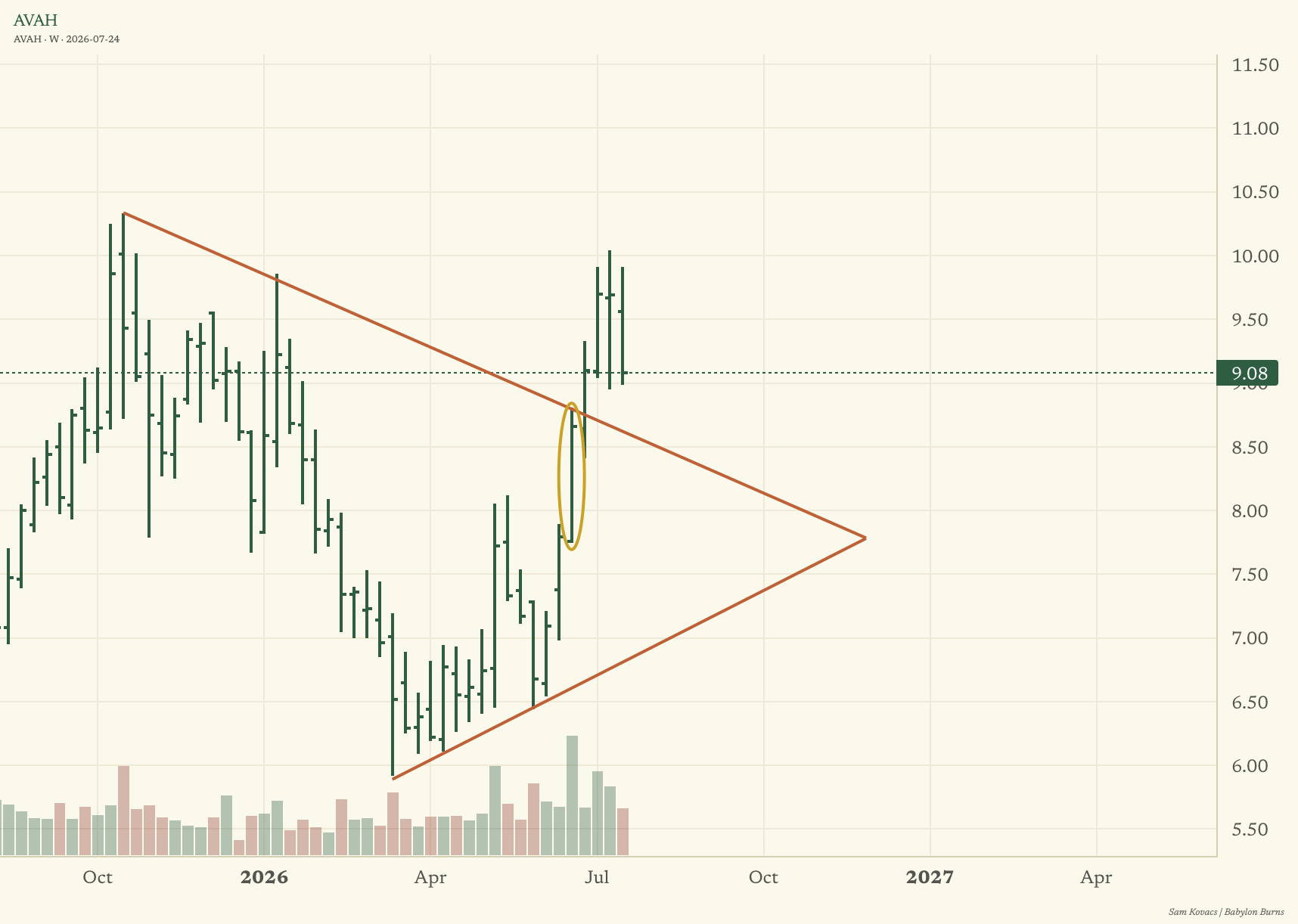
This breakout fails if the stock price goes back below the prior resistance line, in theory. Some leeway must be permitted, and the trick to set that leeway is to look at the last fully contained candle, which I circled in yellow above.
This is a trick I learned from Peter Brandt (who you probably heard of if you read Market Wizards). You’d want to set the exit just below that candle.
This gives us a stop loss target of $7.6.
If you’re allocating 1% of your portfolio, a 17% loss is 0.17%, which is a rounding error.
And that’s the point. My work here is to find great narratives, uncover value by leaving no rock unturned, and then express that as conviction. When conviction is still building, we allow ourselves to be wrong cheap and fast.
I’d add to AVAH if it can close above $10 for a couple weeks.
What comes next?
Babylon Burns is $399 a year or $100 a month, and every member gets everything: every pick with its size, stop and exit, plus the web app with the live portfolio, trade alerts by email, monthly tear sheets and the Studio charting tool. Annual works out to about $1.10 a day, a third of what twelve monthly payments cost. Substack gives you seven days to read everything and take your money back.
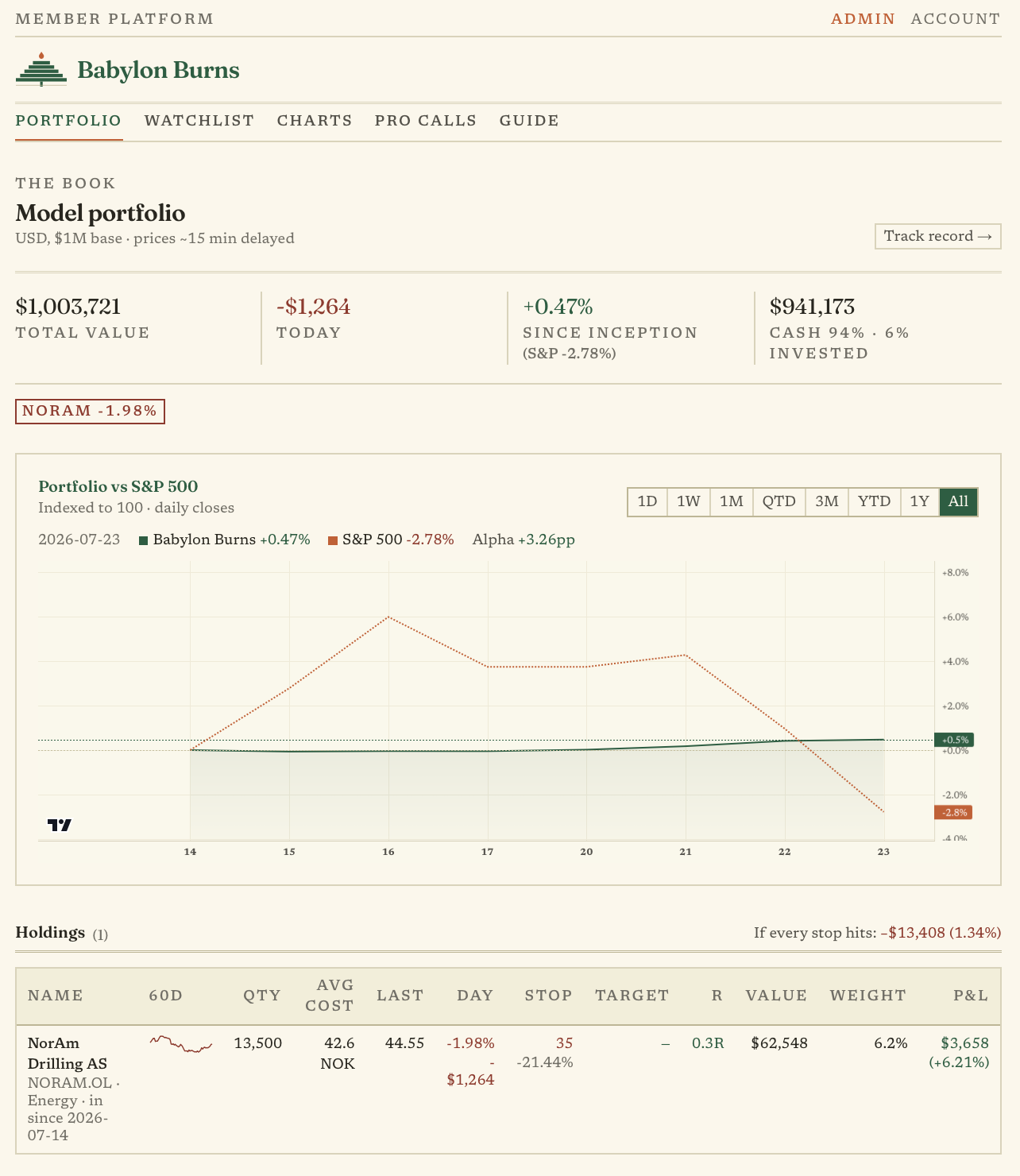
Below is a preview of the portfolio tracker, with the NorAm position initiated from last week’s article. (for demonstration purposes).
I’ll write to you next week.
As Babylon Burns, we’ll light the cigars.
This all makes sense, but doesn't the investment thesis need to consider, or at least discuss, birth rates (or, more precisely, predictions of the numbers of children needing this care) or is that too long range to consider? Also won't the unemployment rates in this wage/sector strata and the mass deportations of health care workers affect the spreads?
This is brilliant research that I skimmed for the last half due to time constraint today, so sorry if you covered this. Quick question…
With the trajectory of births per woman globally and especially stateside going lower, and happening later in life (creating a possible youth shortage/demographic crisis), does that not cut into any growth projections other than rate and spread pricing power?? The labor cost will have to go up I believe….
This leaves me thinking there’s a hard plateau somewhere on revenue and margin.
You can only bill for so many hours, and if there’s only so many kids.
Sorry if you covered this in the article.
Thanks Sam