

I believe the US government is manipulating the price of crude oil to further its own agenda ahead of the November midterms.
In this article I will lay out exactly how it does it, show the evidence each part, and tell you how this manipulation will end.
I’m not alone with this suspicion. Over the past few weeks, discussion I’ve held with industry experts are pointing the same way.
My research has been supported by evidence brought to my attention by Chris Matherson, and various gentlemen going by the pseudonyms of JustDario, Gavin McCracken, and others to whom I owe a debt of gratitude.
The US government has a motive, it has the legal capability, and it has demonstrated the willingness to intervene.
I spent the first decade of my adult life shying away from conspiracy theories. Free markets were great, and those claiming manipulation were the crazies who struggled to generate sufficient PnL.
But there comes a time when you have to consider all the evidence at hand and make an informed decision. I hope by the end of this report, you’ll do the same.
Why would the US even bother?
The most common objection I get to my oil suppression thesis is that if the government is suppressing oil, they’re failing, because gasoline is $4.10.
This is a fact which even confounded President Trump after the signing of the now failed MoU with Iran just a month ago:
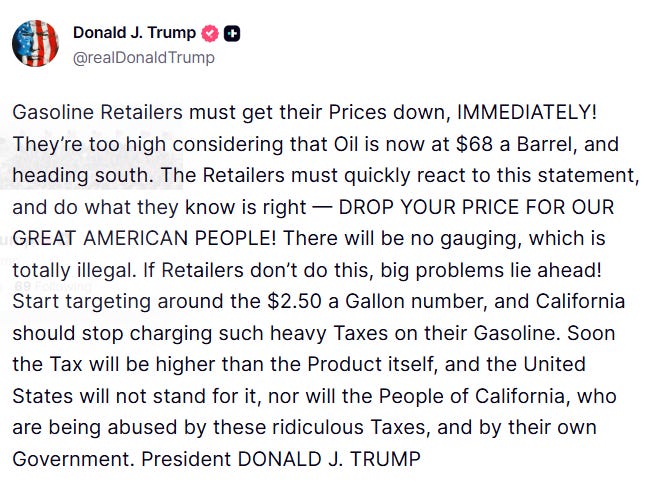
This level of public acknowledgment of ignorance of how gasoline is priced only shows to me that he isn’t the mastermind behind the suppression.
The price of gas was never target number one. Rather, US treasury yields and treasury inflation breakevens are the target.
The federal government has to roll about $9 trillion of debt in the next year on top of a deficit which is running at 7% of the GDP.
The issuance of this debt will be set by the marginal buyer of treasuries, and that marginal buyer will set the price based on expected inflation.
And within the inflation basket, energy is the only component which moves every week, has a deep liquid, forward-dated market attached to it.
And because energy inflation is upstream of inflation in the whole economy, investors, fed officials, and everyone involves uses the crude oil forward curve when setting out their inflation path.
They will look through high gasoline today, if the crude oil curve is deeply backwardated, as is the case today.
That’s why inflation breakevens at different tenors have been coming down despite the price of gas being up. My study of 5 year breakevens show that they move 0.5bp per 1% move in oil.
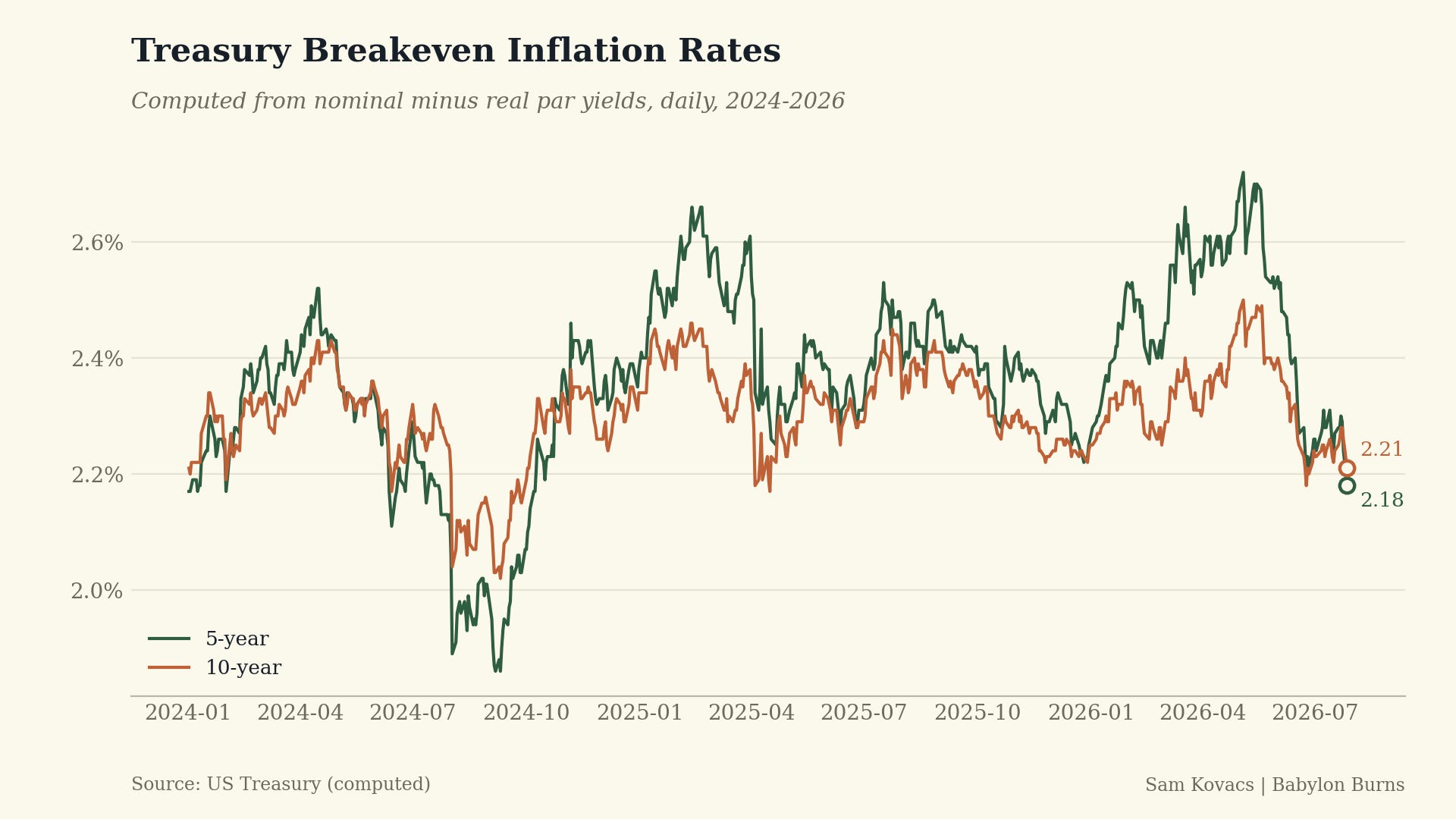
If you can slam crude oil prices, you can slam inflation expectations.
This gives the Fed the cover needed to not raise the rates.
The last thing the administration wants is a rate hike before the November elections. Suppressing oil prices enables that objective.
It also justifies the war with Iran in a way which $150 oil would struggle to do.
That’s the motive: not letting power slip away.
How to actually manipulate the price of oil
There are basically three ways you can manipulate a price, and the taxonomy was established in research by Allen and Gale in 1992, where they concluded that all situations of price manipulation used a combination of the 3 ways.
Information-based manipulation: using the power of narratives and releasing false information and spreading false rumors.
Action-based manipulation: impacting the real world value of an asset through actions in the real world.
Trade-based manipulation: accomplished through buying and selling without any public action or release of any information.
If you were going to build a sophisticated operation to suppress the price of crude oil, you would need to employ all 3 of these tactics together, as they are complementary and build off one another.
You would also need someone smart enough to orchestrate this who understands deeply how markets work.
You’ve got that person. He is the secretary of the US Treasury and his name is Scott Bessent.
I would argue that the US Treasury has never had someone at the helm who understood the game, and who was willing to play it to further the federal governments objectives and wellbeing. (note that this is a very different objective than that of furthering the general public’s wellbeing).
So with that in mind, let’s look at how the administration has engaged in all 3 types of manipulation.
Information-based: lies on TruthSocial
“A lie gets halfway around the world before the truth has a chance to get its pants on.”
-(maybe) Winston Churchill
The first leg of a manipulation campaign has to start with (mis)information. It is humans, which through their bidding and asking set prices in the markets. These bids and asks are set based on expectations.
If you can change the expectations, you can change the price. A statement that cannot be checked moves a market only when the speaker's interests align with the listener's (Crawford and Sobel, 1982).
Most investors are overexposed to the AI trade, whether by decision or lack-thereof with passive investors piled into a trade they don’t understand. This is a very long duration trade, the type that doesn’t do so well when energy prices spike.
So the governments interests are aligned with Wall Street’s and Main Street’s interests.
But even those who aren’t so exposed, get affected. Public signals carry disproportionate weight due to the second order thinking associated: each participant trades not on what he privately thinks, but on what he believes everyone else will now think, and an official announcement is the natural coordination point for that second guess. A loud enough statement moves the price even among traders who privately doubt it, because each expects the others to move.
The oil market should be unusually resistant to this as flows are logged at customs, tanks are measured by satellites, and cargos are mostly tracked by their transponders.
But like Goebbels supposedly said if you “repeat a lie often enough and it becomes truth”.
I think it is a simple statement of the record to say that President Donald Trump’s TruthSocial feed has been full of falsehoods. Here is just a selected few.
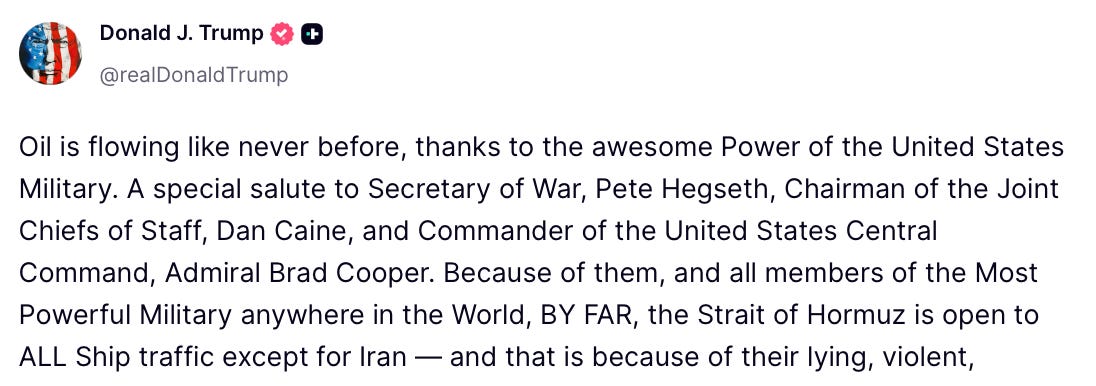
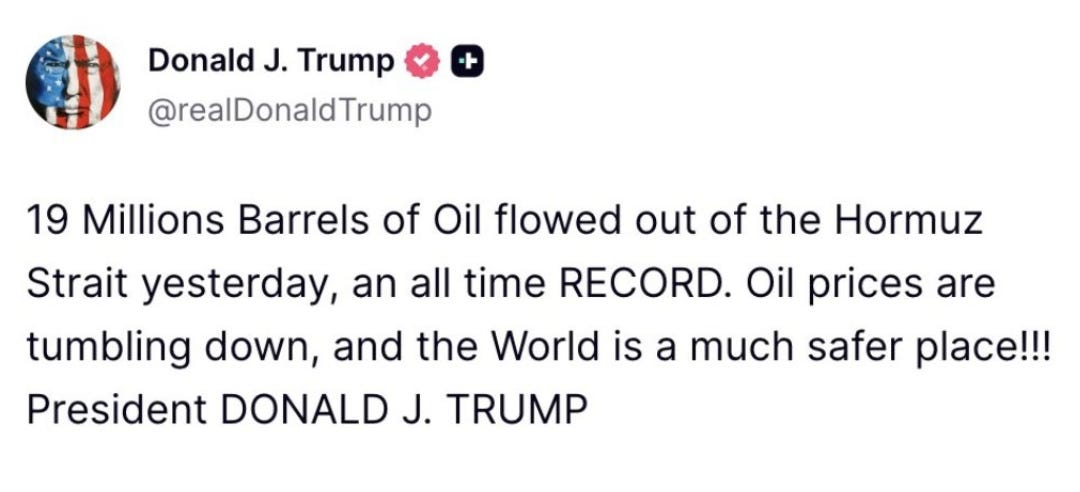
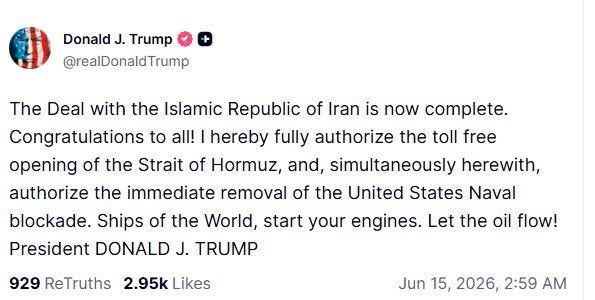
Plus before that there were the dozens of posts between March and May saying that Iran wants the deal to happen, Iran has asked for a ceasefire, great progress is made towards a final agreement, a big day for world peace.
This “firehose” approach of rapid fire assertions with an indifference to consistency is a feature of the strategy. Repetition breeds familiarity, and familiarity gets mistaken for truth (Paul and Matthews, 2016).
The narrative was quick to supply an explanation for falling oil prices on the days it fell, and insisted on that narrative on days it didn’t fall.
Talk is cheap, and it should not survive contact with a well instrumented market. That is can and has are a consequence of the volatile market which we experienced in April 2025.
Market participants learned that following Trump’s “THIS IS A GREAT TIME TO BUY” post a few hours ahead of announcing the pause on his tariff campaign was a source of alpha.
The verification of the information becomes secondary, as market participants are coordinated by the president’s posts, regardless of the information value they contain.
Action-based: Draining the reserves
The information leg seeks to coordinate actors and confuse them on the elements that cannot be fully verified.
The second one, the action based leg seeks to reach into the physical world and change the balance of supply. Governments build up stockpiles of commodities, which they can use to manage the price of that commodity in a crunch. This is nothing new, and for oil, we’ve had the Strategic Petroleum Reserve for half a century.
Unfortunately the theory here is strong and carries a warning which those intervening cannot escape. Governments which defend a commodity price out of finite stockpiles create the conditions for its own defeat (Salant, 1983).
A stockpile which is large enough to hold the price is a a stockpile which must eventually run down, which every participant can see running down.
Once the defended price can no longer be defended, it snaps beyond its fundamentals. It’s like whack-a-mole. You can keep pushing it down, but sooner or later it must come back up.
In 1968, 8 central banks attempted to hold gold at $35, which lasted until the stockpile could no longer cover the claims against it, and then the market broke within days.
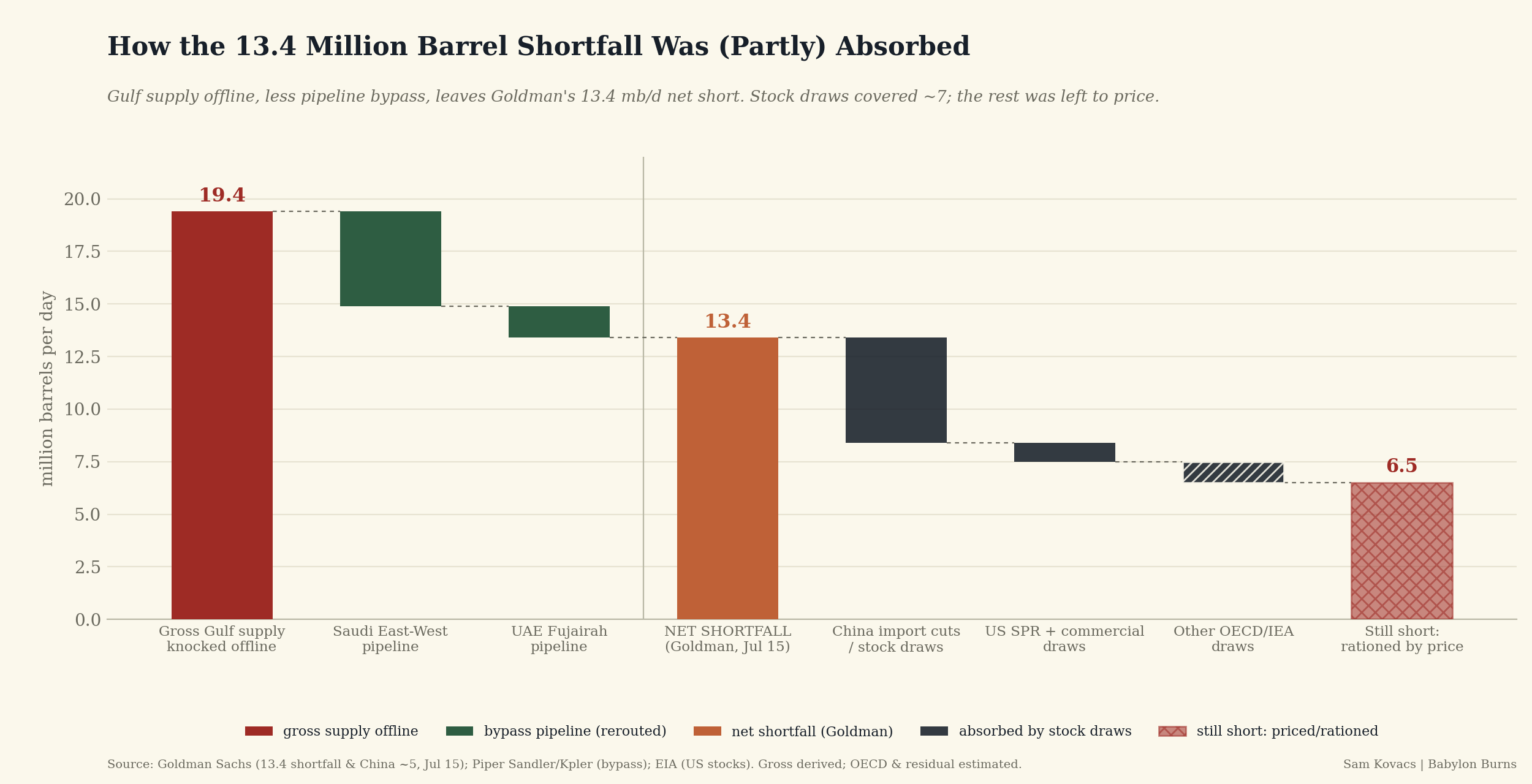
The closure of Hormuz knocked off 19.4mb/d. 6mb/d got rerouted through the Saudi East-West pipeline and the UAE’s Fujairah pipeline. That left 13.4mb/d. China, the US, and the other IEA particpants have been drawing down on their inventories and reserves to plug the gap, to the tune of 7m/bd.
That leaves a shortfall of 6.5mb/d, of which part is rationed by price (oil is after all more expensive than before the war), and part of which is a mix of undocumented Hormuz passages, previously sanctioned oil becoming unsanctioned, the East-West pipeline being pushed above its nameplate peak (not reflected in the chart above), and other unaccounted barrels.
Now this is fine and dandy, reserves are meant to plug and manipulate price in this exact situation, but here, we have reason to believe that it is done to paper over the fact that the market is actually extremely tight.
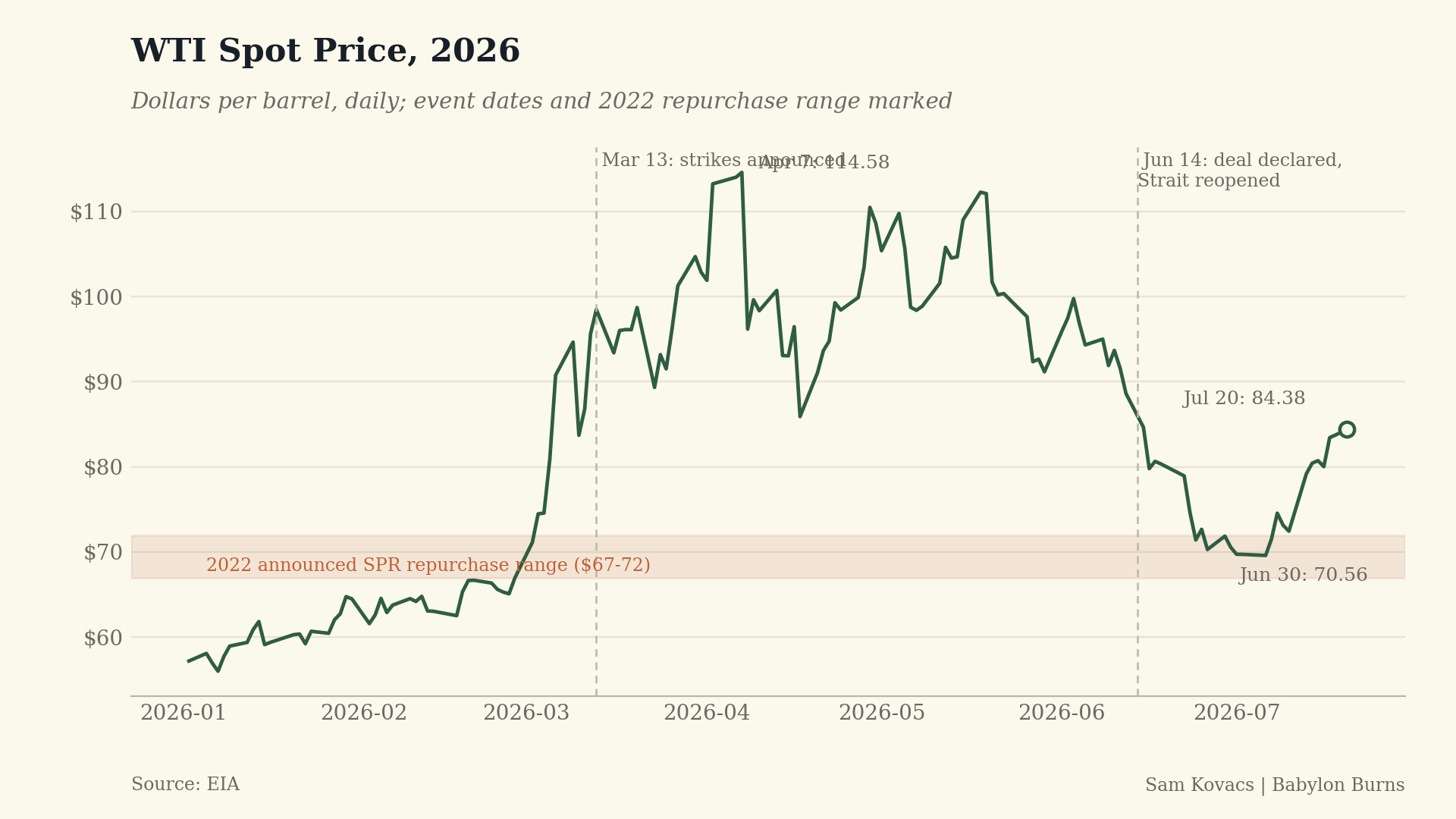
Consider that in October 2022 the Department of Energy announced a price band for crude oil at which it was interested in buying crude-oil: between $67 and $72.
Subsequently they rebuilt the SPR to 413mn barrels by the end of 2025 before being drained to 311mn, the lowest level since 1983 when the reserve was sill being filled for the first time.
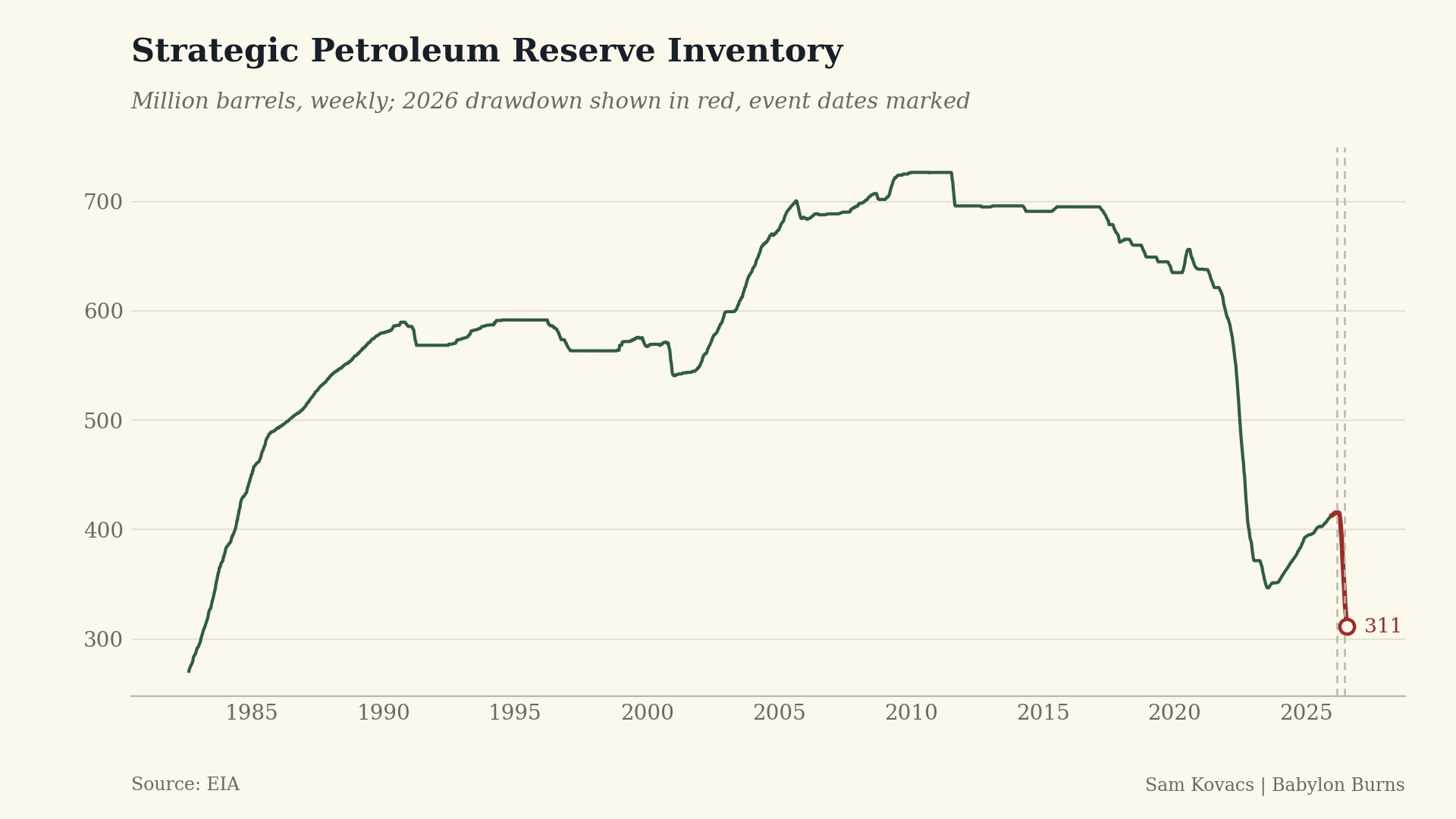
Drawing down into an emergency makes sense. What it does not explain, is why, when the war ended on June 14th by the government’s own declaration, we continue to discharge a further 29mn barrels over the next 5 weeks, at a rate faster than during the war.
What’s more, these barrels were being sold by the end of the month at prices at which they had previously stated the SPR would be a buyer of oil.
Now from the 170mn barrels that the government was authorized to draw, 100 or so are gone. At the current rate of draw, we can continue until October. The IEA’s draws also.
The Chinese 5mb/d reduction in imports above was based on their 6.2mb/d imports in June. In July, these were increased to 7.8m/bd.
The Houthis have been attacking the Saudis, which is threatening the output of the East West Pipeline.
I will not engage in barrel counting and dating when things go wrong, because oil investors have collectively shown they misjudged a handful of events.
The only point that is important here is that the price has been suppressed by the US and other governments letting their stockpiles decline, and that this can go on maybe until the end of the quarter, end of the year if we got the back of the napkin math wrong again.
Physically plugging the market ensures that physical tightness doesn’t get to a point where shorts are squeezed.
Trade-based: shorting futures when nobody is looking
Manipulating paper trading is the third leg. It’s the one which has caught the attention of investors on X who are looking for proof of covert price suppression through flows.
It’s also the one which gets you put into the crazy bin.
I will present the evidence here which others have been more diligent in collecting than I have.
Price suppression in flows is by itself the weakest and most mean reverting of the 3 types of price manipulation and suppression. It works best when done in conjunction with the other two, as the price signal becomes the justification of the narrative, and the propped up physical market further corroborates this.
It creates a reflexive loop where the market inferred information impacts the real world and vice versa.
At least for a while.
Now before we look at whether the Treasury is shorting oil contracts, let’s first ask:
Does it have the capability to short oil futures?
And the answer is unquestionably YES.
The Exchange Stabilization Fund, created in 1934, allows the Treasury Secretary, with the President’s approval, to transact in securities and instruments of credit with no external oversight. It sits outside the appropriations process, and was used to fund the 1995 Mexican peso rescue because it routes around Congress, even when Congress refused to act.
It has been used after the Great Financial Crisis and after the Pandemic led crash. The vehicle for a covert market operation exists, and it has been used to bypass legislation before.
Now the availability of the mechanism is not a proof that it is being used.
The evidence which has been collected by fellow investors and analysts below is suggestive of certain actors attempting to suppress prices.
My takeaway is: if you are willing to drive inventories to the ground, willing to engage in a firehose of lies and misinformation, why not, if you have the ability to, also jam the signal with trade based manipulation?
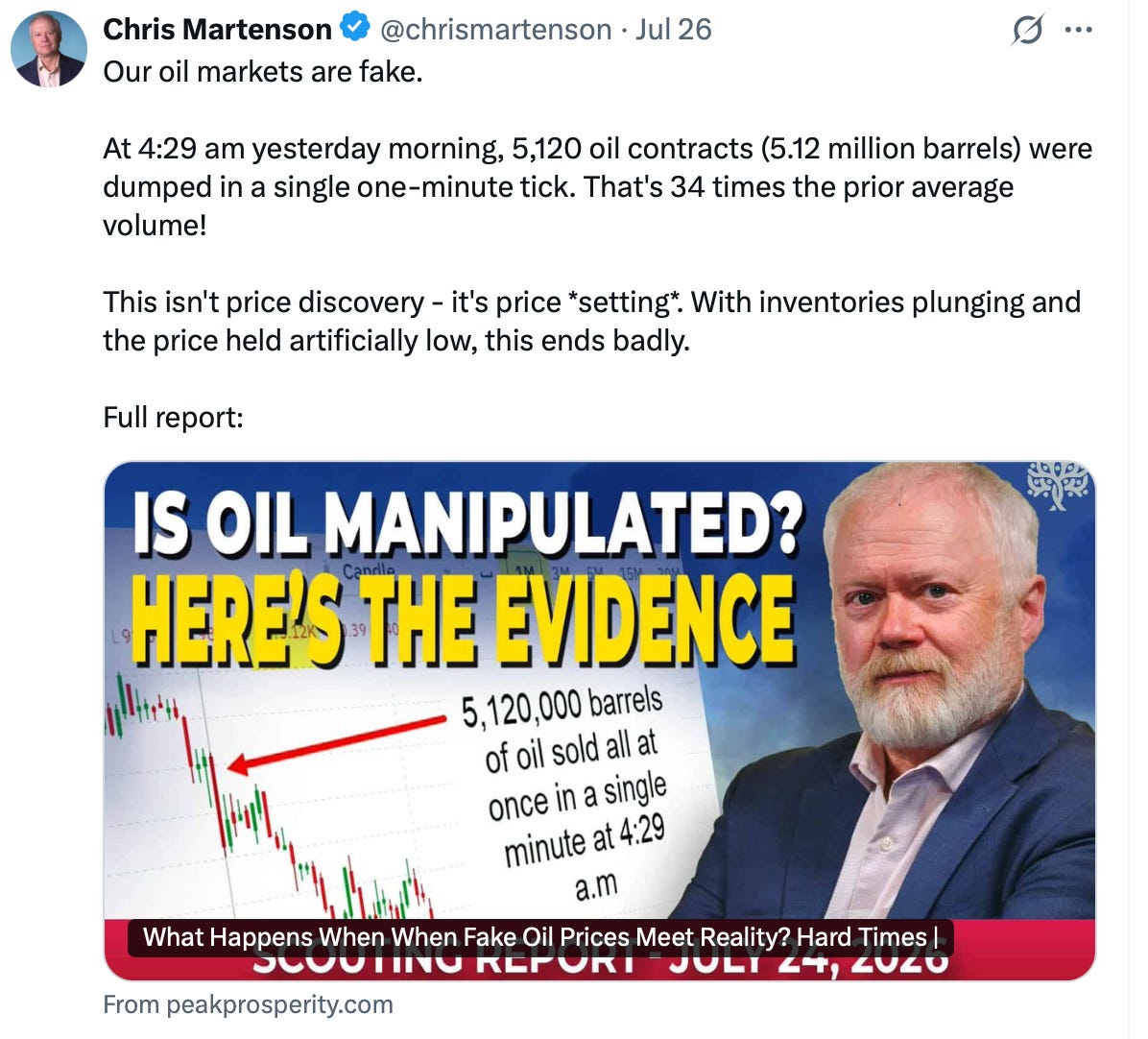
Two gentlemen have done a very good job at scoping at what seems to potentially be the footprint of intervention in public markets. Chris Martenson identified abnormal volumes at 4.29am, where large amounts of Crude got shorted during weak market hours.
Another, who goes by the name of JustDario, has been highlighting the frequent campaign of short selling happening again and again in between 1.30AM and 6.00AM
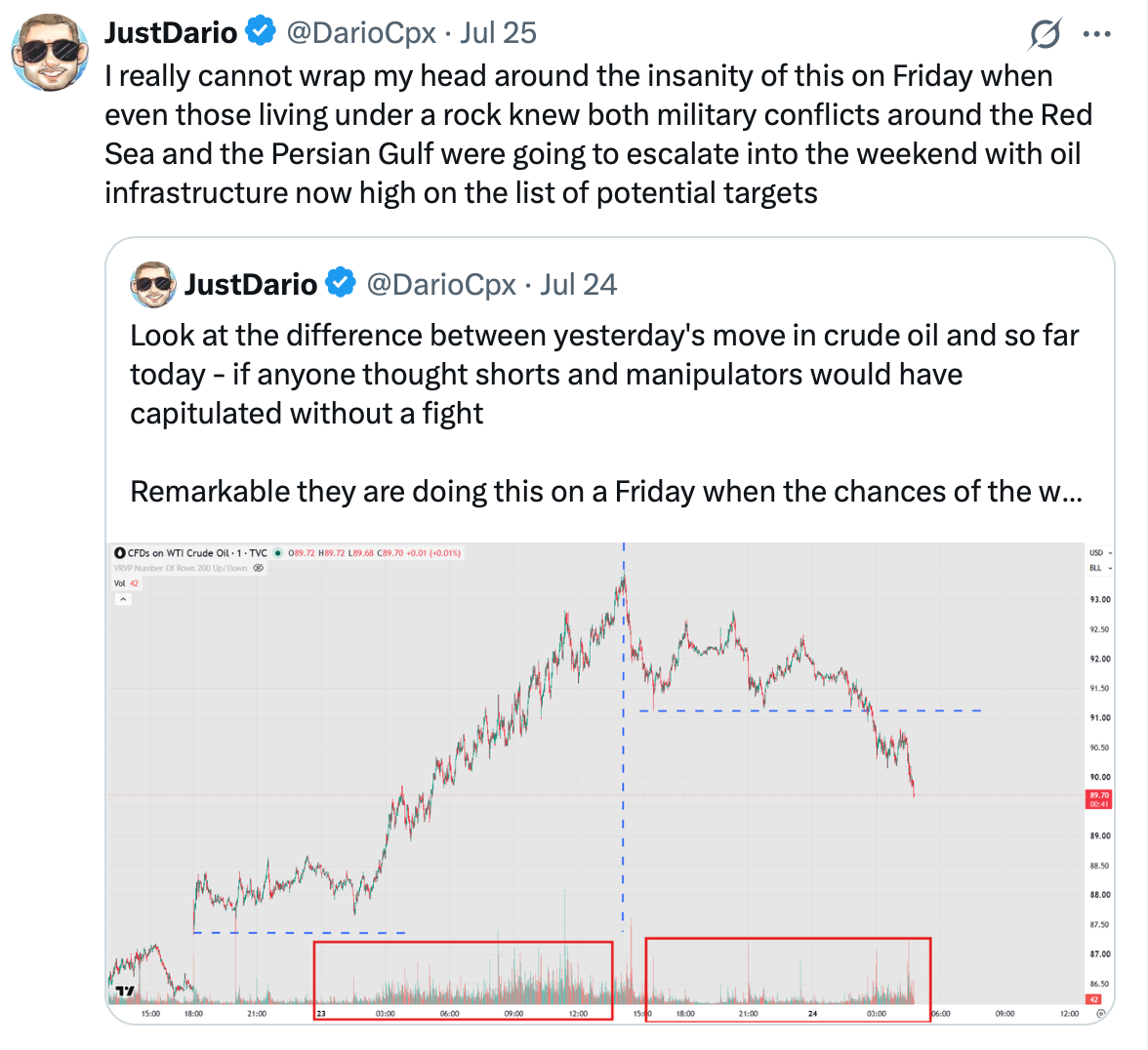
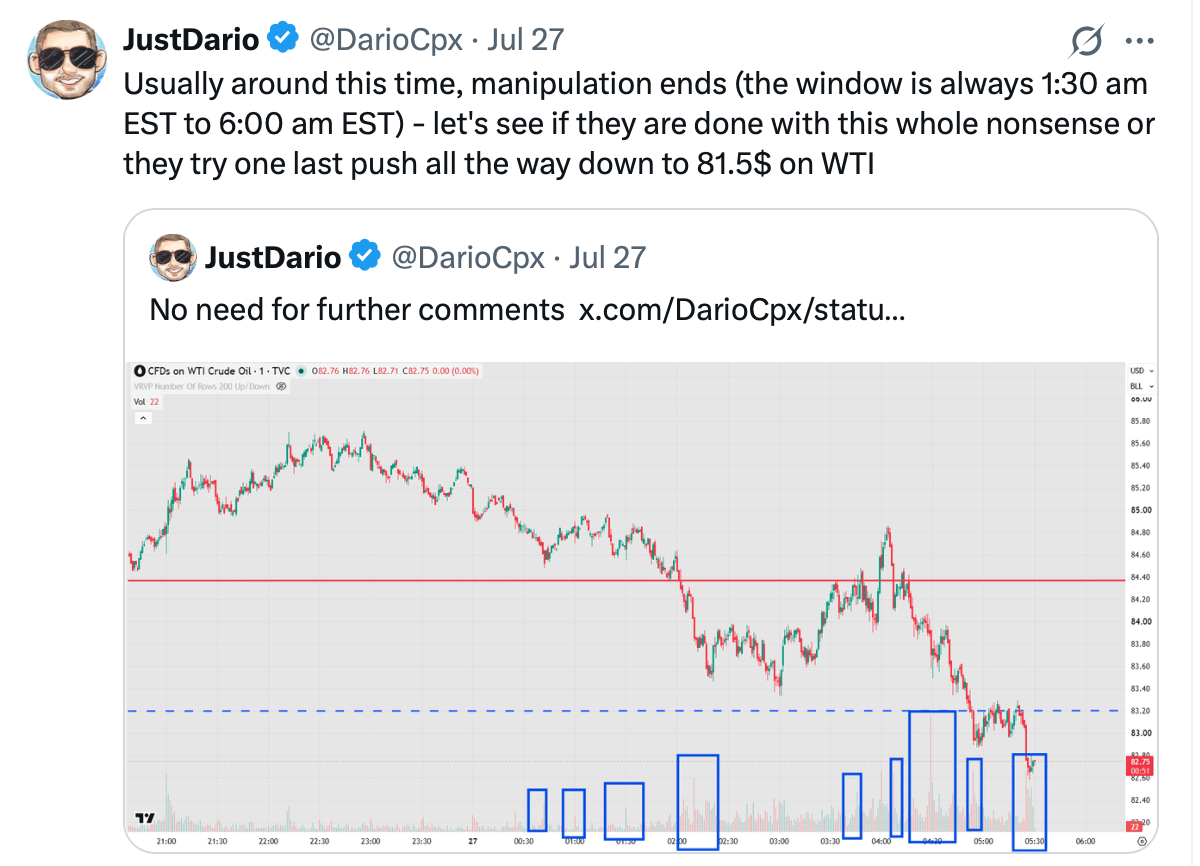
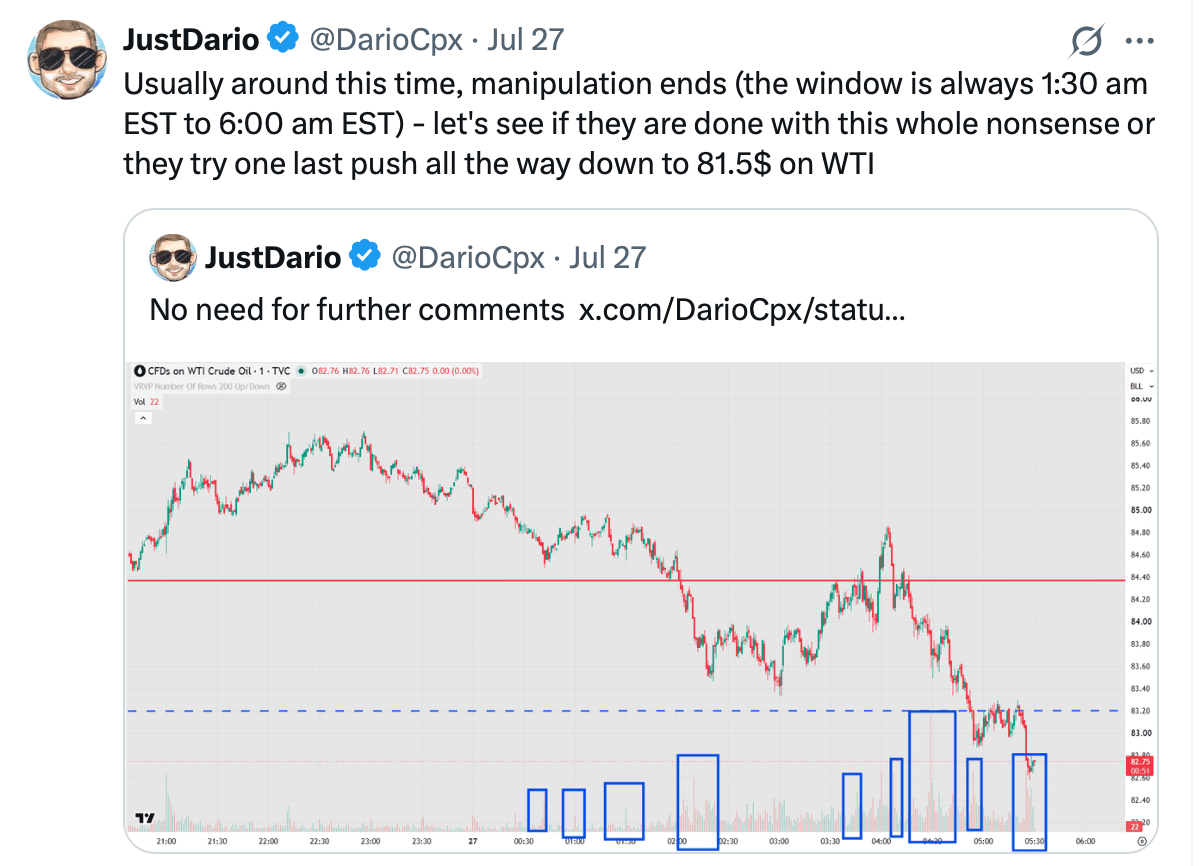
The direction is definitely there. In the past 60 days crude oil has declined over night only to recover during the day, which is consistent with price being slammed during the illiquid thin hours only to recover thereafter.
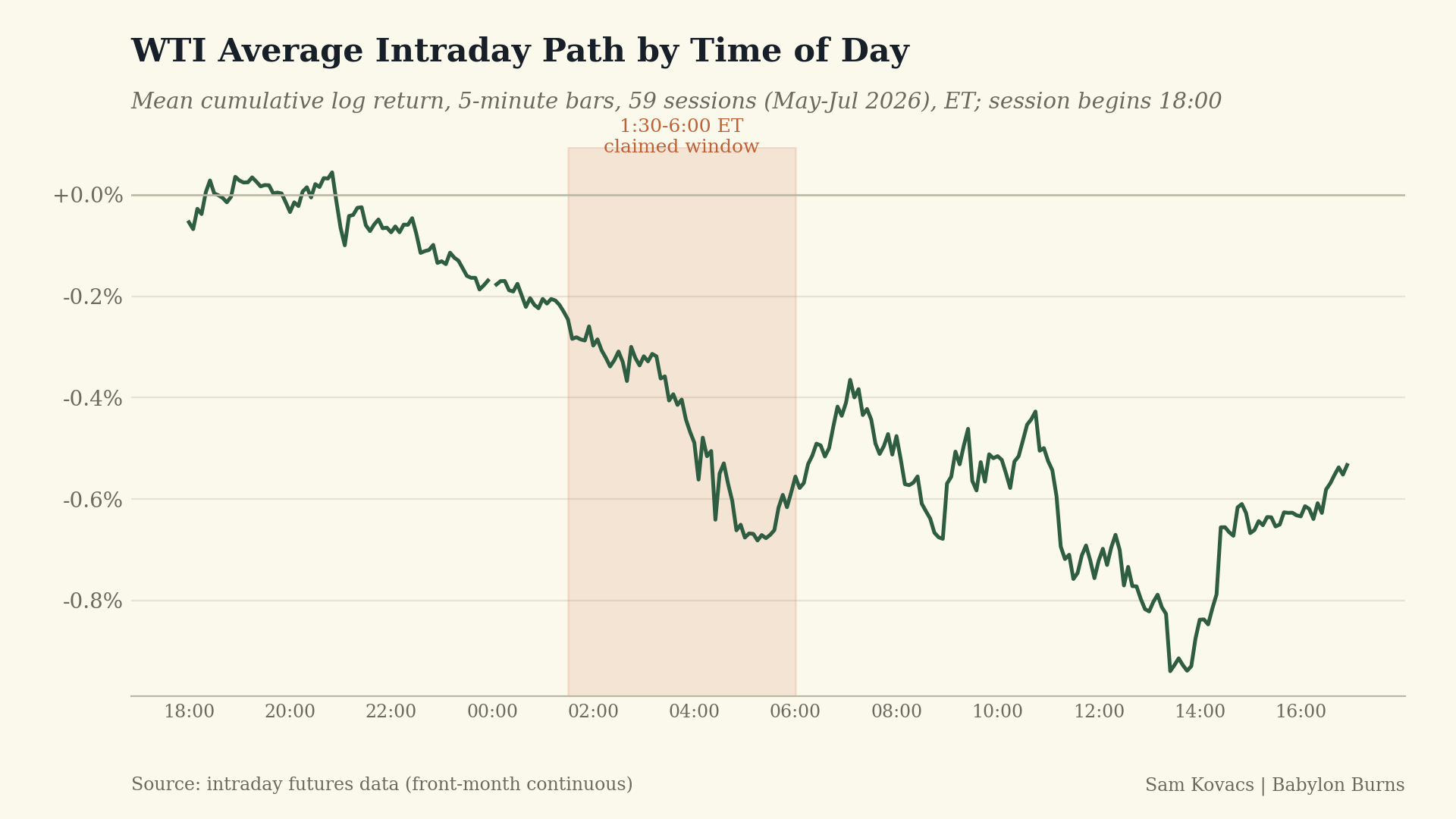
Look, in my opinion, this is suspicious. It’s not the smoking gun that some of us oil bulls would want it to be, and I want to be cautious about the possibility for confirmation bias.
Nonetheless, I think it is safe to say:
The price has been suppressed by using governmental and commercial buffers.
The price has been suppressed by a firehose campaign of misinformation.
This might even have been amplified by a covert trading operation.
While there might still be some debate on how oil prices are being suppressed, it should be extremely difficult for anyone to openly claim: we’re letting oil clear at market prices.
Such rigging of the prices must come with consequences. Some of these are already playing out, others are still yet to unfold.
Let’s take a closer look.
The pros have left the trade
The weekly CFTC report shows who holds crude contracts. Managed money, which includes the funds who usually go long into tightness and short slack in the market usually follow a typical, reliable pattern. When there is steep backwardation, they are pulled long into the trade.
Backwardation between the front and second contract has been particularly steep, and historically when it’s been this steep, managed money has been net long 270K contracts on average. Right now, they’re net long 87K contracts, which is the 15th percentile of the past 20 years.
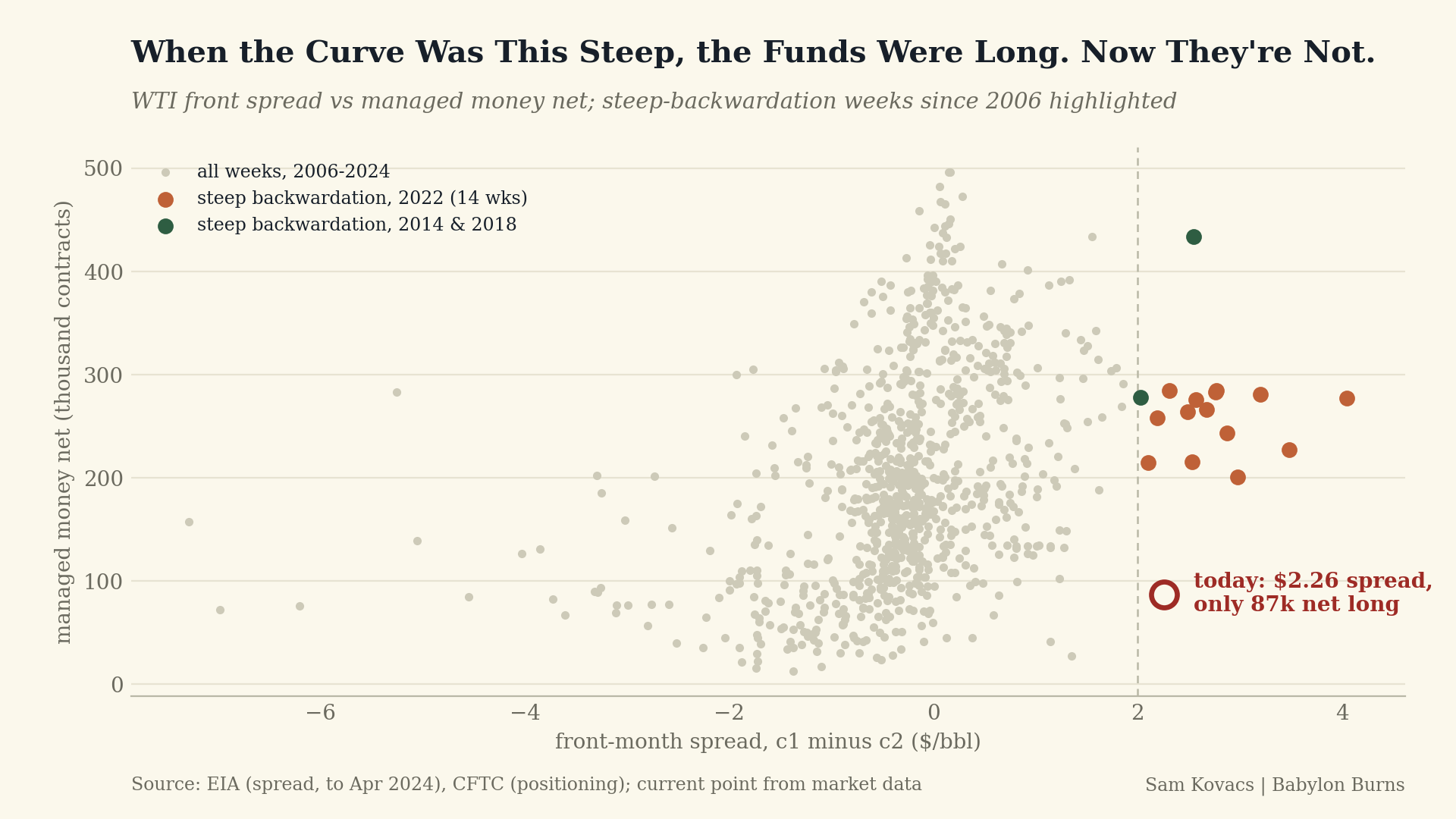
Either the funds know something about the fundamentals which the general public does not, or they have learned that the price is being set by a group which doesn’t care about the fundamentals, and they’ve learned not to fight the tape and leave the trade all together.
Having market participants vacate the trade does the suppressors work, as an asset with less natural longs needs less selling to hold down.
The refiners are getting a free lunch.
I’ve been chanting this for a while, but if you suppress crude but not the products refined by it, then with tightness held equal, cracks widen quite naturally.
The 3-2-1 crack which measures the spread between 3 gallons of crude against 2 gallons of gasoline and 1 of diesel.
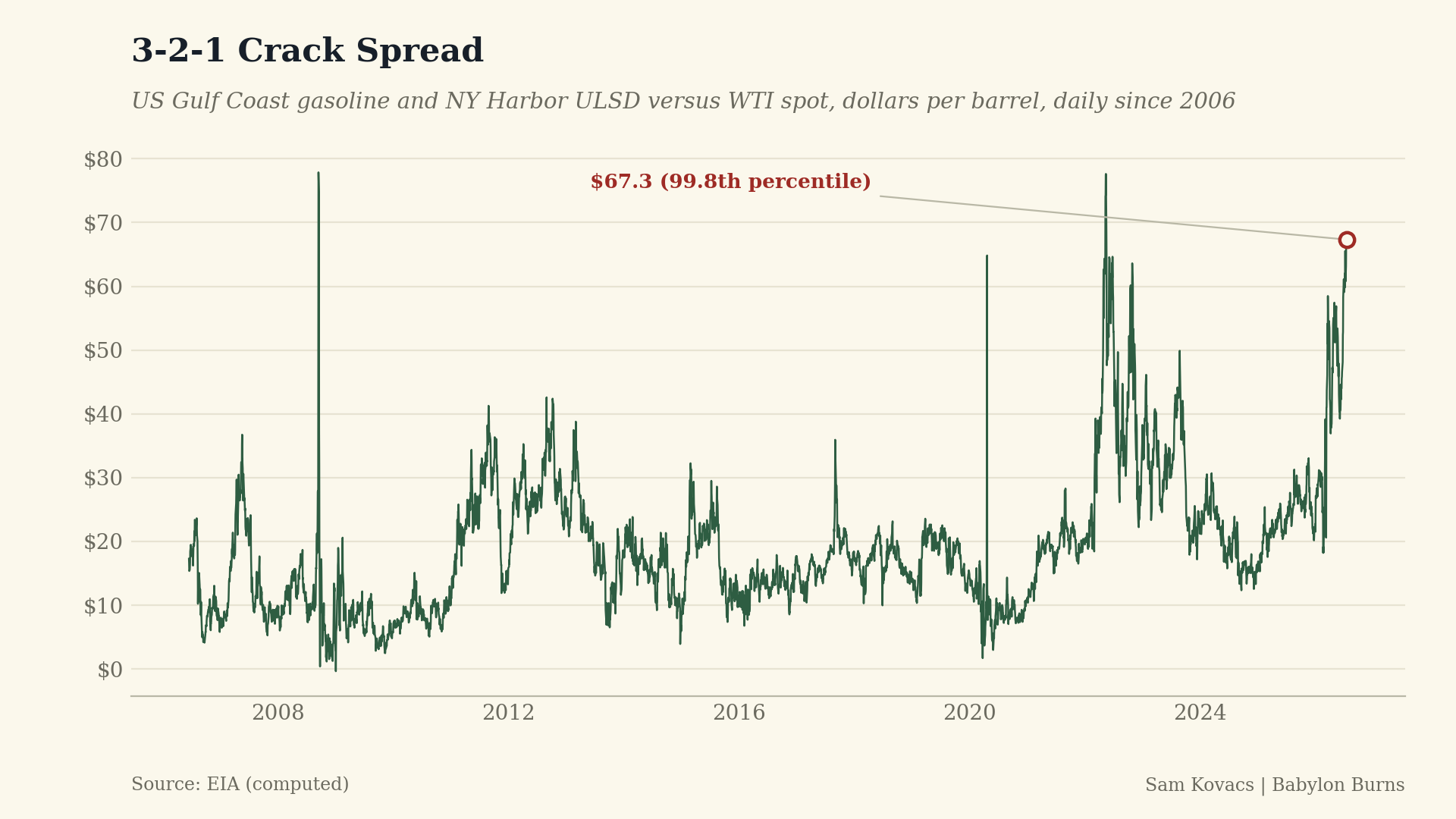
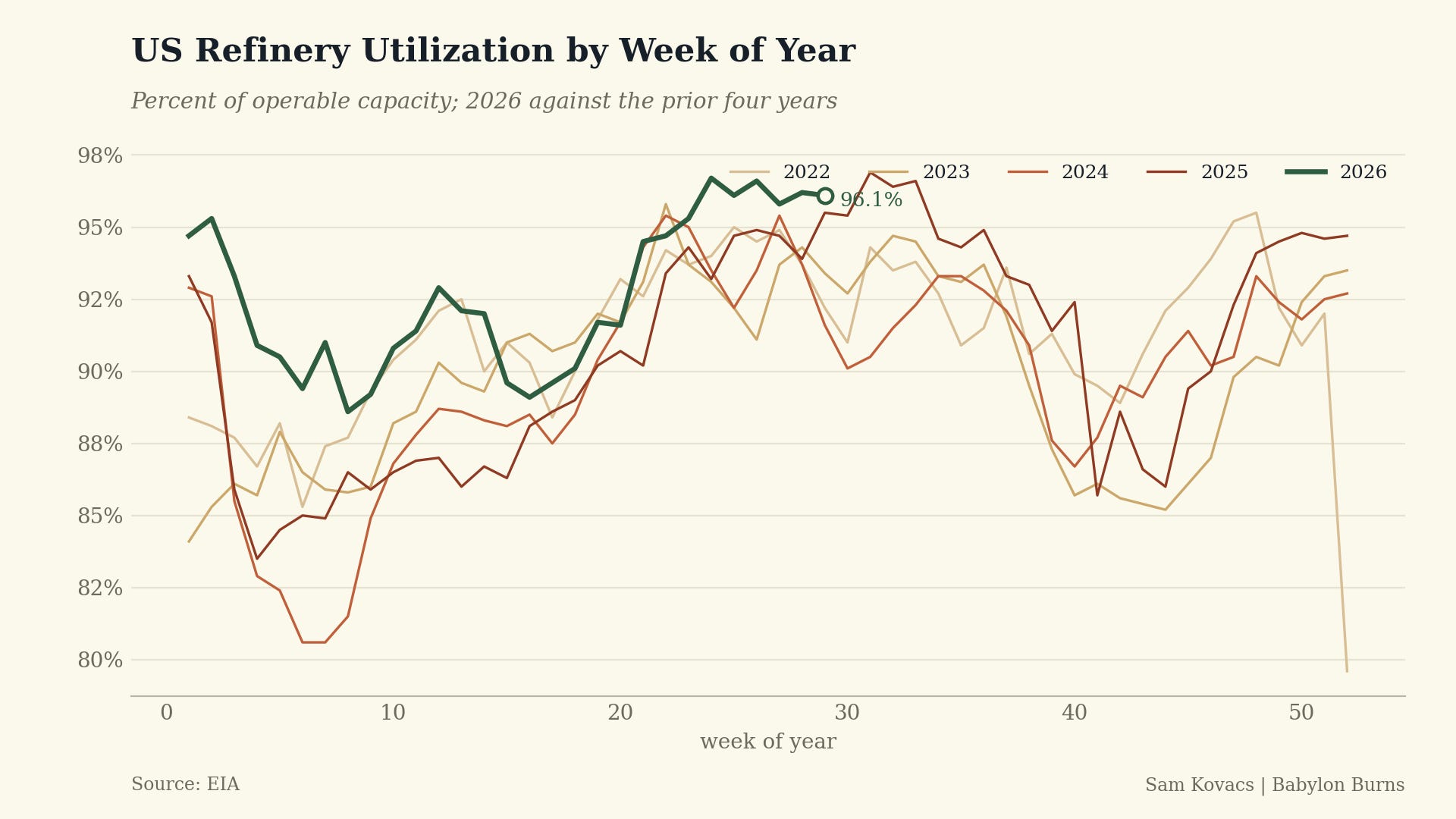
Refiners in the US have been running flat out at 96% to capture once in a generation cracks.
There is no spare refining capacity to be added on demand. Gulf refined products have been shut in, Russian and Saudi refineries have been blown up, Chinese refineries have reduced runs, all events which are downstream of conflict and locked in barrels.
Because crude is kept mechanically low, products continue to clear at market prices. A stressed but elevated $30 crack would suggest crude to be up to $40 higher than it now is, yet it isn’t because it’s suppressed.
Trump doesn’t understand this and Bessent doesn’t care. It’s why the price at the tank is still so high.
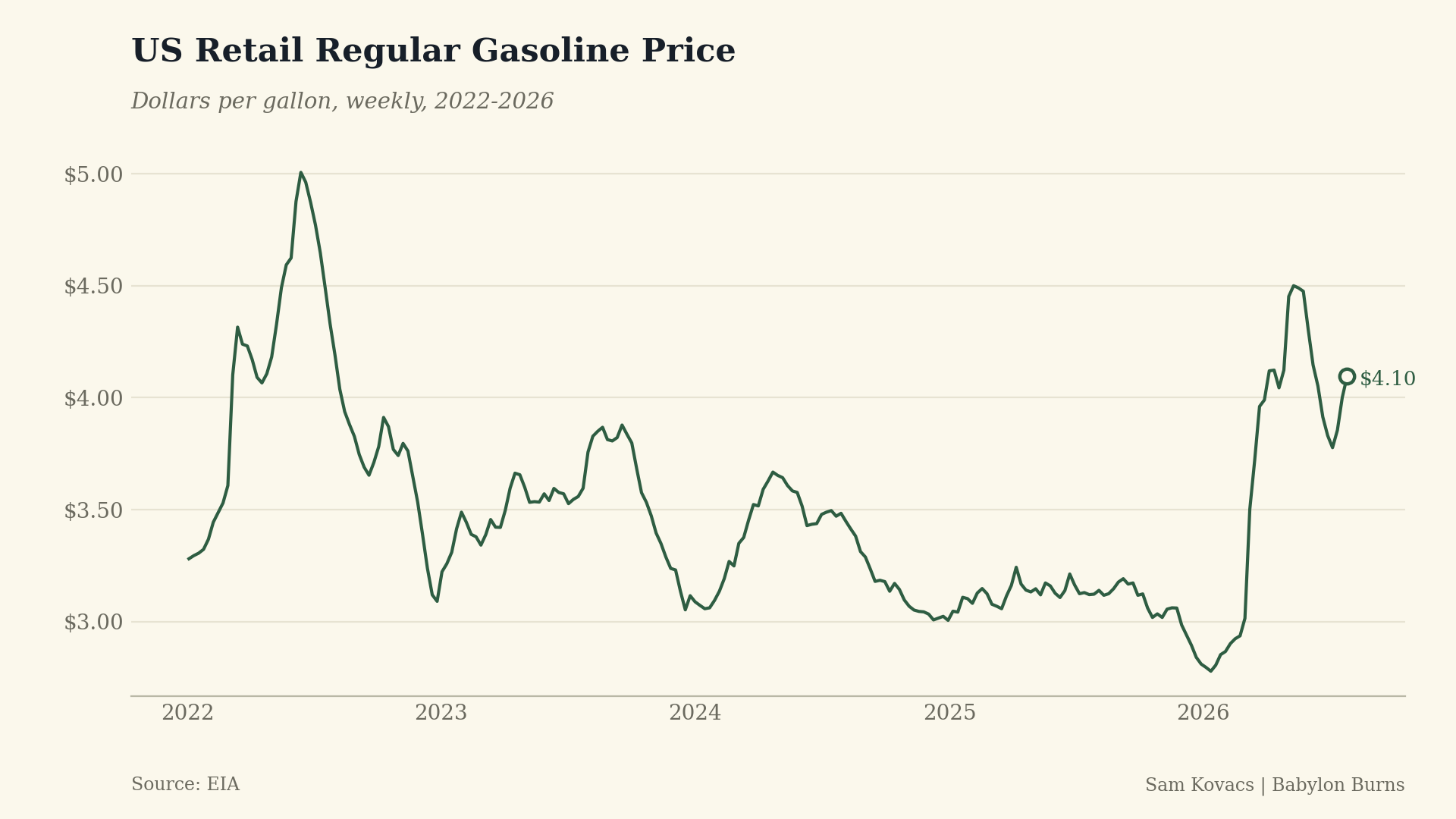
That is the tough part to stomach morally. The suppression which the government is undertaking is being done to support the forward curve, pin inflation expectations and yields, and further their objectives. It does nothing for the person who has to spend 35% more on a tank of gas than they did at the beginning of the year.
The tanks are draining
Suppression of the oil price into tightness with steep backwardation incentivises refiners to run hard, exporters to move US barrels onto the sea, and for inventories to be depleted, as buyers continue to buy at rates which are not sustainable due to reduced flow and supply globally.
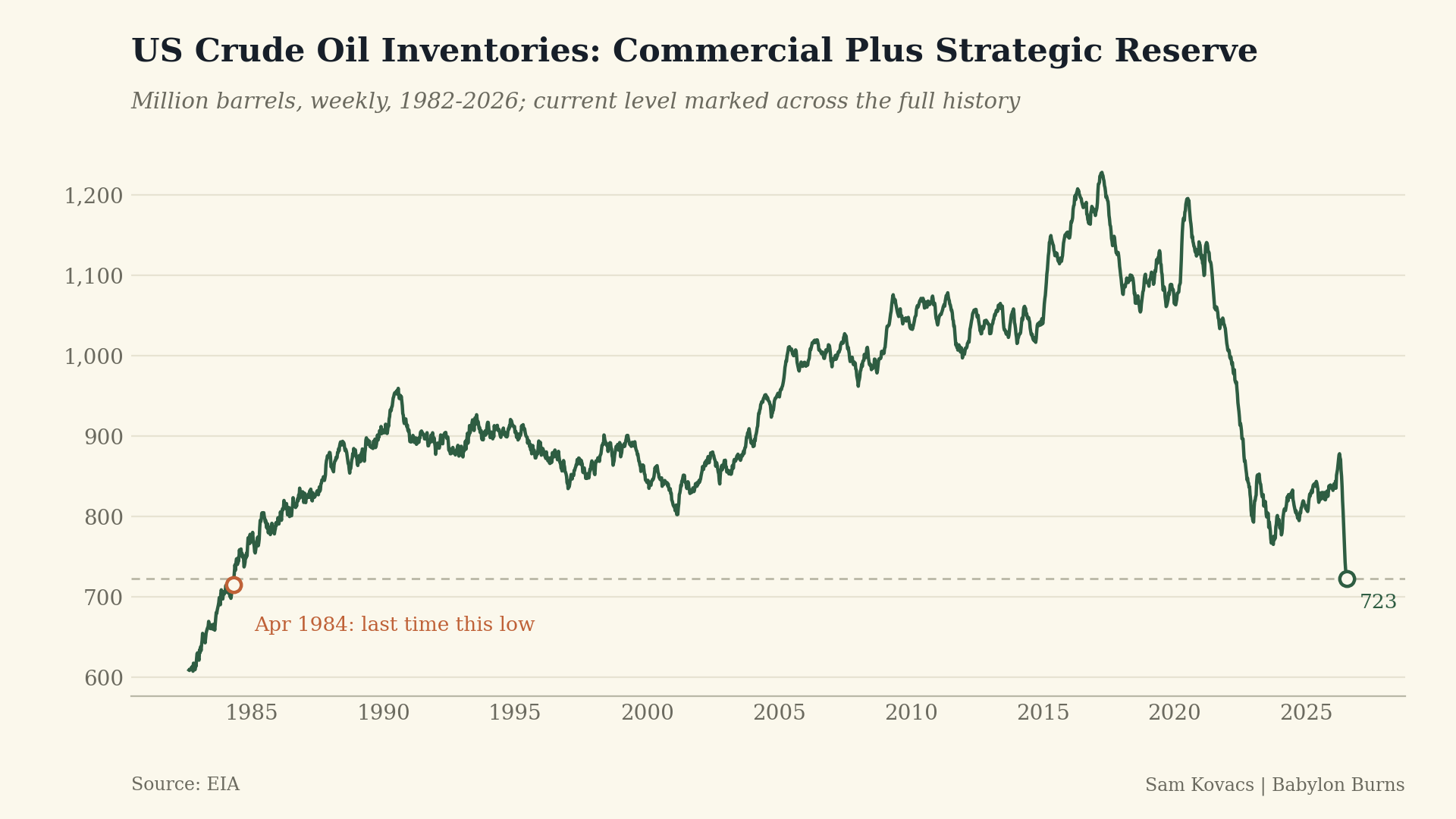
The last time total inventories was this low was in 1984 and we haven’t finished draining them yet.
Cushing hit tank bottoms and has pretty much stabilized at the minimums. Commercial crude, gasoline and diesel all sit below their seasonal norms.
Drilling postponed
The slowest and probably most damaging cost, is that producers in the US, and particularly in the Permian are being sluggish in drilling new wells. The Dallas Fed Q1 survey put new-well breakevens in the $63-70 range, and we saw rig counts decline while spot hit $115, as capital discipline and a difficulty in pricing the duration of the conflict postponed decisions with the oil strip for next year sitting at their breakeven.
I wrote a whole piece on why I built a position in a micro-cap super-spec rig company to play what I see as the invariable snap once the charade is over.
You can read it here if you’re so inclined.
But this means that the second order effect of suppressing price is that it postpones Capex decisions which postpones when new supply will hit which only exacerbates the problem.
Governments have done this before, it always ends the same way.
Governments suppressing prices isn’t a new theme, it’s been tried in the past and it usually depends on one factor: whether the government can print what it sells.
As long as there are inventories to draw, it’s as if the government were printing barrels. The problem is that in this case it has a finite stockpile, and that it is also dependent on China, which is not an ally, continuing to suppress the price alongside it.
The US Treasury capped silver for decades and sold from its stockpile, which ran out in 1961 and forced silver to leave coinage within 4 years. There was the gold example from earlier which also ended badly in the late 60s.
Then there was the Megatons to Megawatts program which between 93 and 2013 turned Russian warheads into reactor fuel, an artificial supply that held uranium near $10 for two decades. At the end the repricing was violent because the Western countries had given up on adding supply into a market which was emptying a finite stock pile.
The lesson from history is unanimous: a finite defense against fundamentals buys time, transfers a fortune to whoever successfully times the break, and ends discontinuously.
If you know what’s good for you, own energy stocks
After the oil trade failed to truly catch fire in between April and June, I have been approaching the oil trade differently.
I still own a healthy amount of oil positions which I built up in 2020 and 2021 and never sold which were more investments.
This time around though, I’m thinking about it differently: what are the plays which are inevitable due to the physical constraints that emerge due to the conflict. The US rig play I mentioned was one. Down the line there will be the refinery maintenance play, although that is still too early.
Long term everything Atlantic basin should carry a risk premium to Middle Eastern barrels especially if the situation doesn’t resolve cleanly or fast (neither have been true so far).
There are pockets of the market which are interesting trades with a lot of potential torque.
What next?
When I launch the paid version of Babylon Burns on August 15th, annual subscribers will get my full list of energy investments in the companion web (and then mobile) application which will give you trade alerts, all my research, all my charts, and a portfolio so you can follow me along.
The post launch price will be higher than if you pledge today, which is why I highly encourage you to pledge right now.
I’ll be preparing extra bonuses for everyone who pledged early, as a token of appreciation.
We’re living in a complicated world. Fiscal largess, shifting demographics, saturated debt loads and productivity which doesn’t find its way into incomes have turned us away from the globalized status quo we came to expect.
The Middle Eastern conflict and the subsequent misinformation and price suppression campaign are only symptoms of a larger regime shift which will dictate the next 20 years.
Our only chance at outrunning it, is to generate returns which protect us in downturns, give us ample upside in bull runs, and keep us sane in markets which misbehave.
That’s what I’m striving for with Babylon Burns. In the coming world, you either do the getting or get got.
It is my intention that, as Babylon Burns… we’ll light the cigars.
The problem with the strategy is, nobody burns crude oil. Crack spreads are off the charts. If you treated crack spreads as normal, crude would already be at $150. Bessent can’t create refining capacity, and it is off-line in the Middle East and Russia, and reserves are draining. Prices are continuing to go up. Shortages are imminent. Diesel over $5 will tip rural voters away from the GOP and we are already there.
They’ve had decades practice manipulating the gold price, using all three techniques. Those early AM slams are legendary to long time PM holders.