

Author’s note before we start: I’m a bit upset
I’m a bit upset, because I can come up with an investment idea and build personal exposure faster than I can write up a full report and build charts, which as you can guess, is a long and laborious process.
It’s a labor of love, and for the past 2 months I’ve been publishing reports weekly for free, with no paywall.
Which also means for the past 2 months, everything I've published for free has reached you after I already had the position on. That's the honest reality of a weekly newsletter.
But that changes on Saturday.
The premium version of Babylon Burns launches this weekend. My macro analysis stays in front of the paywall. Everything that actually makes money (the stock picks, the timing, the sizing, the positioning) goes behind it including numerous exclusive features.
Annual members get:
Live trade alerts. You'll know when I put a position on, as I put it on, rather than waiting for the write-up.
The full live portfolio. Every position, every stop-loss, every target, with the rationale for each.
The companion web app, with my complete chart library organized by theme and every position tracked in real time. Mobile version to follow.
All premium research going forward, including single-name write-ups you won't find anywhere else.
Monthly members get the full research, every premium write-up as it publishes. But the live portfolio, the trade alerts and the app are annual only. These letters aren't built to be followed month to month, and the pricing reflects that.
Now’s the best time to subscribe before we put the paywall up. Get started today.
I’ll be wrong quite a bit, and I’ll be right quite a bit, and being able to turn those insights into alpha is something that will require the annual membership.
The pitch:
In the autumn of 2025, one hundred and sixty six people took part in a study that would decide the fate of a drug.
Their task was simple: Open a small foil pouch, take out a strip of film about the size of a postage stamp, and place it under the tongue.
Nineteen of them put it on top of their tongue instead
That was enough for the FDA to reject the drug on January 30 of this year. Now, you should note that the agency raised no question about efficacy, none about safety, none about how the product is made.
The rejection was based on the fact that the pouch that took seventeen seconds to open and that 11% of people put the film on top of their tongue rather than underneath it.
Within three weeks the company behind it had lost roughly half its market value, because a rejection is a rejection in a headline.
Often with these small names, the market can’t always tell the difference between a drug that failed and a simple packaging problem.
Thankfully, I could.
The company is Aquestive Therapeutics, ($AQST), and I tweeted the call on July 29 at $3.60.
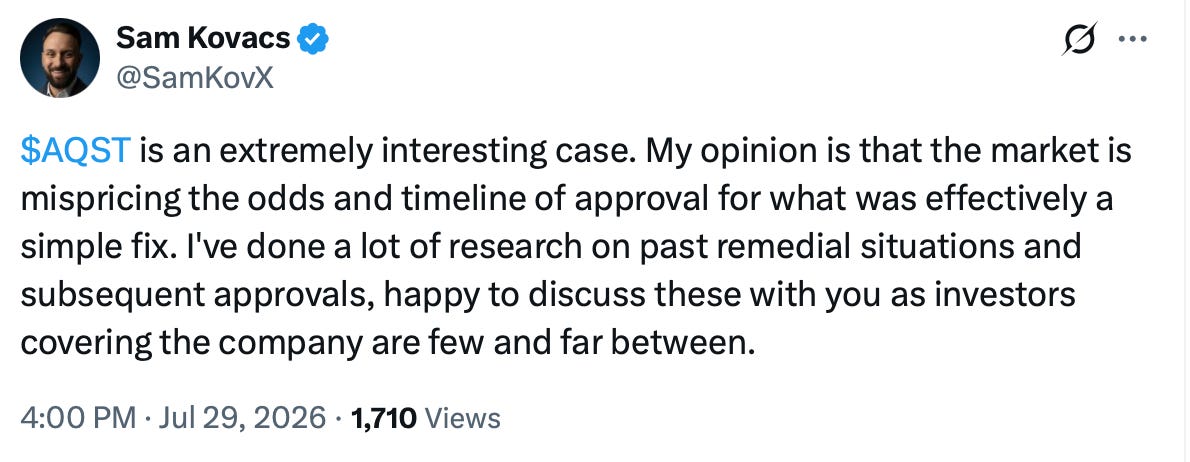
The stock has gained 20% since. I expect another 50% upside, a move to at least $6.50, by next spring, when I expect the drug to be approved.
And just this Monday, we got the first hard evidence that it’s on track: the redesigned pouch now opens in three seconds, the placement errors are down by more than 80%, and the study everyone feared came back very, very clean.
I’m laying out the full case in this report.
A good drug is one people actually use
Anaphylaxis is a sudden, severe, and potentially life-threatening allergic reaction.
It can be caused by peanuts, shellfish, a bee sting, and within minutes the person’s airway swells, blood pressure collapses, and without treatment… people die.
There is just one drug that reverses it: epinephrine.
It also goes by the better known name of adrenaline. It has no substitute.
The entire question in this market is one of delivery: how do you get this drug into a terrified human being rapidly. Self-administration, or a parent helping a child are the two common scenarios.
For half a century the answer has been an injectable needle. The EpiPen and its generics from Viatris and Teva own the prescribing habit; Auvi-Q is a talking auto-injector; Symjepi is a prefilled syringe.
They all work, and they all share the same flaw, which is that people don’t use them.
Patients delay because they’re frightened of the needle. Worse, they don’t carry the thing at all, because an auto-injector is a bulky plastic tube that doesn’t fit in a pocket.
Study after study shows the same pattern: fatal and near-fatal reactions where the device simply wasn’t within reach, or wasn’t used in time.
In August 2024, ARS Pharmaceuticals broke the needle barrier with neffy, an epinephrine nasal spray.
It proved the point the whole industry suspected: give people a needle-free option and prescriptions follow. neffy did $72 million of US revenue in its first full year, and CVS Caremark, one of the three big pharmacy gatekeepers, added it to formulary this July.
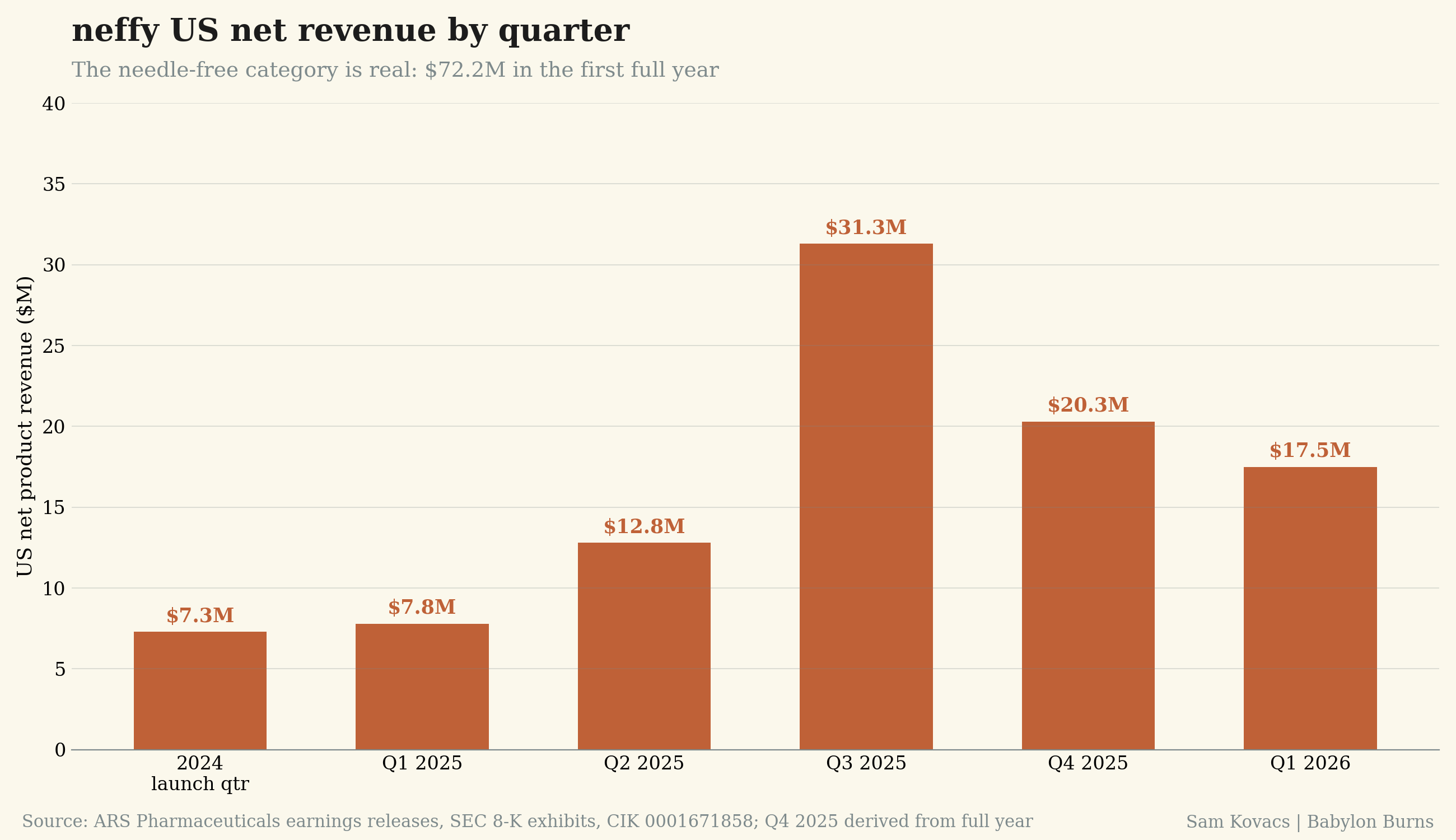
Anaphylm, which is AQST’s drug, is the next step in that logic, and I think it’s a step change in convenience and usability.
It is delivered on a film the size of a postage stamp that dissolves on contact under the tongue.
It weighs less than an ounce and you can pop it in your phone case or your wallet, which makes forgetting it less likely.
If the category’s core failure mode is that the medicine gets left at home, the small stamp is the best solution for that problem so far.
It would be the first and only oral epinephrine, and the FDA’s own review didn’t question any of its pharmacology.
Needless to say, this is a multi billion dollar market which AQST would be chipping away.
The company behind it
Aquestive isn’t a story stock invented for this product, which is refreshing, as it gives us a floor under the share price which is a setup which is easier to get behind.
It’s a twenty year old drug delivery manufacturer in, New Jersey, whose specialty is exactly one thing: turning drugs into stamp sized films.
Its base business makes Suboxone film, the opioid dependence treatment, for Indivior, along with a handful of smaller licensed products. That business did $44.5 million of revenue in 2025 and runs from a plant which the company owns.
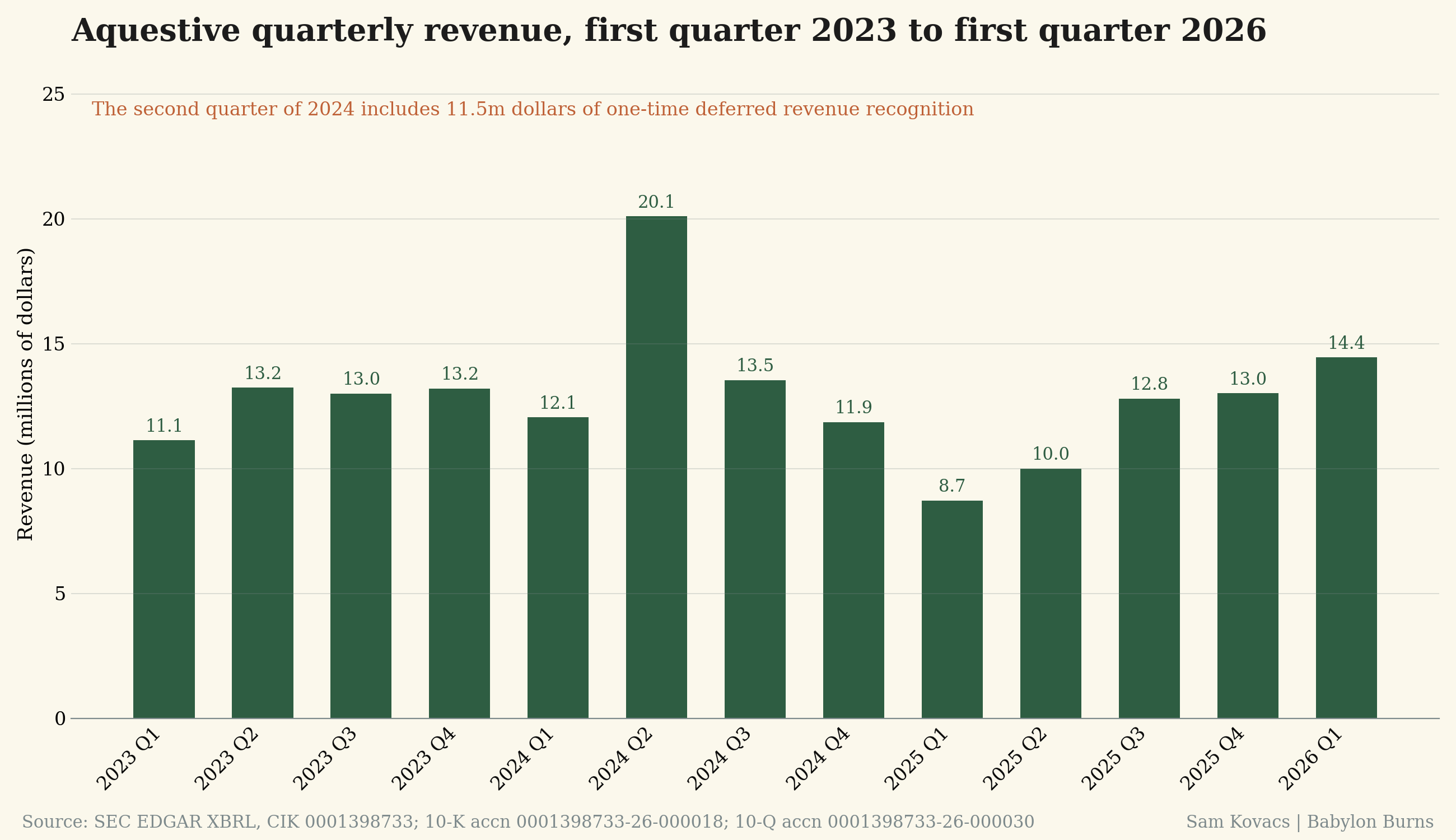
This business is probably worth about $1.50 per share without Anaphylm.
Add in the option of eventual approval through a third or fourth submission, and failure from here looks like a $2 to a $2.50 stock.
What the FDA said, and the case against this idea.
A Complete Response Letter is the FDA’s formal no: the application won’t be approved in its present form, and here’s why.
Aquestive’s letter, received January 30, basically said that the label needed to be improved to address the film placement, the pouch was difficult to open, and asked for one supportive pharmacokinetic study.
According to the company, there were no clinical deficiencies, no safety deficiencies, and no manufacturing deficiencies. The drug’s core data, the head to head pharmacology against auto-injectors across eleven studies and 967 administrations, went unchallenged.
This was the whole case for it which got me interested, but before we go deeper, there are some clear counterpoints which I think it would be best to consider before we go down this road.
First, we haven’t read the letter. Nobody outside the company and the agency has.
Everything above is management’s characterization, and the FDA’s researchers once compared 61 of these letters against the press releases describing them: only 14% of the statements matched, and sponsors omitted roughly 85% of the agency’s safety and efficacy concerns.
Aquestive’s framing has been consistent for six months and is corroborated by the specifics it volunteered, but let’s not forget that we are asked to trust the party with the most to lose.
Second, Aquestive is second in its category. neffy is approved, funded, eighteen months ahead, and defended by a sales machine which Aquestive won’t have the resources to match.
And finally there is about $95mn of committed capital from Oaktree and RXT, which only comes through if the drug is approved.
So this isn’t an obvious layup operationally. I’m more interested in the binary nature of the approval though.
From here, I paused, and asked: what happened in other cases when companies got a rejection similar to this one?
This is where my detective work started.
Twenty one rejections like this one
There’s no published approval rate for rejections of this type, and the academic work that classifies rejection letters is too generic to be of use.
So I built the dataset myself, by hand, from FDA review documents and two decades of SEC filings, and then ran the entire EDGAR full text corpus across over 4,500 filings, to make sure I hadn’t missed cases.
I found 21 original applications since 2010 where the FDA’s objection was substantially about human factors, usability, device performance, packaging, instructions, or labelling.
Let’s look at some of the case studies, as it will give us a better feel for what we’re dealing with. You can speed read this bit if you need to.
First the good ones:
In November 2014, Avanir’s Onzetra Xsail, a migraine drug delivered through a novel breath powered nasal device, was rejected. The FDA’s summary review says the letter was issued “because of human factors deficiencies”: in the usability study, only a fraction of patients delivered a full dose correctly. There were no clinical questions, nor manufacturing questions. Avanir fixed the device, reran the study, and the same reviewer wrote that the sponsor “has adequately addressed the device usability issues” and approved it.
It took 14 months from the letter of refusal to the approval.
Kloxxado, an emergency nasal spray for opioid overdose, drew a 2020 letter in which human factors was one deficiency among twenty; the agency found “insufficient information to support the design of your proposed user interface.” There was one resubmission, and after 14 months, it was also approved.
Gimoti, a nasal spray, took a letter on device quality and clinical pharmacology with no new clinical data demanded: it was approved in 15 months.
Kynmobi, an apomorphine film for Parkinson’s is worth reading closely because its letter was worse than Anaphylm’s. The FDA cited human factors and inadequate bridging to the reference drug and inadequate characterization of adverse events, a mixed rejection that reached clinical ground. It still cleared on a single resubmission in 16 months.
MydCombi, an ophthalmic spray whose only sin was device documentation, took 18 months.
Now, the not so good ones:
Adamis’s Symjepi, an epinephrine prefilled syringe, is the case that shows us what the FDA sounds like when it doesn’t approve of the device: the agency wrote that the device as designed “could fail in the hands of the intended users,” and that in an anaphylaxis emergency, delivery of epinephrine could not be assured.
It took the company two rejections, a redesign and 27 months to approval.
Primatene Mist spent 54 months and two letters proving that ordinary consumers could read its label.
scPharmaceuticals’ Furoscix, a wearable furosemide pump, took 52 months and three review cycles even though the FDA twice said explicitly that no new clinical trials were needed, because the fix required modifying hardware.
Amphastar’s naloxone nasal spray, took 72 months, because the human factors remedy forced a device change, the device change altered the delivered dose, and the altered dose demanded new pharmacokinetic studies.
Teva’s generic EpiPen needed 30 months. Mannkind’s Afrezza inhaler, 52, after the agency demanded two new clinical trials to bridge a redesigned inhaler.
And 5 never made it at all.
20 of the 21 are resolved. 15 were approved, 5 died. 75% made it eventually, against a baseline historical base rate of about 73% for rejected applications and a 50% first try rate, from a decade worth of studies.
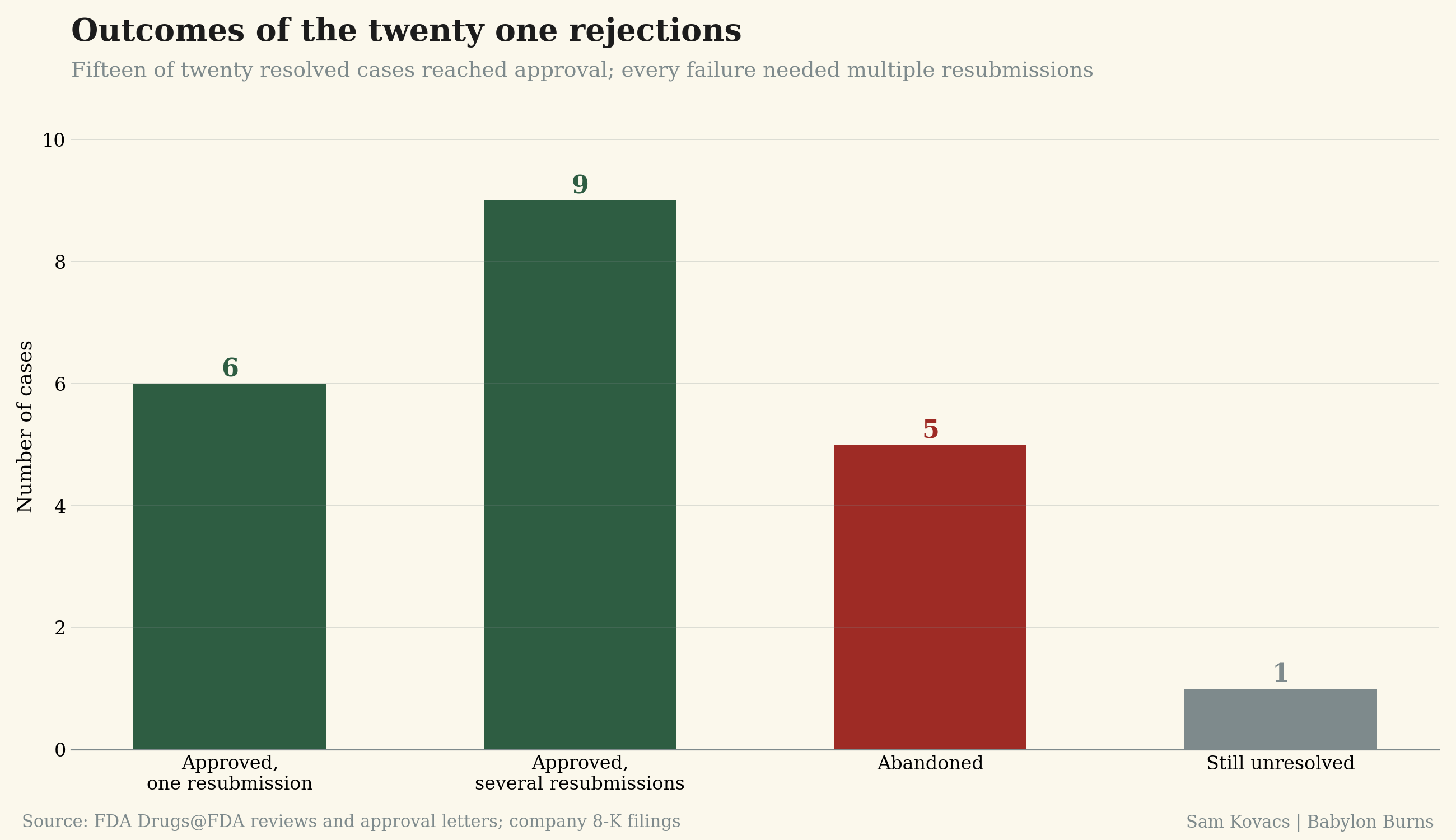
But the aggregates aren’t so interesting to me, it’s more the structure of the letters which gave us insight into when it would go
Every case that cleared on a single resubmission was approved in 12 to 18 months, with a median of 14.
Every case that needed more than one resubmission took 26 to 72 months, with a median of 44 .
There is a massive fork in the road which lies between the group that tried on the first fix, and those that didn.t
It’s whether the first fix works. When the remedy is packaging, instructions, and one repeat study, you get 14 months and done. When the remedy turns out to require changing the product, you get years, or never.
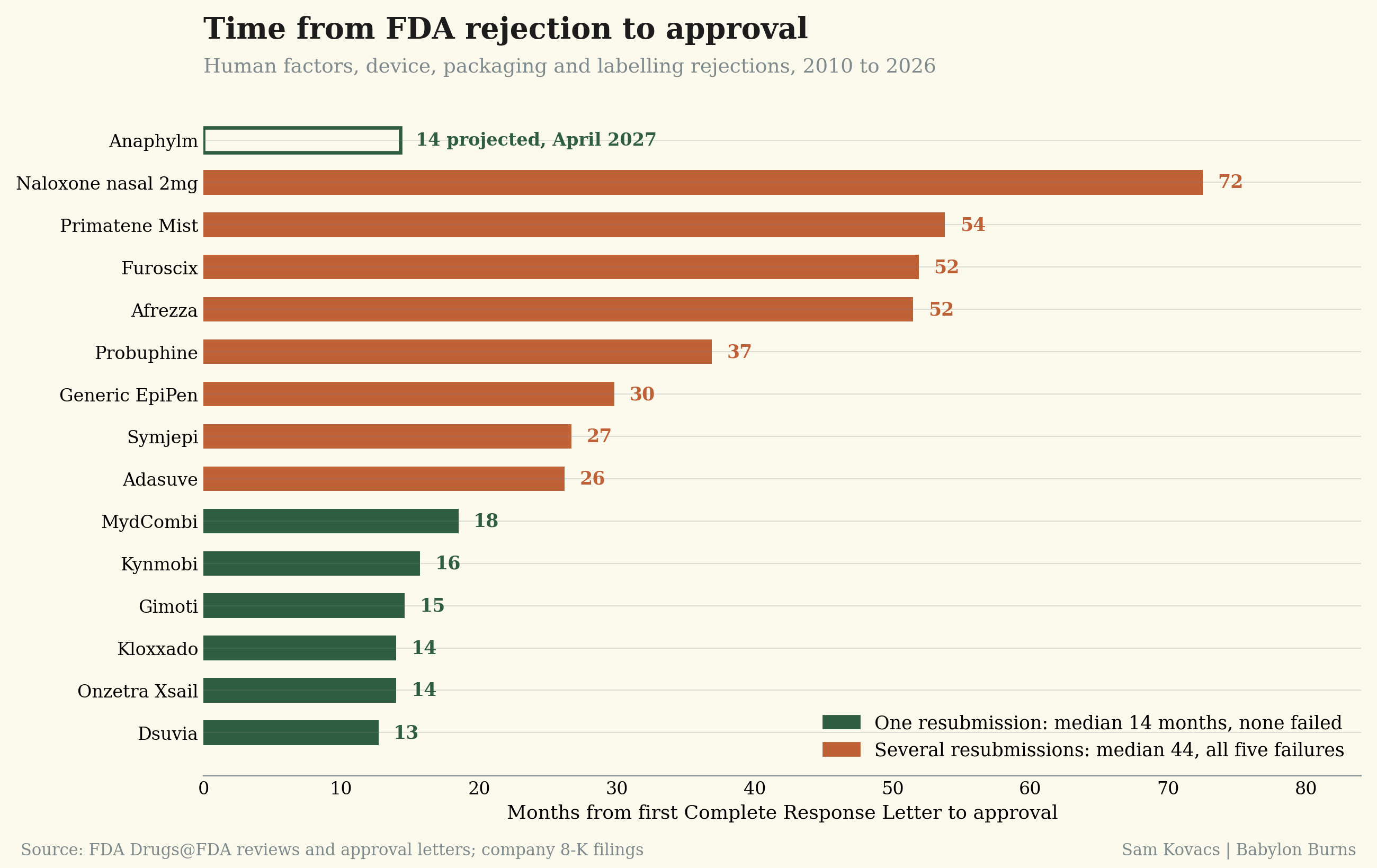
Where it gets interesting, in six of the resolved cases, human factors or packaging was the only problem, with clinical and manufacturing untouched. All six were approved. Anaphylm, per everything disclosed, is the seventh member of that group.
Plot Anaphylm on this distribution and the projection writes itself. The letter is dated January 30, 2026.
The single resubmission median of 14 months lands in April 2027, and the mechanics agree: a 3rd quarter resubmission plus the FDA’s standard six month clock for this class of response puts the decision between late March and June.
That’s the spring I’m pointing at, and everything now rests on one question, whether Anaphylm’s first fix works. Hold that question, it was mostly answered on Monday.
On Monday morning, August 10, Aquestive published the results of the redesigned program, and they read like the fast lane of the reference class.
The pouch that took a median 17 seconds to open now takes 3. Incorrect film placement, the error that triggered the entire rejection, fell by more than 80% against the failed study. Self administered pharmacokinetics matched clinician administered. And the study I flagged as the single biggest risk in this situation, the deliberate misuse arm testing what happens when the film is placed on top of the tongue anyway, showed clinically meaningful pharmacodynamic response.
That last result means even the residual error mode, now down to roughly one user in fifty, has acceptable pharmacology behind it. The fix, if we believe the evidence, works.
The resubmission stays on track for this quarter, and Canada, the UK and Europe are advancing in parallel, with European regulators already on record that no further trials are needed to file.
Back of the napkin valuation
If approved, I expect the stock around $6.50. It could be $7, it could be $8, it could be higher. Let’s be conservative and call it $6.50.
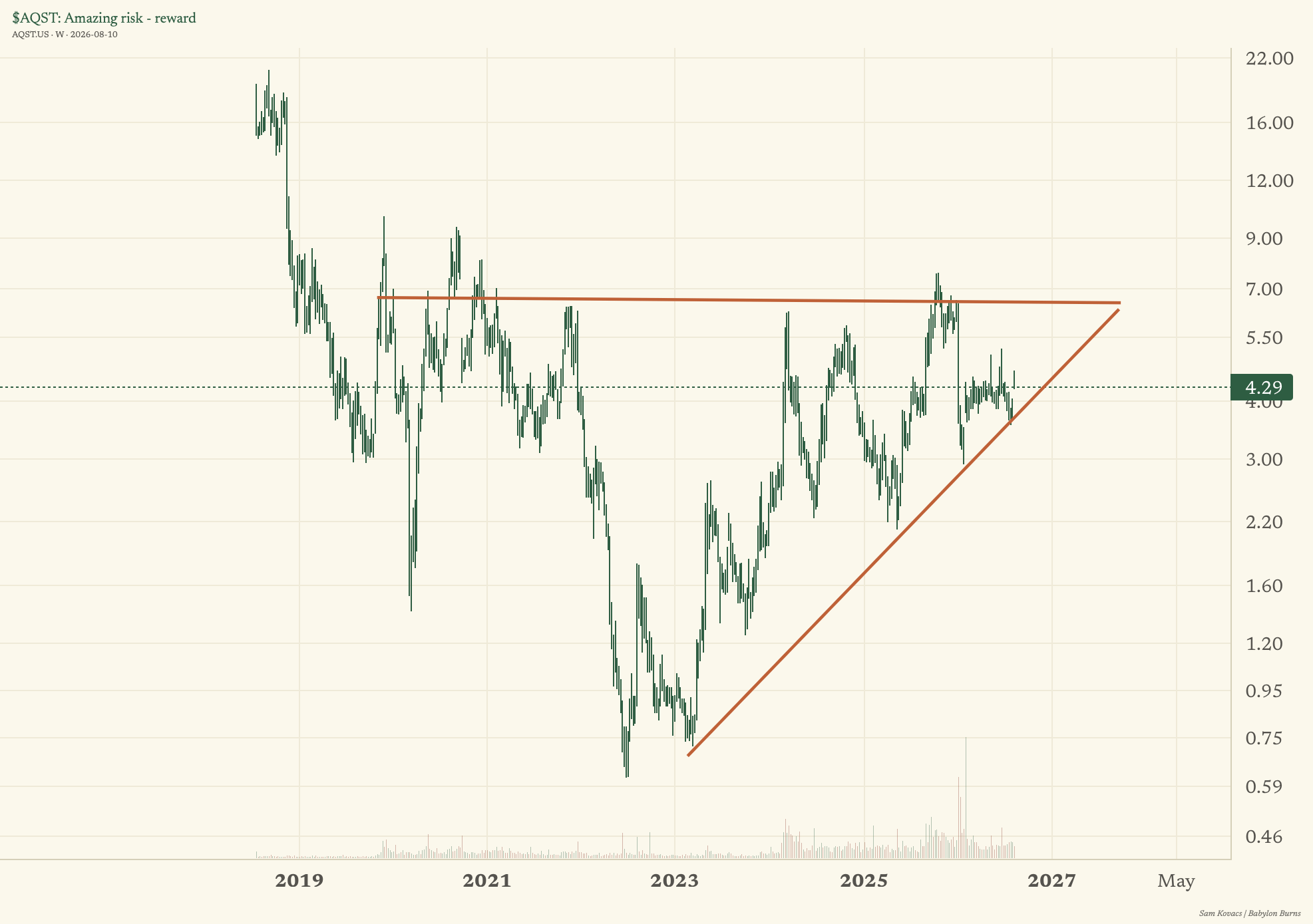
From September 2025 through January, while the market treated approval as likely, this stock traded between $6.00 and $7.55, on a weaker balance sheet than it will have at approval, with every revenue encumbrance already disclosed.
I see no reason the market stops short of a price it already paid when the question was still open, so I think I’m being very conservative here.
If rejected again, we’re probably looking at $2.25, as I suggested earlier. That’s the manufacturing business, the optionality of resubmission, and the remaining cash, net of debt, and it’s consistent with the $2.93 panic print in February, with now extra newfound negativity.
I put approval chances at 80 %. It has all the hallmarks of the fast to fix drug category which I just dissected, and it seems, none of the curve balls which delay it.
At 80 % the expected value is $5.65 using my conservative upside scenario.
Yet the stock today at $4.29 is basically still pricing this as a slightly below 50% chance of success.
AQST is a $540mn market cap. It’s quite frequent in these cases for the market to ignore the situation, and leave some free money on the table. I already picked up some, but there is still plenty, and it now more free than ever.
neffy’s expensive lesson, and who paid for it
The strongest objection to the investment case isn’t regulatory, it’s commercial: the main competitor, neffy, has had a launch with brutal economics.
ARS spent roughly $230 million on selling and administration in 2025 to book $72 million of neffy revenue, $3 out for every buck coming in, with a team of 148 reps, a national ad campaign, and a pediatric co-promotion reaching 20,000 clinicians.
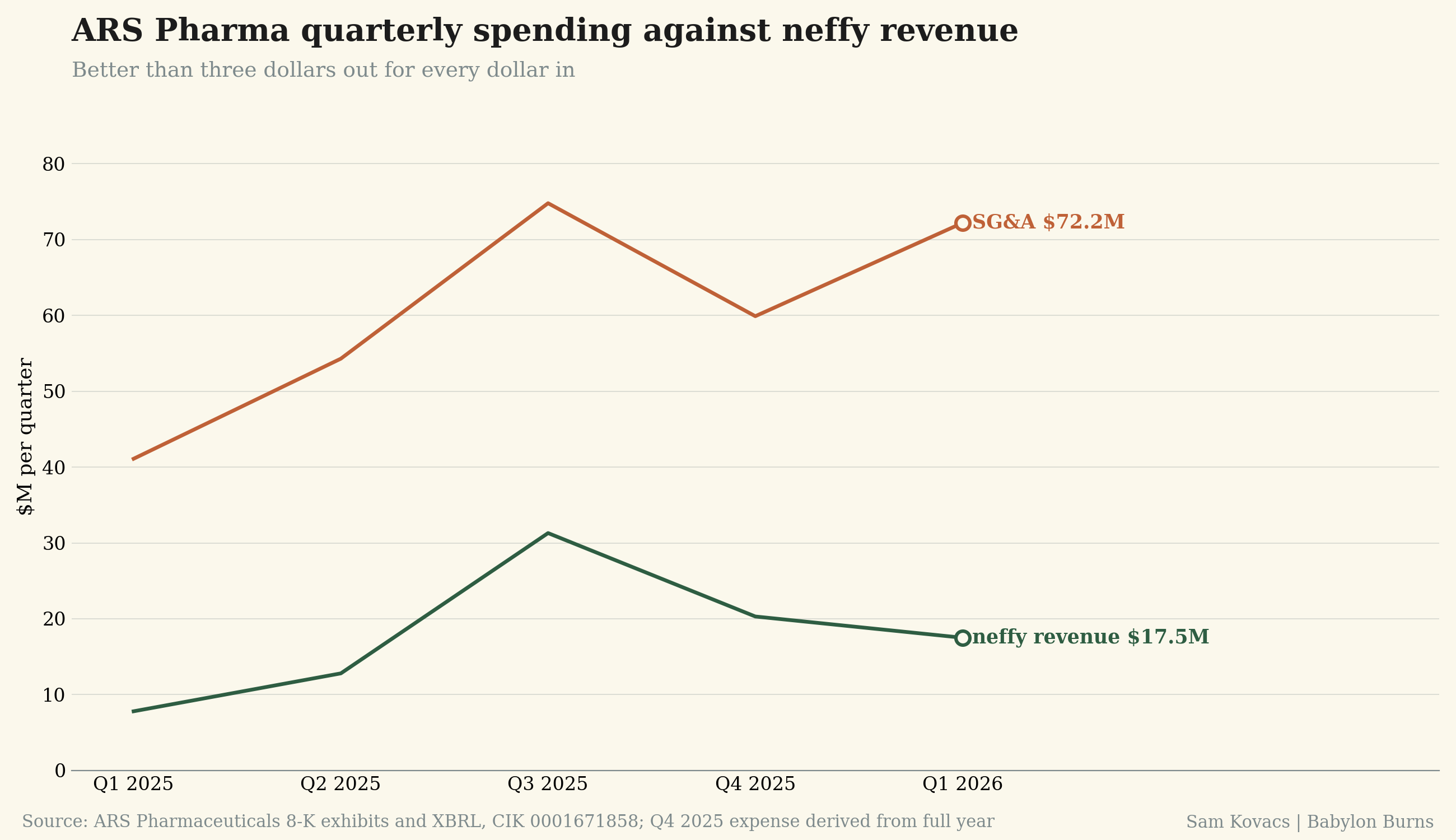
If that’s what this market costs, a company Aquestive’s size just can’t afford it, and the billion dollar product management likes to talk about isn’t anywhere close.
But here’s the thing: neffy wasn’t just selling a spray, it was building a category.
Those dollars went to convincing allergists that needle-free rescue epinephrine is legitimate medicine, convincing patients it exists, and forcing the pharmacy gatekeepers to create a formulary lane that didn’t exist, which finally opened at Caremark this July.
That work is done, and it doesn’t have to be done twice.
Aquestive launches into the category neffy paid to create, with the more radical convenience story in a market whose core failure is that people don’t carry the product, a concentrated team of 50 to 75 reps aimed at the allergists who write most of the scripts, and its own film plant, so every strip is made at commodity cost in a factory it runs itself.
Conclusion
You’ll come to find that my work at Babylon Burns will span many asset classes and industries.
There will be macro opportunities and micro opportunities, like this one.
AQST could be worth $6.5 or $8. I can’t honestly tell you what the number is upon approval. What I can tell you, is that all of the fundamental work done on it suggests that approval is much more likely than the market is crediting.
The risk reward is very attractive.
On August 15th, this Saturday, to celebrate 55 years of Nixon debasing the US dollar and forcing me into a position where I have to go into the weeds to find opportunities for us to stay ahead, I will be launching the paid version of Babylon Burns.
For the past 2 months, I’ve given everyone a free ride to demonstrate the breadth of my work.
Saturday that changes.
If you pledge today, you’ll get access to:
All of the stock ideas like this one, which will go behind the paywall.
My live positioning and trade alerts in a portfolio which we’ll build from scratch.
All of the above available in a members only web application (only for annual subscribers)
And much, much more.
So use the button below to join us now, on what will invariably be an amazing adventure.
As Babylon Burns, we’ll light the cigars
PS: Joining now, means getting the discounted price. Post launch, the price of the annual subscription is going up, so now is the best time to get in on the action.
Sam - the only thing that troubles me about this business is that 31 / 38 quarters their Cashflow from operations is negative. Not sure how then we come to a baseline value of the business at $1.50 - $2.50 / sh.
The financing was split between Oaktree debt ($55M of Oaktree's $150M facility is drawn, remainder gated on approval/milestone/mutual-consent) + RTW (not RXT) Investments LP ($75M, paid back as revenue sharing, capped at $225M): https://www.sec.gov/Archives/edgar/data/1398733/000139873326000042/aqst-20260630.htm
My research-agent after working on valuing it for an hour also noted:
- No recent open-market insider buying.
- Dilution: diluted share count nearly quadrupled since 2020 (33.7M→125.5M), funded entirely by equity issuance, zero buybacks/dividends ever (10-K FY2025 (https://www.sec.gov/Archives/edgar/data/1398733/000139873326000018/aqst-20251231.htm), Statements of Stockholders' Deficit). Relevant to whether the "$1.50/share ex-Anaphylm" and "$6.50" targets hold up as more capital gets raised before/at launch.
- Suboxone/Indivior legacy base is eroding fast: 73% of FY2025 revenue, company calls it a "sunsetting product," and computed roughly -9%/yr decline (10-K FY2025 Note 6 (https://www.sec.gov/Archives/edgar/data/1398733/000139873326000018/aqst-20251231.htm)) — relevant to whether "$1.50/share base business" is a stable floor or itself declining.