

There are certain things which just take time. Buffett would say that you don’t make a baby in one month by getting 9 women pregnant.
Bearish compression of the Saudi stock market has been running for years now, since peaking in April of 2022.
It is extremely rare for me to initiate short positions, as I usually favor the asymmetry, which a long position offers me. However, the technical setup, along with the market’s perpetual mispricing of the risk of the current conflict, and a natural transmission risk into the Saudi economy, suggests to me that initiating a short in the iShares Saudi Arabia ETF ($KSA) presents a brilliant risk-reward here.
In 2026, the market has acquired an ugly reflex when it comes to Saudi Arabia; missiles hit, oil price rises, and investors choose to look past the damage inflicted. This cycle has been going on for 7 months now, but in the past month, the paradigm has changed, and the price of the index is starting to validate that.
An increase in the price of oil can compensate the kingdom for barrels it has lost, but it cannot reopen Saudi airports. The Saudi stock market doesn’t reflect this at all. It’s as if the country is priced for peace.
The Houthis struck the the domestic terminals at King Khalid Airport, on Saturday afternoon, killing 13 people and wounding more than 300, according to Saudi authorities. This made it the deadliest attack on Saudi soil in over a decade.
On Sunday, the same airport was struck once more, killing yet another person and injuring even more.
Today, the aviation authority has extended the airport’s closure to at least October 17. I believe this closure is likely to be renewed.
In today’s report, I will be explaining why I believe the iShares Saudi Arabia ETF is an interesting short, where my targets are, so grab a coffee, because it should be an interesting read.
To be clear, I do not seek to profit from war, I seek to profit from a mismatch between reality and the numbers. I believe the market has been too complacent in rerating the Saudi Arabian stock market, and that this gives us a good opportunity for a trade, with the fiscal direction changing.
I pray for peace, and for the war crimes which have occurred all over the Middle East to cease, but in the meantime, finding the opportunities for investors is my job.
Paid member housekeeping
It seems like you’re not a paid reader, so this small section is not for you.
Don’t worry. I’ve opened up the entire article on Saudi Arabia for free.
However, if you want to know my latest targets for Brent and two stocks which we exited today, the two we initiated positions in, and if you want access to my full body of work, then I highly suggest you join us on the Babylon Burns adventure.
I believe that it comes as no surprise to you that Babylon is burning. My promise is that as it burns, we will be the ones lighting the cigars.
If you want access to my macro research, to me hunting for the best idea before it becomes consensus, at the very least, put your email in so I can send you the free reports. If you want all of the extras, access to my web application, and so on, join for a paid subscription.
You won’t regret it. I won’t regret it. It’ll be a great time.
So far, investors have looked through the conflict...
Insofar as our investment analysis is concerned, Saudi Arabia is a country which is attached to an oil company, Aramco. The country drills and refines huge amounts of oil, which it then puts onto the sea, either through the Strait of Hormuz or through the Red Sea. It ships it to Europe or Asia and gets paid for it. It then pays out to the state through dividends, royalties, and tax. So long as enough barrels get out at a price that’s high enough, then the war premium on price can compensate for a big part of the disruption.
Early on in the war, when Hormuz was entirely closed by the Iranians, Saudi Arabia pushed oil through its east-west pipeline line to Yanbu on the Red Sea. When, on July 20, the Houthis closed Bab al-Mandab, the kingdom turned around and started shipping oil back through Hormuz using the ship-to-ship (STS) method, which allowed them to shuttle oil out and keep flows going.
You must realize that Brent averaged $67 in January and February, then $88 in August, and $102 in September. Even with the East-West pipeline down for 11 days after drones launched from Iraq shut it down, the exports from Saudi were largely enough for it to continue taking in significant revenues.
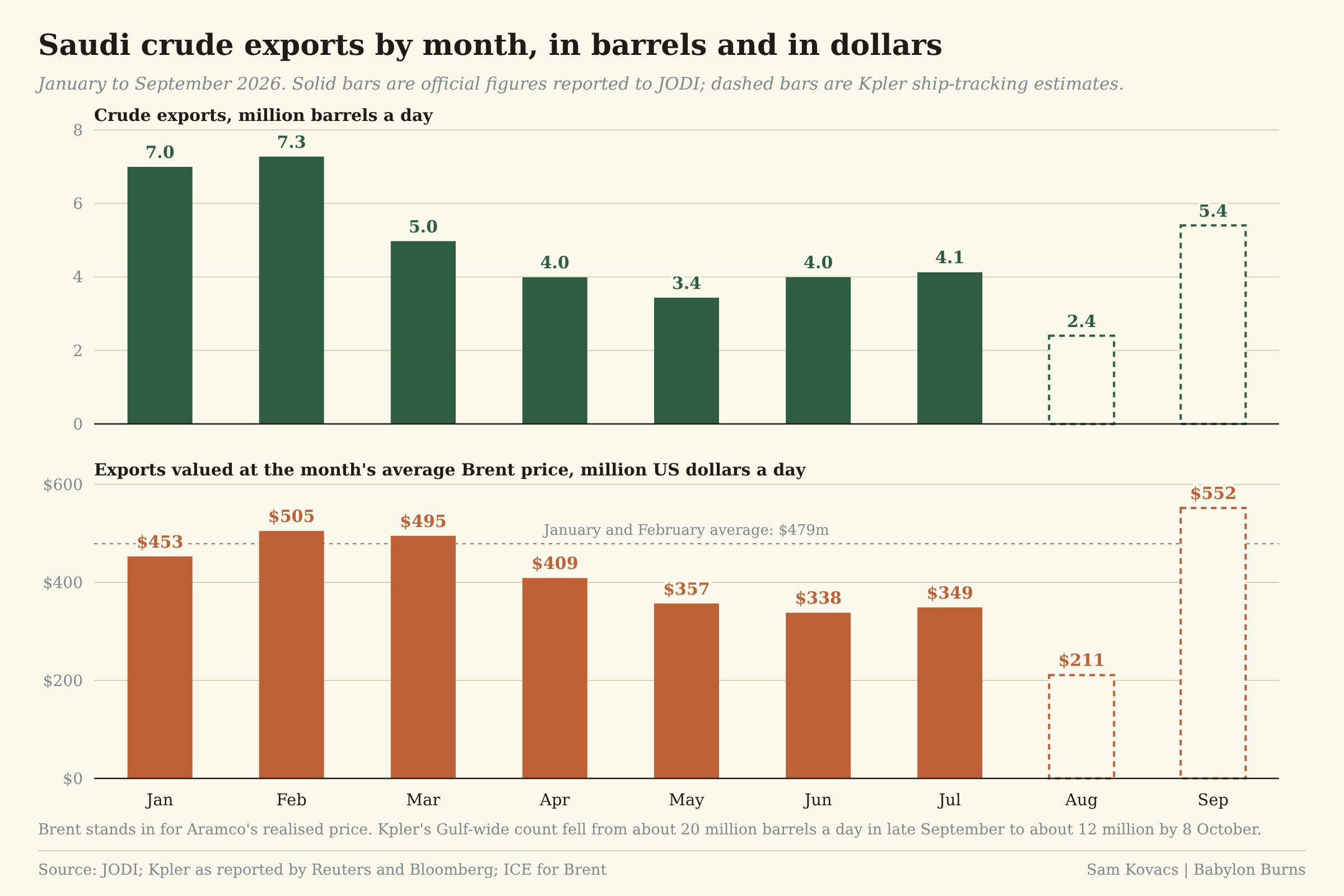
And if you take the 5.4 million barrels per day that exited Saudi Arabia in September at $102 a barrel, they brought in more revenue than they would have with their full level of exports before the war started.
In the first half of the year, state oil revenue rose by 9%, and Aramco reported $33.4 billion in adjusted profit for the second quarter.
So it is natural that many are thinking that April to August was a blip, and that we are now back on track.
If you only look at the barrels and the price in the rearview mirror, then Saudi Arabia is looking like it’s coming out alright. So far, this is the calculation that the market has been making, as the share price is only a few percentage points below where it was when the conflict started.
In many ways, the problem hasn’t been oil revenue for Saudi Arabia, but more the knock-on effects that happen from this war.
There are two fronts to this war for Saudi Arabia now
The first remains the kinetic escalation threat. The Houthis have hit refineries time and time again in the past few weeks, and increasingly so since October, targeting the pipeline, oil fields, and refineries. So far, it is too early to say whether this has seriously hindered flows, but preliminary numbers suggest the answer is yes.
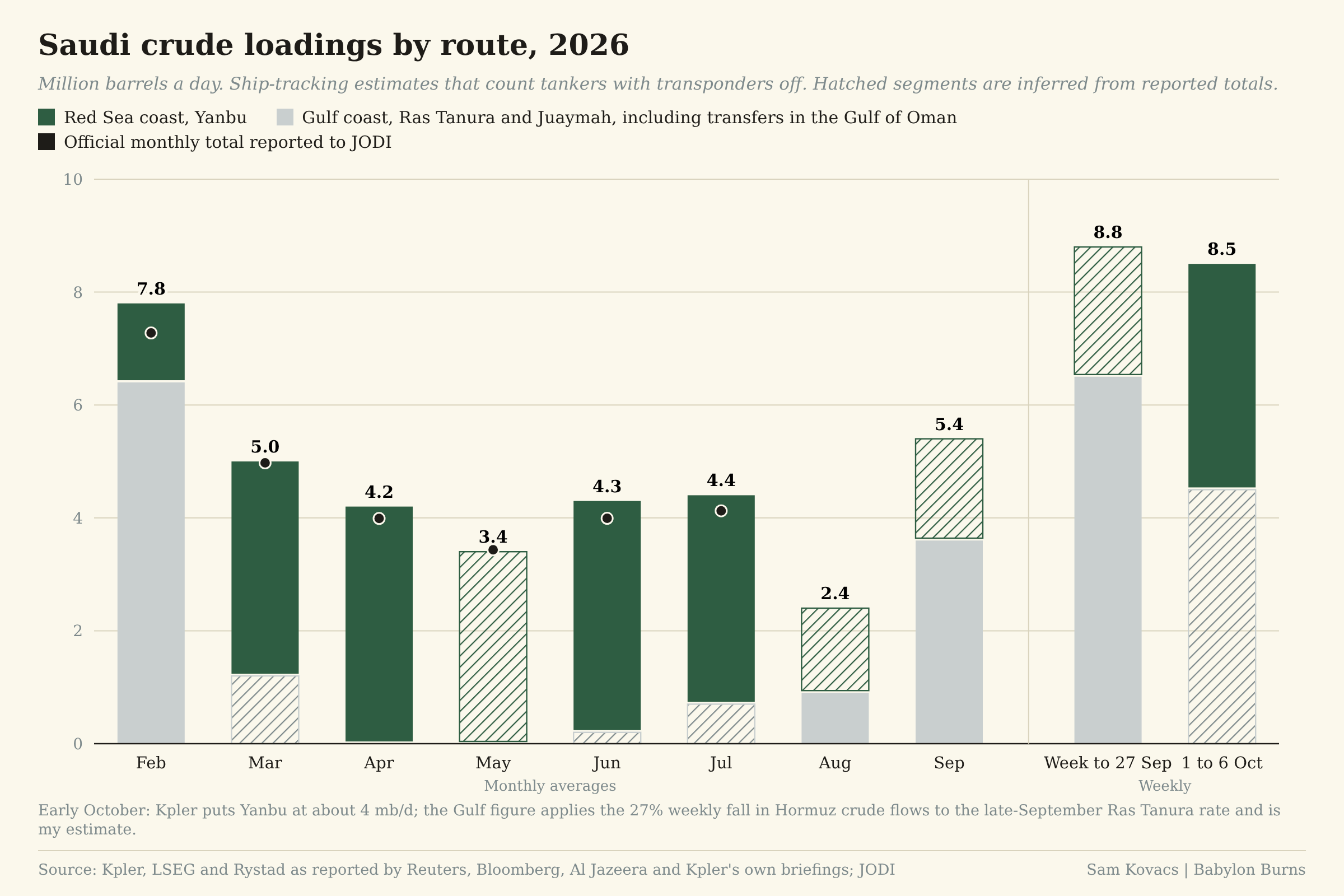
If it has, there is no question that it will therefore hinder Aramco revenues and therefore hinder state revenues. But the more important and maybe less priced development, I believe, is the recent expansion of the war to atrocities on civilian infrastructure.
Last week King Khalid Airport was hit by missiles on four separate days.
The Houthis have declared Saudi airspace a theatre for their operations and told Aramco’s workers they’re targets. On Sunday the Saudi aviation authority confirmed a strike on Dammam’s airport, and the Houthis claimed hits on two Aramco energy sites that Riyadh hasn’t confirmed. By Monday afternoon Cirium counted 46.4% of all scheduled flights in the kingdom cancelled, and Riyadh’s schools had moved online.
A pipeline and a refinery strike cost Saudi Arabia barrels of exports, and they’ve been compensated for these with a higher price of oil. Also, it should be noted that no one is as skilled as the Saudis in rapidly repairing their pipelines and their refineries.
However, a closed airspace costs Saudi Arabia its visitors, conferences, and investment from the foreign companies that Vision 2030 was written for. Triple-digit Brent doesn’t help a single bit here.
Saudi Arabia’s Vision 2030 requires 150 million yearly visits and $100 billion of foreign direct investment each year before the end of this decade. Even before the Houthis struck the airport, foreign arrivals were down 13% in the first quarter. Riyadh’s hotels were earning 26% less per room through August, and foreign direct investment had declined by 18% in the second quarter, about a quarter of the pace that the government’s programs require.
Riyadh’s King Khalid Airport transports about 29% of the kingdom’s air passengers. Lufthansa has already suspended Riyadh until October 16, and Air France-KLM until the end of the month. Britain, France, and Germany all advise against anything but essential travel to the capital city.
Thankfully, Medina and Mecca have been excluded from the Houthi areas of attacks, which means that pilgrims can still travel. Rather, it is commercial travel for investors, which is slowing down. The World Petroleum Congress opened this Monday without the chief executives of Exxon, Shell, Total Energies, and BP, who, according to the Financial Times, cancelled their visits. The Crown Prince’s investment conference is due to open in the city on 26th of October, and it is difficult to imagine how attendance and turnout will not be impaired at this point.
The consequence of course, will be the strain on the budget deficit, on economic growth, and therefore on the banking sector.
Government revenue rose 6% in the first half and spending rose 15%, with SAR 125 billion going to the military. The deficit for the first six months of the year amounted to SAR 160 billion against a plan of SAR 165 billion for the year. On September 30th the ministry raised its estimate for the year to SAR 245 billion.
That estimate leaves SAR 85 billion for the whole second half. Last year the deficit stood at SAR 181 billion in September and the fourth quarter alone added SAR 95 billion.
To hit it, second-half spending has to come in about 10% below the first half, during a ground offensive in Yemen. Last year it ran 11% above. The ministry’s estimate for 2025, made last December with weeks of the year left, was also SAR 245 billion. The outcome was SAR 277 billion.
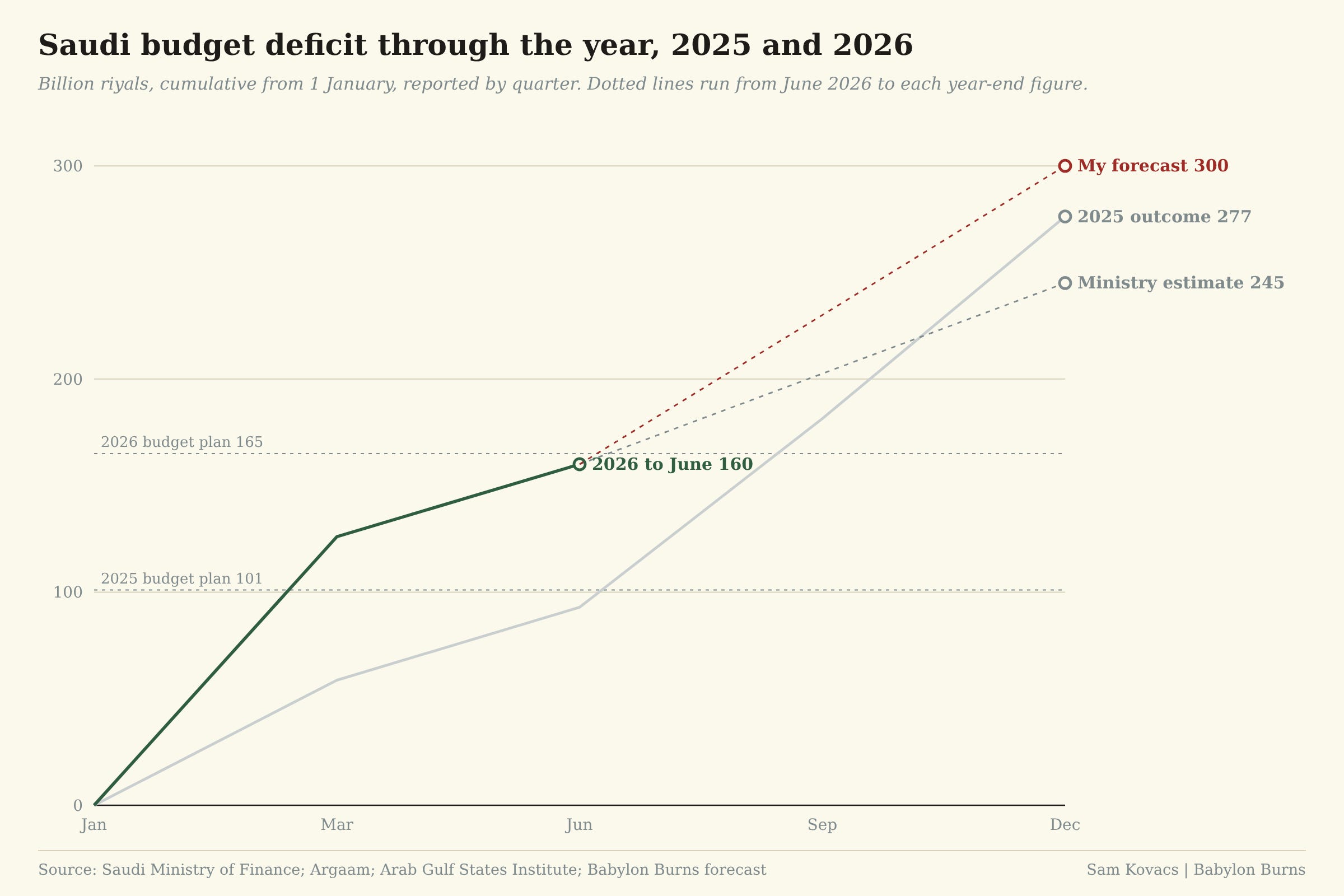
I am therefore estimating a SAR 300bn deficit for the year. Could be higher.
All of this has come from higher borrowing, 73% of which has been issued domestically to the banks.
The Saudi Stock market is mostly banks
Saudi banks hold SAR 676 billion of government and quasi-government paper, almost two-thirds of the state's domestic debt, and their lending to state-owned companies grew 18.4% in the year to August.
Their deposits haven't kept up. Bank credit grew 7% over that year and the money supply 5.6%, and in August the money supply shrank. Fitch had the sector's loans at a record 108% of deposits at the end of 2025. The banks cover the difference abroad. They owe foreigners SAR 217 billion more than they hold overseas, and that figure grew 3.1% in August alone.
Riyadh ran this experiment in 2015 and 2016. Oil collapsed, the deficit blew out, the government drew down its deposits and sold bonds to its banks, and the interbank rate rose for 15 straight months. The peg held and the banks survived. KSA launched in September 2015 and lost 28.8% in its first four months.
Now, of course, my base case here isn’t that oil will collapse. However, it is that the expected foreign direct investment doesn’t come in anywhere near expected. Expenses blow out way above anything that is expected, and there remains the kinetic risk that outflows don’t come in anywhere near expected. All of these would point towards further losses, which the banking system must absorb.
The early sign this time is in the provisions. Al Rajhi, one of the country's two largest banks, grew its profit 14% in the second quarter and its impairment charges 46.8%.
When people think about the DIshare Saudi Arabia ETF (KSA), they think of an oil fund because they think of Aramco, but that categorization is incorrect. Financials are actually 41.7% of the fund, and energy is only 12.4%. What’s more, Al Rajhi is the largest holding at 13.9%, ahead of Aramco at 11.4%. The nine Saudi banks together make up 36% of the fund.
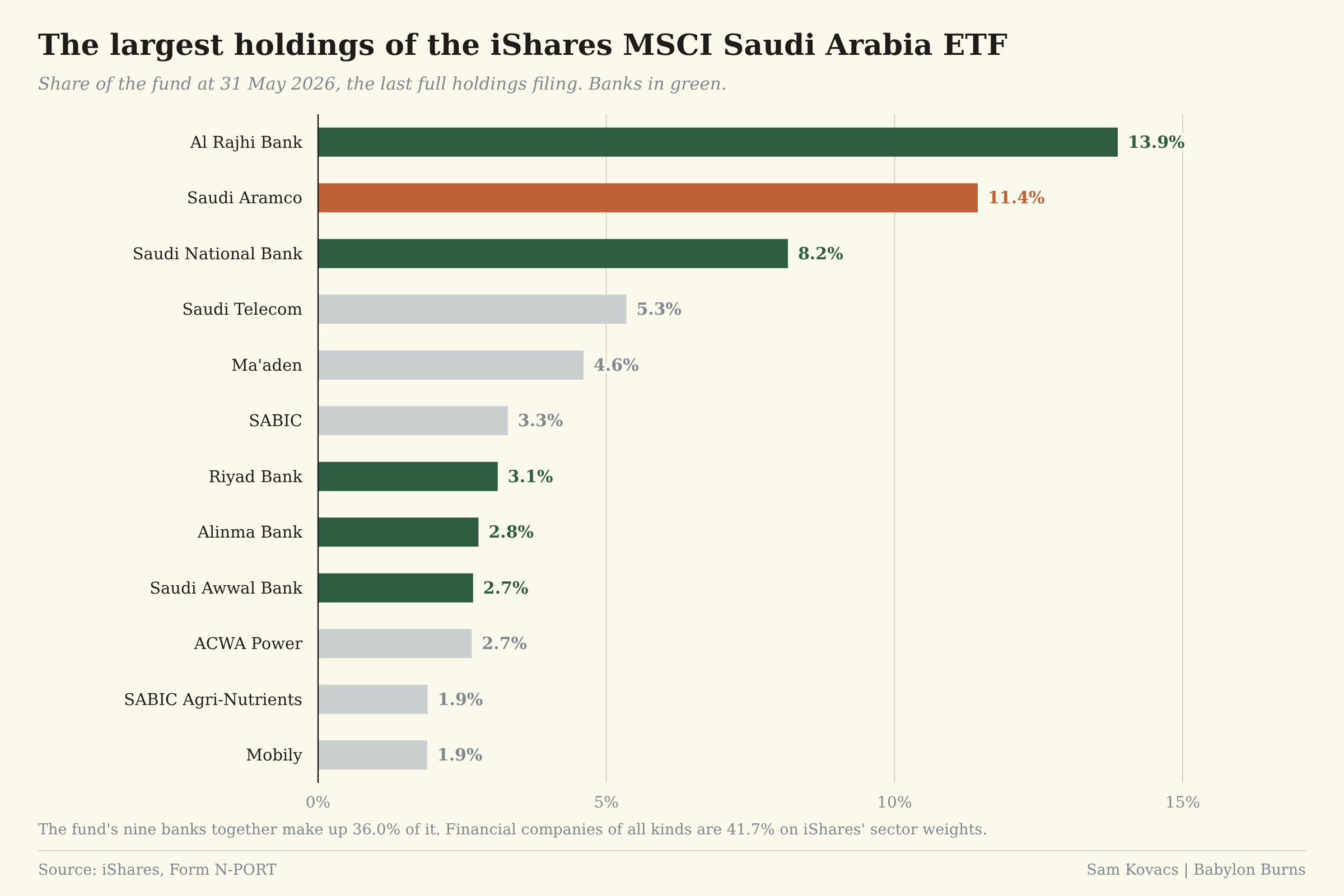
In my scenario, it is now seeming extremely likely that these banks own less than their current price assumes. The fundamental transmission towards a lower stock market index seems complete. As a whole, this fund, which is, like I said, 42% financials, still trades at 2 times book value, which would suggest that it is growing at around 6.1% per year. However, the ministry expects the economy to shrink 3.6% this year and has built its 2027 budget assuming growth of 12.8%.
For comparison, Al Rajhi trades at 3x book and earns 19% return on equity, which, of course, is excellent on an extremely low cost base. While profits grew 14% in the second quarter, as I said above, impairments grew 47%. If you compare this to Emirates NBD, which earns 17% and trades at 1.3x book with a loan-to-deposit ratio under 19%, you see that it is trading on a sound balance sheet in a safer environment right now and has around half deposits (which, of course, leaves a lot of room for Al Rajhi to re-rate lower).
Saudi banks will be reporting within the next two weeks. Saudi National Bank reported last year on the 20th of October, and Al Rajhi on the 27th. What we’re likely to see is that profits are still rising, but impairments are arising faster, and more debt is borrowed abroad. This means that, for now, the headlines will still look fine. This is an important but: the technical setup is suggesting that the market is now looking forward and prepared for a serious re-rating towards the downside.
The technical setup
For some reason, I feel like I have to keep justifying my use of technicals, but nonetheless, I believe doing so always provides an opportunity for education. Technical analysis is effectively a ledger of everything that was bought and sold by the market. It tells you at what price, in what volumes, and when people transacted. It would seem natural to me that behavioural patterns might be observed through such setups.
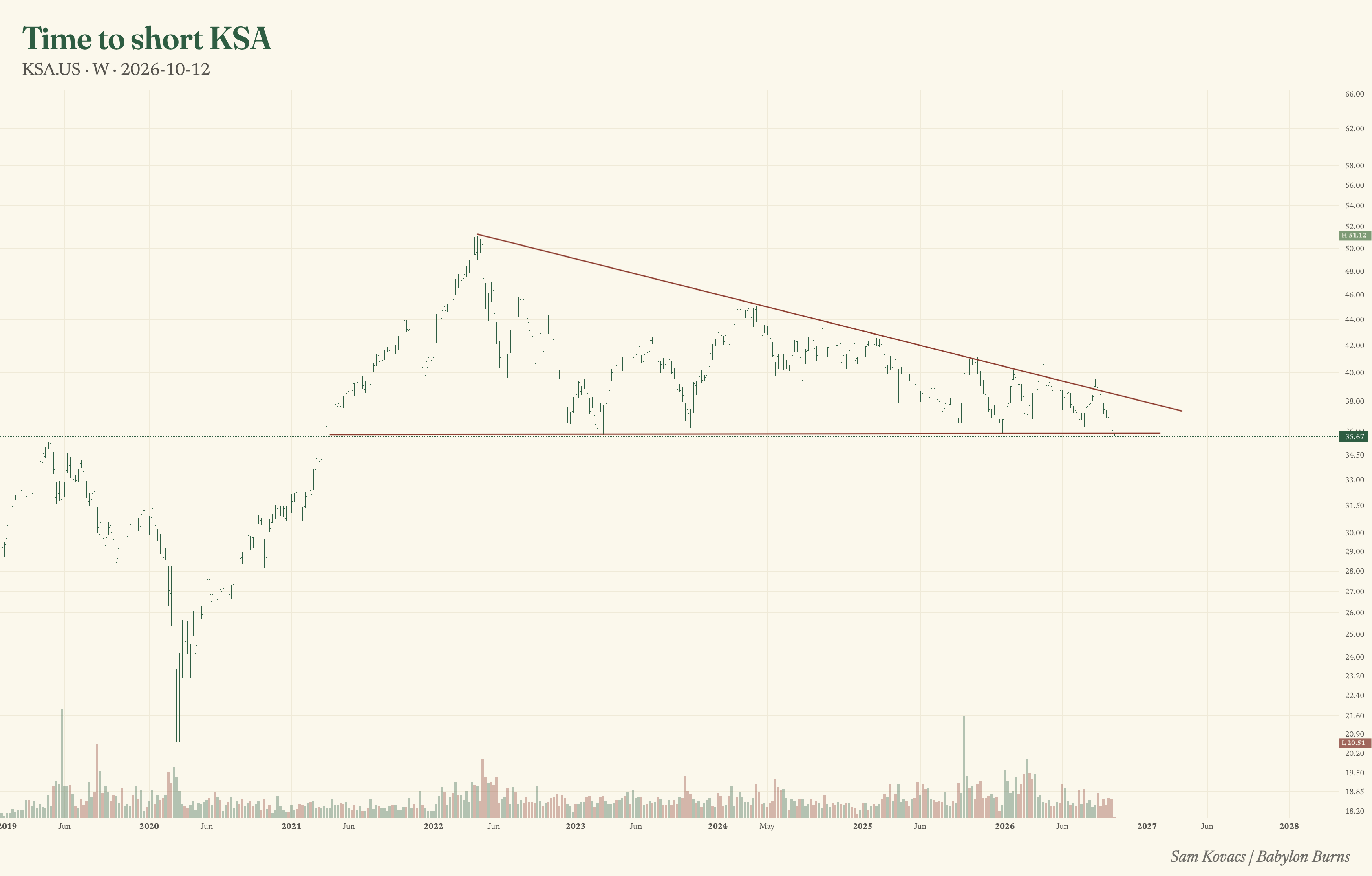
For the past 5 years now, the KSA ETF has been in what is known as a declining triangle, where the highs are sequentially lower and the lows form a flat line. Once that line is breached to the downside, if it stays there, it is extremely likely that we can see more share price declines.
Richard Schabacker, the father of technical analysis (and a fundamental piece of work to start with, it is 97% of my technical analysis education) had this to say about these setups:
The form of Right-angle Triangle, with its hypotenuse slanting down from the beginning of the pattern to its conclusion, is called a Descending Triangle, and almost invariably forecasts a downward movement to come. The Right-angle Triangle with its hypotenuse slanting upwards is called an Ascending Triangle, and it almost invariably forecasts a subsequent advance.
The Right-angle Triangles are, therefore, much more valuable for the purposes of practical forecasting than the Symmetrical Triangles. We have seen that the Symmetrical Triangle offers the decided drawback of not forecasting, in itself, the direction of the [eventual move].
The immediate targets in this case are $32 and then $27, which are prior levels of resistance and support.
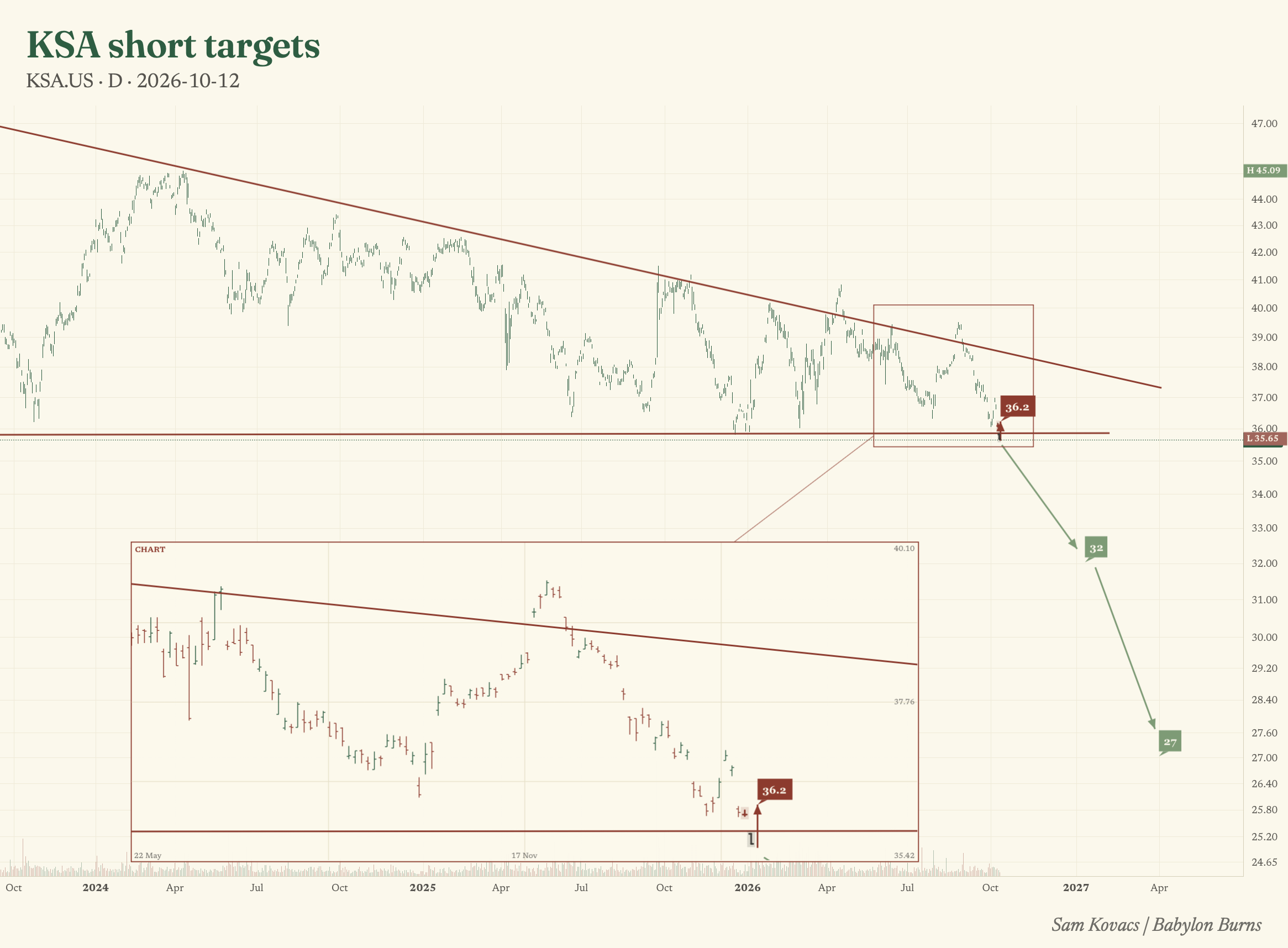
I am setting the stop loss at $36.5. The methodology would suggest $36.2, as it would be just above the last engulfed candle (which you can see in the magnified section of the chart. This comes from Peter Brandt, who was well documented in Market Wizards, and is a trick which is part of the 3% of non-Schabacker sourced technical education.
So we’re putting $1 at risk for every $4.3 of potential return in my baseline $32 case. If we reach $27, we’re looking at a phenomenal 10:1 risk return ratio.
The setup is skewed in our favor.
I don’t like war, but we need to trade the numbers and where the puck is going.
The puck is going in a direction which suggests we have a lot to gain by going short here.
As Babylon Burns, we’ll light the cigars.
Liked this article?
If you liked this, you’ll love Babylon Burns, and I strongly suggest you join us. I work pretty much around the clock to find the next big idea.
12 days ago I picked an investment which was a Chinese company listed in the US which had nothing to do with oil & gas. We’re up 20% as this has rerated hard.
I seek out value, and try to put myself at the inflection of that value rerating.
Right now my focus on the Hormuz conflict does dominate our positioning and therefore our coverage, but only because it is the biggest opportunity.
I am not an energy only analyst, I’m an all equity analyst, and will continue to bring you the next big trade before it becomes consensus.
If you join Babylon Burns, you’ll get access to:
My whole library of research.
The Babylon Burns live portfolio.
Our web-application which tracks the portfolio, gives you my charts, as well as real time notifications when trades are made.
I’ll be publishing this week a “Getting Started with Babylon Burns” article, which means that even if you’re coming in now, you’ll be able to use it for guidance in deciding how to position yourself in light of all my research.
So what are you waiting for? Come smoke a cigar with us, and if you don’t smoke a cigar, at least pick up a good stock idea. It only takes one for the subscription to pay for itself. I’ll see you on the other side.