The S&P 500 closed at a record of 7,819 on 6 October. Five weeks later it's 3% lower, which is nothing. You could look at the index and conclude that nothing has happened.
But that would be wrong, oh so wrong.
If we take the largest 50 stocks in the S&P 500, 20 of them are tech-related, and they account for about 41.3% of the entire S&P 500. If we then take the top 30 non-tech stocks, they account for 21% of the S&P 500, and the remaining 450 stocks or so account for the balance.
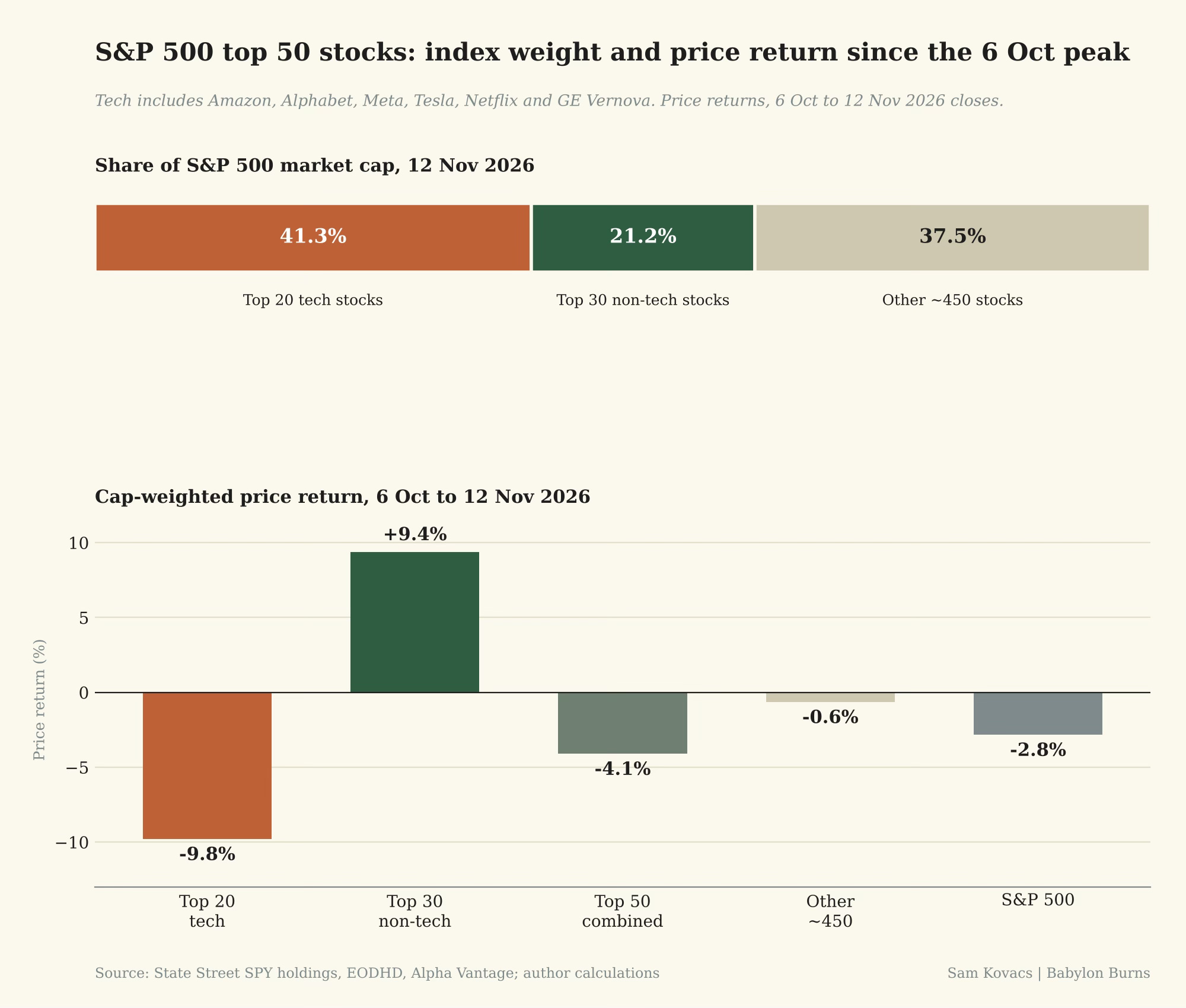
Now, what is interesting is that since the market peaked, these top 20 tech names are down 9.8% as a market-cap-weighted group, while the top 30 non-tech names are up 9.4% as a group. The remaining 450 are more or less flat, so we’ll exclude them from this analysis.
I like to geek out on a nice long chart, so below are all 50 of them and their performance since the S&P 500 peaked in October.
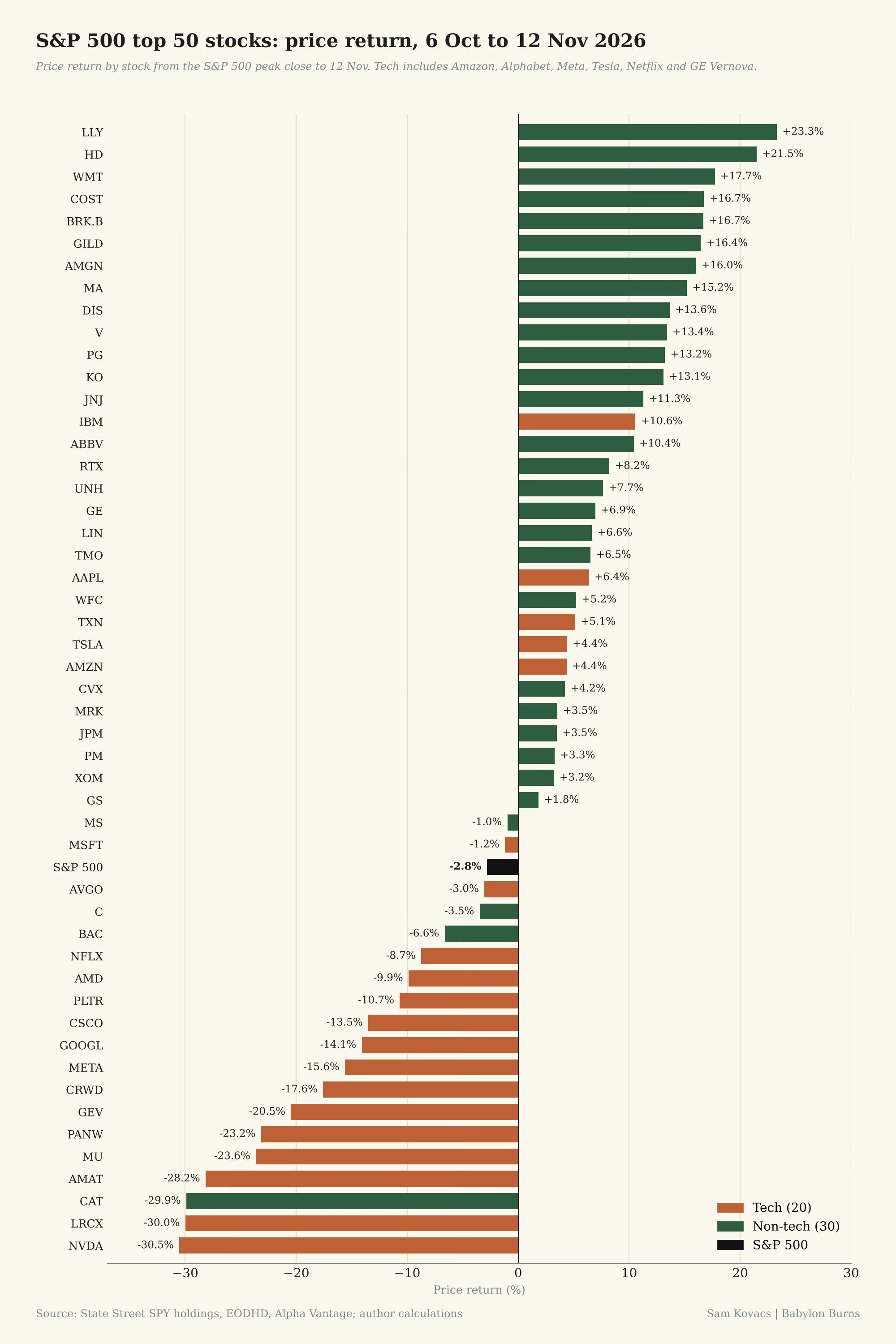
It doesn’t take a genius to realize that the index is holding up because money has rotated out of the tech names into the non-tech names.
Guess what leaders do? They lead.
In any bull market, it is the leaders that will turn first. The index is a lagging indicator due to these rotations. I hope that the chart above has shown you that, since the recent top, there has been a clear rotation underway. Whether this turns into a fully fledged bear market is still, of course, too early to call, but it is extremely important that we note what is going on.
Astute investors have been studying what happens when markets top for decades. In fact, Jesse Livermore described what the end of a bull market looks like in Reminiscences of a Stock Operator, which was published in 1923. He said that a market often stops being a bull market before prices in general (the index) begin to break. He said that we should be extremely concerned when leaders, one after another, fall from the top and, in his words, “for the first time in months, did not come back.”
And I’d argue that this has happened already in two stages. The first stage has been what I call the speculative unwind. Here, we can think of the unwind in the stocks which increased the most in percentage terms. If we look at all the stocks from our October 2022 lows until their peak this cycle and rank them by peak gain, 41 of the 50 biggest gainers are now in a bear market, which is commonly defined as 20% below the peak.
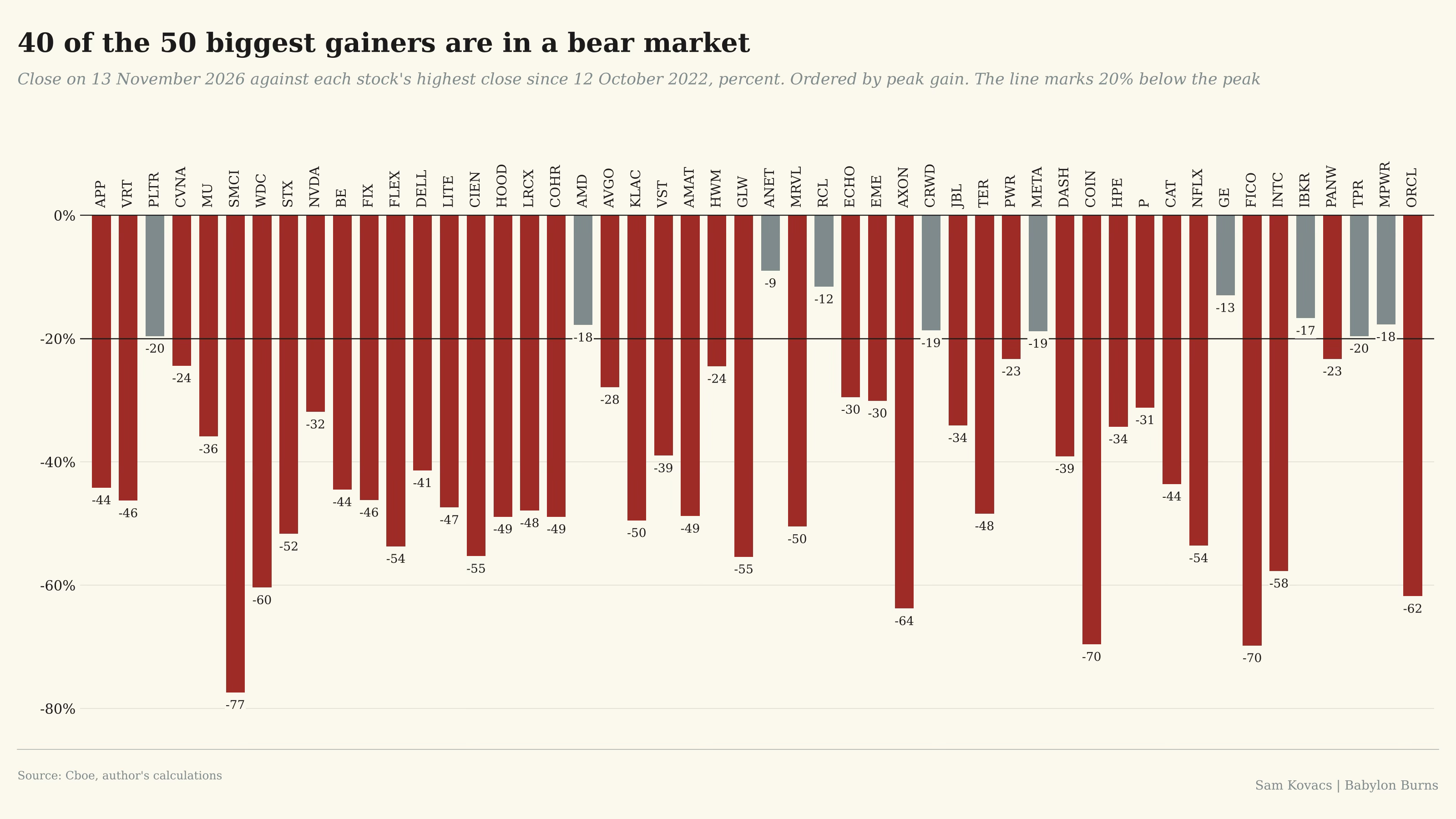
For a lot of these names, this peak happened over the summer.
We’re in a very curious environment where, right now, 80% of the 50 leaders of the bull market by percentage gains are in a bear market, while the index is only 3.2% below its record.
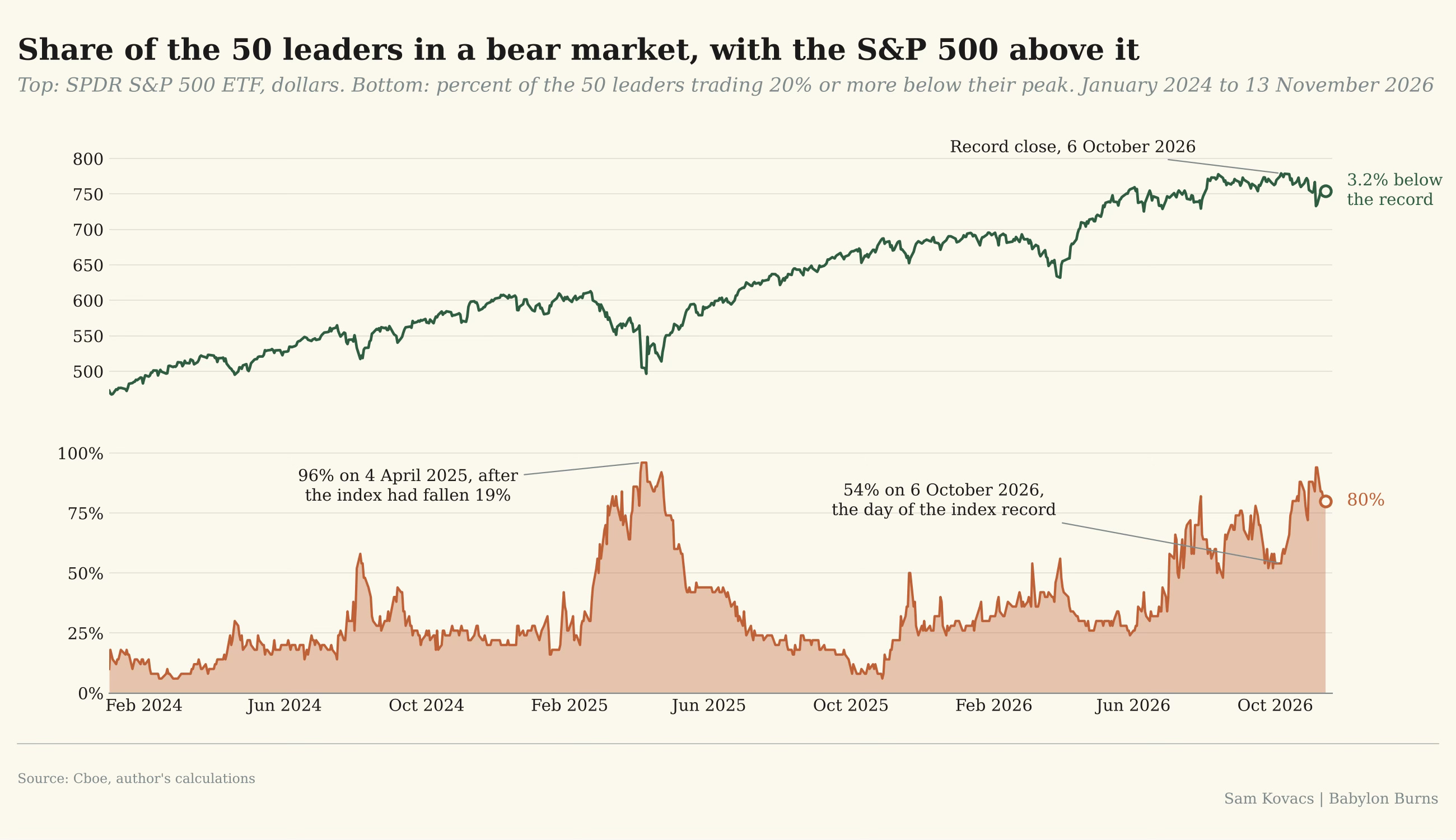
In comparison, 96% of them were in a bear market in April 2025, but this was after the index had fallen 19%. Right now, the index is only 3% off its highs.
We had the speculative unwind first, and now we are going through the market leaders’ unwind, what Jesse Livermore would have called the market generals. These are the stocks which gained the most, not in percentage terms, but in market cap. In many ways, this is much more significant. Of course, no one is going to argue with the fact that Nvidia is more important to the market than AppLovin is.
And three weeks ago, my view was the same as it was back in June: that this thesis was still incomplete because Nvidia hadn’t yet broken. Of course, as you all know, on November 5, I went short Nvidia, which was documented in an article, which you can read here, titled “Nvidia: When It All Falls Down.”
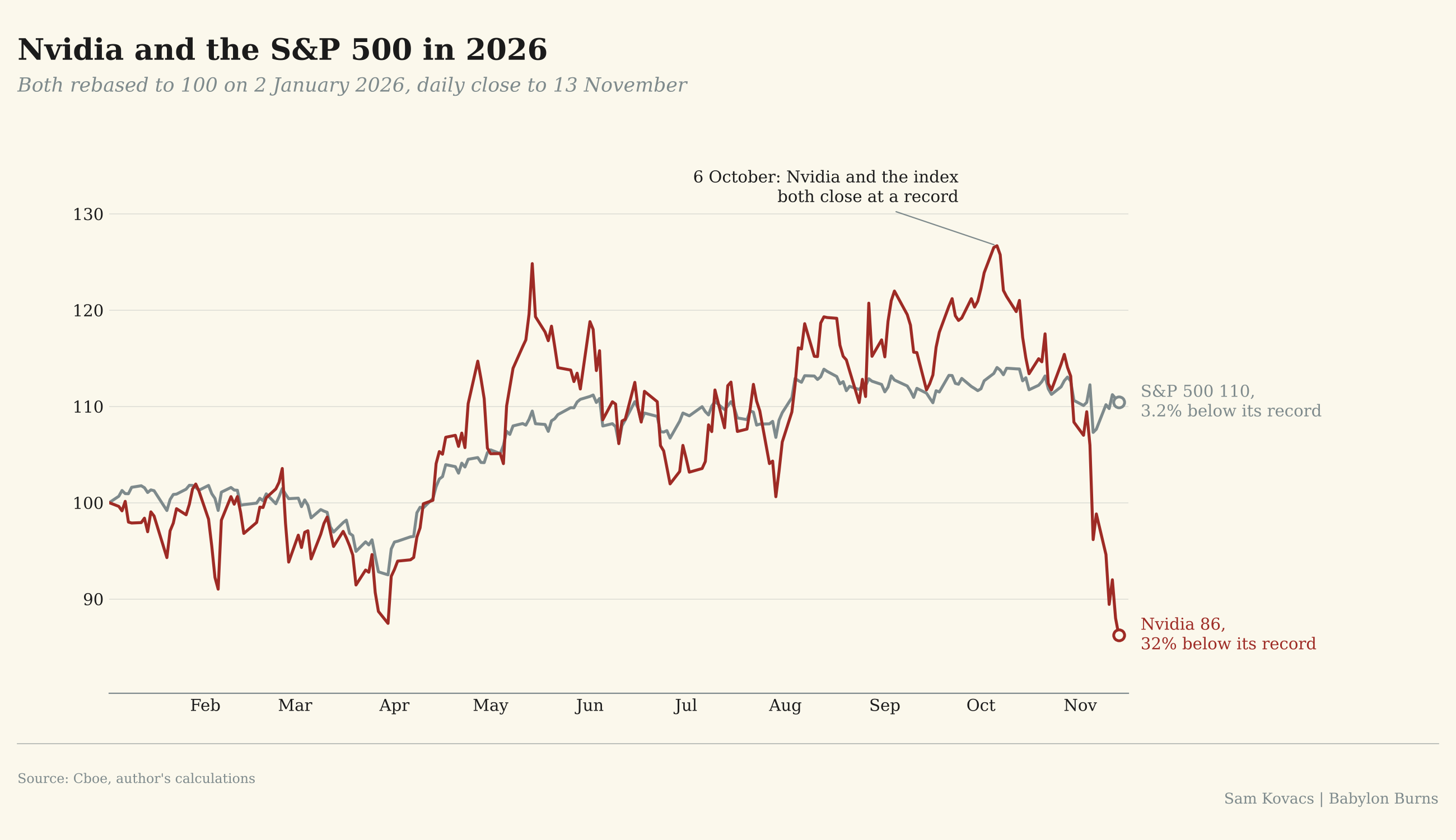
We have the absolute bellwether stock of the index, which is now 32% below its record and 20% below where we started shorting it.
So, an unwind of the leaders and a total collapse of the most speculative names is typical of market tops. The other part that you need in a market top is the exact price action we’re seeing right now in blue chips: the last stage of a great bubble. This comes from Jeremy Grantham’s work. He’s studied bubbles for five decades but gets mocked as a perma-bear for it because his critics are unable to analyze and depict the different stages of a bull market.
His work has highlighted that in 1929 and in 2000, the most speculative stocks had fallen about 30% before the market broke. This happens because, after the speculative frenzy, a shrinking number of very large blue chips keep going up, while the high-beta and momentum stocks lag and fall.
Of the 50 leaders above, 23 of them peaked early in the summer, and so I compared these to the 10 largest companies outside technology:
Berkshire Hathaway
Eli Lilly
JPMorgan Chase
Visa
Mastercard
Walmart
Exxon Mobil
AbbVie
Johnson & Johnson
Chevron
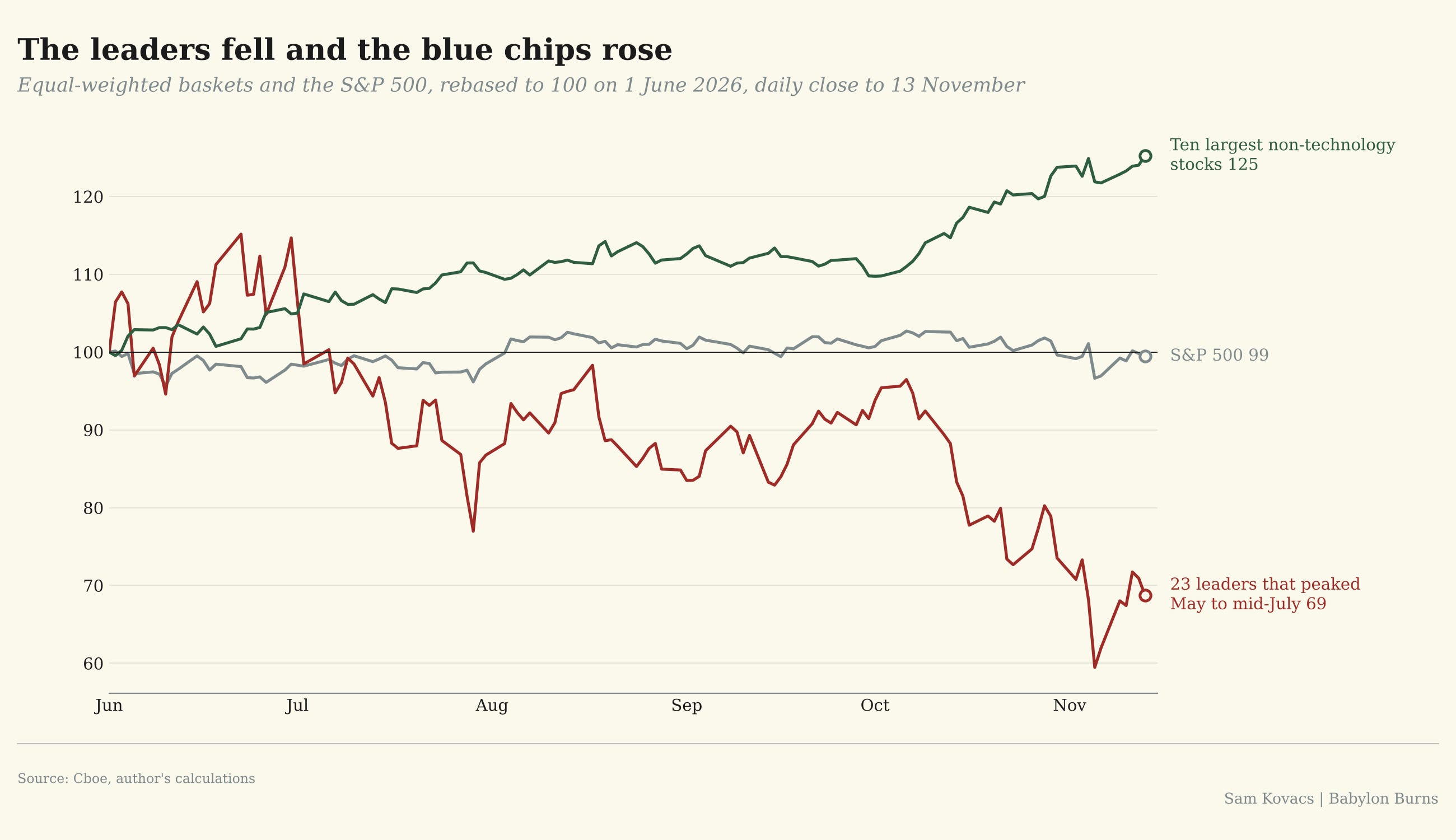
And you get the exact footprint that we warned about, where there was a progressive unwind first in June of the most speculative names. You can see how this has accelerated since the index peaked in October, in both directions. The most speculative stocks have accelerated their decline, whereas the 10 blue chip stocks have accelerated their ascent.
Now, of course, it is important for you to understand that this is just a question of flows. As money is exiting these stocks, which have acquired very large market caps during the past few years, the money that can get out has to go somewhere. The most obvious candidates are stocks with large enough market caps to absorb the volumes.
While this trend lasts, there are profits to be made by shorting the stocks which are among the last to fall and going long those which are still being bid up. It is extremely important that you do this in an astute manner because, sooner or later, the whole house of cards might come falling down.
We have taken positions that reflect this in the Babylon Burns portfolio, and they are already bearing fruit: the shorts have made money this week, and so have the longs. There is still upside to be had both ways if you haven’t entered these positions yet.