

Six years ago I put money into a business the market had already buried.
Everyone I respected thought I was an idiot. The company owned local television stations, and by 2020 owning local television was supposed to be a slow-motion funeral. Cord-cutting was real. The audience was aging. The obituaries wrote themselves, and the crowd had already moved on to anything with the word “streaming” attached.
The stock was Nexstar, ticker NXST, and I bought it at around $80 a share, as it was recovering from its pandemic lows.
I sold this year at roughly $180. That’s 2.25x my capital on the share price alone. Along the way the company paid me a dividend that started at $0.56 per quarter and finished at $1.86, so I collected close to $31 a share in cash while I waited, which is nearly 40% of what I paid, handed back to me in installments that grew every single year.
Add it up and I made about 2.6x my money in six years, a little over 18% a year compounded, on a business the smart crowd told me was dying.
Put $100,000 in 2020 and you walked out with roughly $263,000, and for the last stretch of the hold you were collecting a 9.3% cash yield on your original cost, still rising.
Nobody wanted it, and that was the whole point
Nexstar was boring, and it was tainted. Local TV carried a stink of decline that kept generalist money away, and the sell-side barely bothered to cover it.
The people who owned it were the people who’d owned it for years. That gap, between what a thing is worth and how it makes people feel, is where the whole game is played.
Because underneath it all, the economics were extraordinary. Nexstar converted a torrent of its revenue into free cash flow, held its leverage roughly steady, and did one thing with the cash, relentlessly, through good years and bad: It bought back its own stock.
In 2020 there were about 46.7 million shares. By the end of 2025 there were 30.7 million. The company retired roughly a third of its shares in five years.
If you shrink the share count by a third and the business simply holds its ground, each remaining share lays claim to a third more of the same earnings.
The stock can go “nowhere” for years, the pundits can keep reading the last rites, and the owner who does nothing but hold keeps waking up with a bigger slice of the same pie.
Add a dividend that more than tripled on top of that, and you get an 18% CAGR on a stock everyone left for dead.
If you can find a business which has:
Extreme cash generation, a relentlessly shrinking share count, steady leverage, and time, then shareholders are in an extremely good position.
That’s it. That’s the machine. It isn’t complicated, and it isn’t a secret, which is exactly why it keeps working: it’s too boring for anyone to get excited about.
All I had to do was buy a wonderful cash machine that the crowd had mistaken for a dying one, and then sit still while it ate its own shares.
I’m looking at the same setup right now
There’s a business I’ve been building a position in that rhymes with Nexstar so closely it’s uncanny.
The market has decided this company’s best days are behind it, that something younger and shinier is going to eat it alive, and so the crowd has walked away and left the price reflecting the fear instead of the facts.
It throws off an enormous amount of free cash flow. It trades at a low multiple against that cash. And management is doing the one thing I care about most in these setups: taking that cash and retiring stock, aggressively, while nobody’s watching.
The reason I won’t give you the name yet, or the industry, or a single identifying number, is that the full write-up is the work I do for the people who subscribe, and it isn’t fair to them to hand the whole thing away.
But I’ll give you the one difference that makes this better than the Nexstar trade, and it’s a big one. Nexstar really was in a declining industry. Local TV is shrinking, and I still made 2.6x my money because the buyback machine was strong enough to overpower the decline.
The business I’m looking at now is not shrinking. Whatever you want to believe about its growth rate, and the crowd believes it’s roughly zero, the underlying business has a real tailwind behind it and is not going away.
So I’m running the same play I ran on a melting ice cube, except this time the ice isn’t melting. The market is misreading a growing company’s cash-flow story as a dying one’s, and it’s pricing the two the same.
Why this is closer to arithmetic than to a bet
Forget growth for a second, the way I forgot it with Nexstar.
Take a business throwing off, say, a 10% free cash flow yield that spends most of that cash buying back its own shares.
Hold everything else flat, and the share count falls by something in that neighborhood every year, which means earnings per share climb by a similar amount before the company grows by one dollar. That’s the floor. That’s what you get if the business does nothing but exist.
Now put even mid-single-digit growth on top of a shrinking share count, and you’re compounding in the mid to high teens, from a starting multiple low enough that a re-rating alone could hand you a second engine of return. I’m telling you those numbers because they’re mechanical.
The one thing the arithmetic assumes is that the company keeps converting cash and keeps retiring stock at roughly the current pace, which is precisely what it’s doing and precisely what it did all the way through the years everyone ignored it.
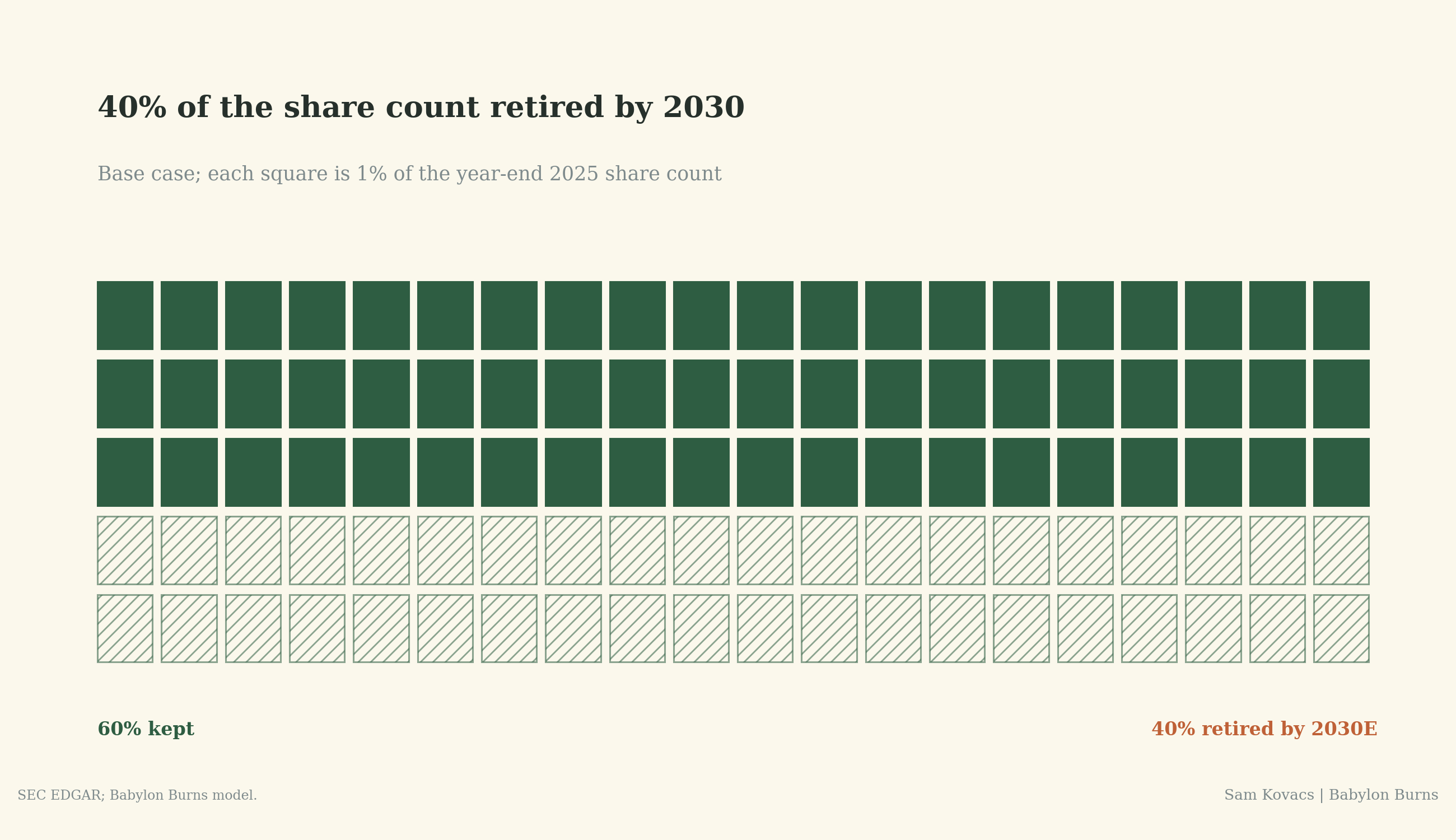
Wall Street has already written this company’s obituary. Nobody on the Street is going to get fired for avoiding a name everyone agrees is yesterday’s story, so the name stays cheap long after the story stops being true. I’ve made money on this setup time and time again: on a business the market had buried alive.
What to do about it
I’m putting my own money into this the same way I did with Nexstar, and I’ve written the whole thing up inside Babylon Burns: the company, the exact math, the price where the buyback engine does the heavy lifting. If you want to own the compounding machine before the crowd remembers it exists.
If you join today you can still benefit from our launch discount where you can join and lock in the price of $299 per year. On September 8th, that goes up to $399 per year.
I’ve been in this industry for a while now. I know how this goes. On September 9th, invariably, someone is going to email me asking for the discount, and the answer will be no.
I believe I’ve been very generous in giving away 2 months of content for free, and keeping a discount window open for 3 weeks.
If you’d rather not seize a good deal when life presents you one, there is not much more that I can do.
