

The Fed just raised interest rates into an oil shock.
Yesterday, Kevin Warsh’s Fed increased its benchmark rate by a quarter point to a range of 3.75%–4%, arguing that tighter policy would bring inflation back toward its target faster.
But households are already absorbing a hit to their purchasing power. The Fed is adding borrowing costs to an economy where fuel costs are already squeezing budgets.
So Kevin Warsh is risking turning a cost-of-living crisis into a jobs crisis.
In August, consumer prices rose 0.4% in one month and 3.4% over the year. Gasoline prices jumped 3.9% over the month and 27.4% YoY.
Gasoline alone accounted for more than a third of the monthly increase in headline inflation. Core inflation, excluding food and energy, was lower at 2.4% year over year although it still rose 0.3% during August.
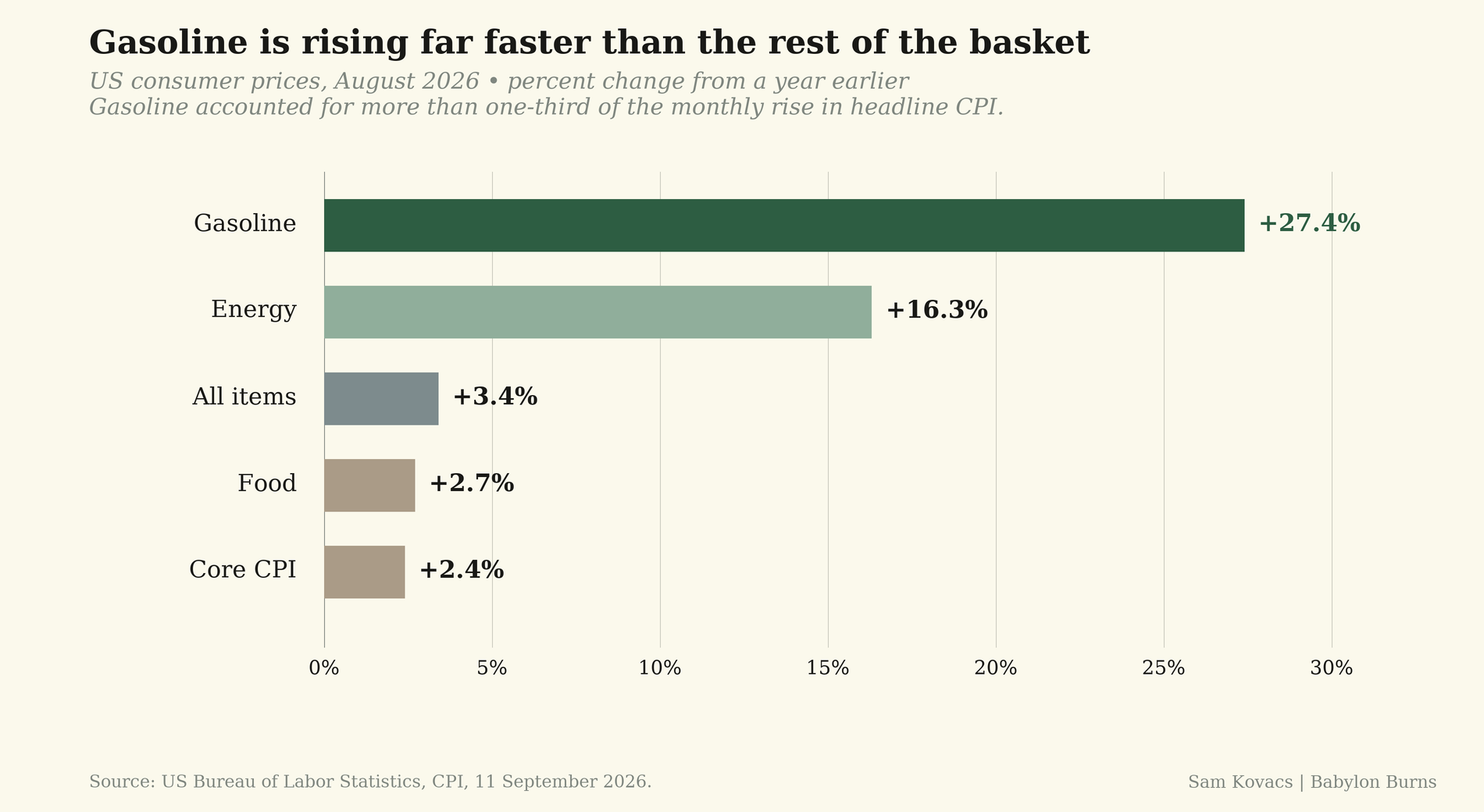
For a household buying the same amount of gasoline, a 27.4% price increase turns a $300 monthly fuel bill into roughly $380. That’s 80 bucks they’re not spending elsewhere.
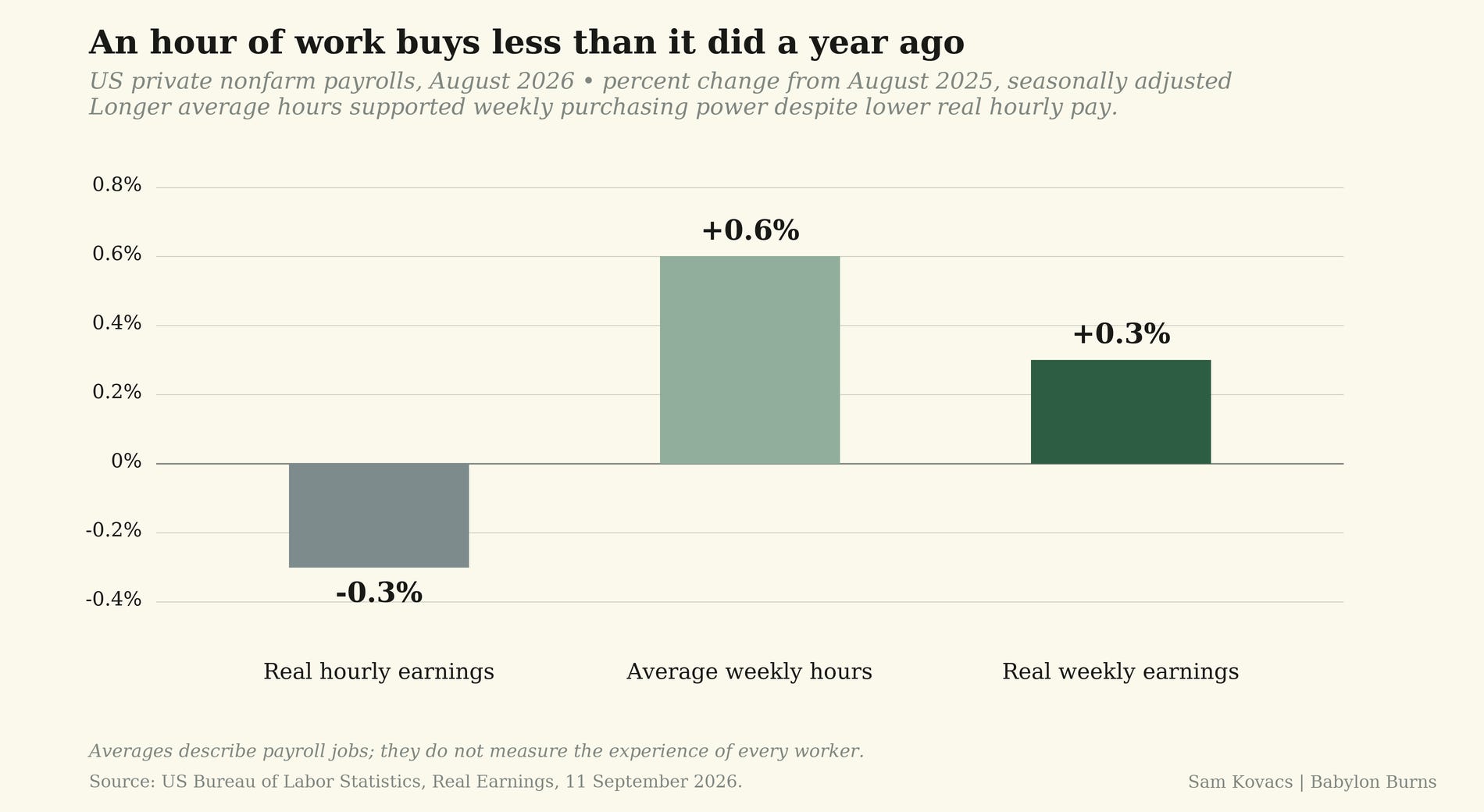
And purchasing power is already slipping. Real average hourly earnings fell 0.1% in August and were 0.3% lower than a year earlier.
Real weekly earnings were still up 0.3% over the year, supported by longer working hours.
Workers were, on average, working more hours to stay slightly ahead on weekly purchasing power while earning less per hour after inflation.
That pressure has started showing up in spending, although the evidence is still uneven.
Inflation-adjusted spending in July was essentially flat, following a 0.4% increase in June.
Spending in dollar terms rose 0.2%, but that increase largely disappeared once price changes were accounted for.
The personal saving rate was just 3%. However, real disposable income rose 0.4%, so this was a spending stall rather than an across-the-board collapse in household income.
August’s retail figures then delivered a rebound: sales rose 1.2% following July’s revised 0.5% decline. Sales excluding gasoline stations increased 1.1%.
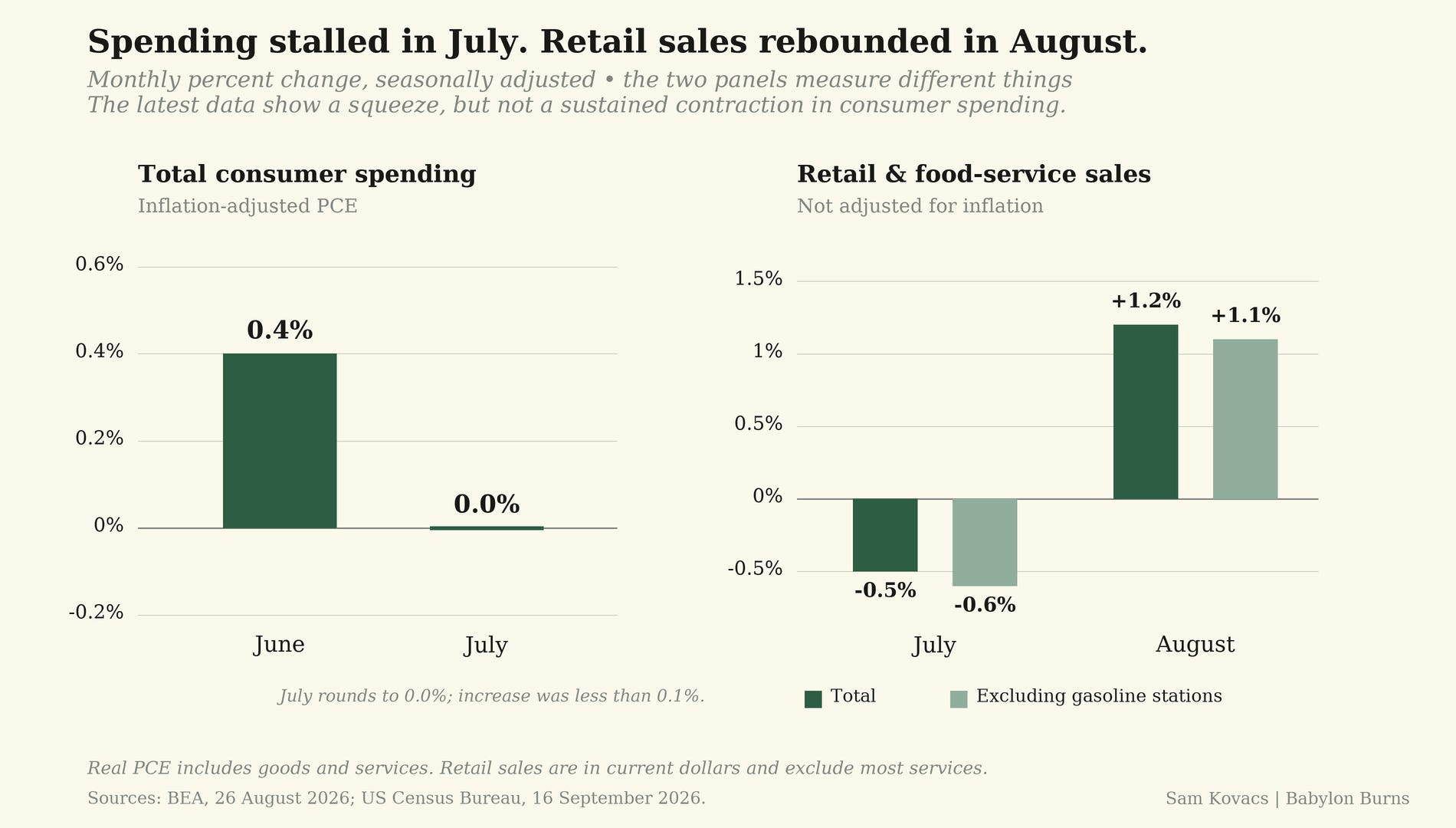
The evidence therefore supports a squeeze on purchasing power and an interruption in spending growth. It does not yet establish a sustained consumer contraction.
But that should offer us limited comfort.
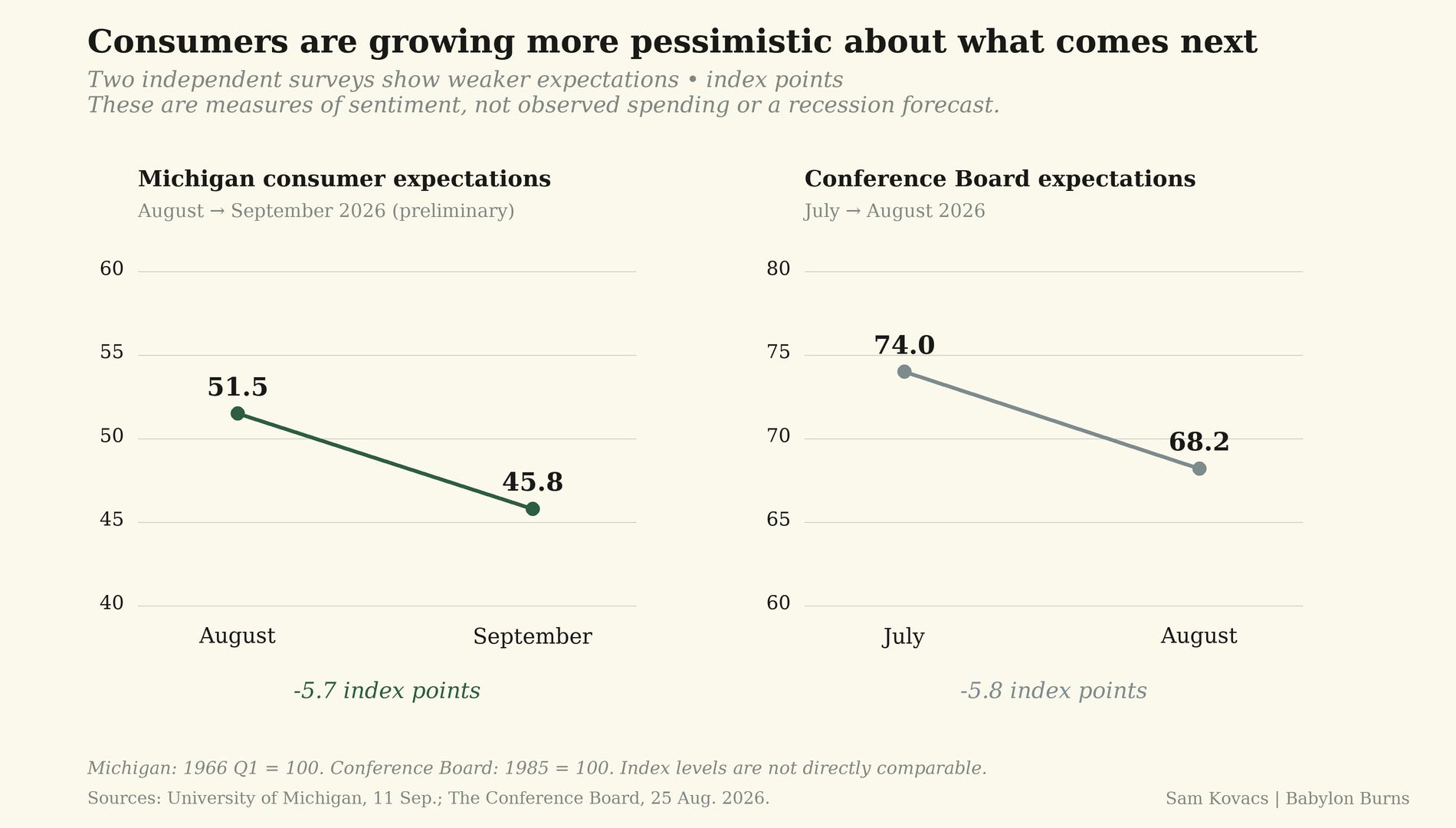
The University of Michigan’s preliminary September consumer sentiment index fell to 47.8, from 51.7 in August.
Its expectations index dropped 11.1% in a month. Consumers’ assessments of their future personal finances and business conditions deteriorated sharply, with the survey’s director pointing to renewed fuel-price pressure and trade tensions.
The Conference Board’s August survey told a similar story. Its expectations index fell to 68.2, from 74.0.
Fewer consumers expected their incomes to rise, and more anticipated fewer available jobs.
The New York Fed supplied another warning: the average perceived probability of missing a minimum debt payment within three months rose to 13.2%, up 1.2 percentage points.
Households also reported worsening financial situations and harder access to credit. These are expectations and perceptions,, but they show pressure building before this latest rate increase.
Now add the rate channel.
Higher rates increase interest costs on variable-rate debt and make new borrowing more expensive. Existing fixed-rate mortgages do not suddenly reset. The pressure falls on revolving credit, adjustable loans as they reset, new borrowers, and businesses refinancing debt or funding expansion.
Businesses then face weaker customer demand alongside higher financing costs. Expansion becomes harder to justify. Hiring slows. Overtime gets cut. When revenues cannot cover costs, jobs go.
Your employer needs customers who can afford to spend. This connection between borrowing costs, spending, and employment is precisely how monetary policy works.
In 2006-08, they stopped hiking into the oil crisis.
The Fed’s previous tightening cycle ended in June 2006 at 5.25%. It held that rate until September 2007, then began cutting. There were no Fed rate hikes in 2007, in part because the oil shock intensified.
Average US regular gasoline prices rose from about $2.33 a gallon at the beginning of 2007 to $4.11 in July 2008.
The recession began in December 2007, before the autumn 2008 financial panic.
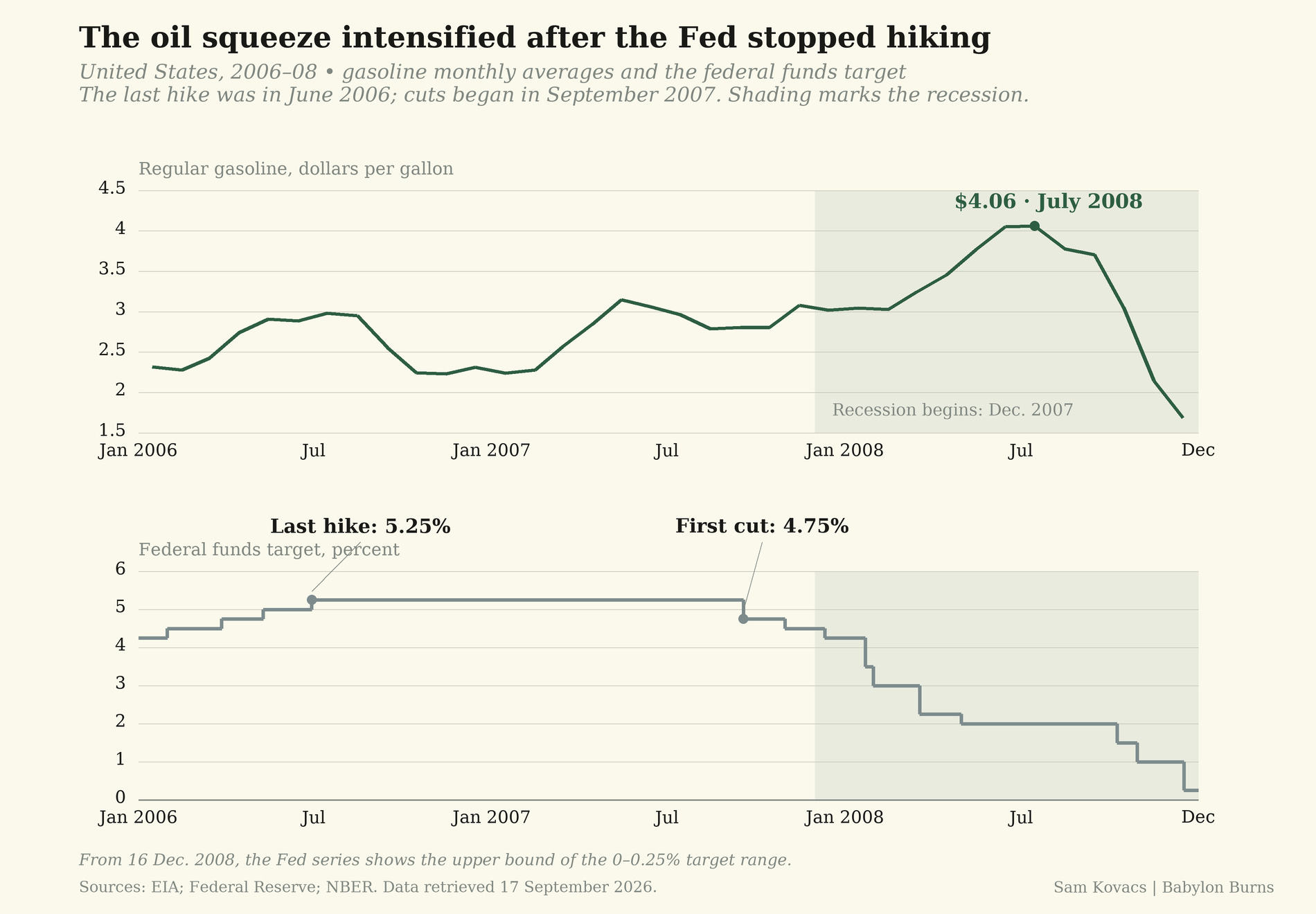
The 2007–08 oil shock materially weakened consumption, particularly purchases of domestic automobiles, and contributed to the recession.
The lesson is that expensive energy can deepen a slowdown even after the Fed starts easing. Households cannot instantly undo higher fuel bills, existing debt burdens, or lost purchasing power.
Preventing an energy shock from spreading into persistent inflation is a legitimate policy objective
But that does not eliminate the cost of the response.
A rate hike doesn’t produce a single barrel of oil. It restrains spending and financing across the economy while households are already paying more for necessities.
I say it’s like whacking the economy twice.
The warning signs are visible: falling real hourly pay, July’s spending stall, deteriorating confidence, and greater anxiety about meeting debt payments. August’s retail rebound shows consumers still have spending power… for how long?
Oil squeezes the household budget. Higher rates squeeze borrowing and business activity. Push both far enough, and the adjustment moves from what people can afford to whether they still have a paycheck.
That is the gamble the Fed is taking with Americans’ livelihoods.
We’ll stay nimble and positioned for this as always…
As Babylon Burns, we’ll light the cigars
PS: Thanks for reading this! I have one small ask from you:
If you enjoyed this free article, please click the Subscribe button below. You’ll receive my analysis straight to your inbox. While my actionable stock picks and insights are usually reserved for paid members, I believe you’ll find I’m rather generous in handing out analysis and insights for free.
In a world where you don’t know who to trust, turning towards honest, hard working individual analysts is the right decision.
If you want to know how the Fed’s decision is impacting our portfolio and my positioning, Sign up today. I give actionable insights on how I trade the market in this environment.
I’ll be publishing new stock picks tomorrow and Monday, you don’t want to miss them out!
