

THIS REPORT IS GIVEN TO YOU FREE OF CHARGE. ENJOY IT FROM START TO END. IF YOU ONLY READ ONE REPORT ON LABOR DAY, MAKE IT BE THIS ONE.
In an investment note I wrote on January 16th to a hedge fund client who was asking about silver, I said:
Euphoria and overheating has historically led to compressions in the ratio, followed by correction across the board in precious metals. It is my belief that precious metals are likely no longer the best risk adjusted trade here.
Because of its high beta to gold, silver is at best a tactical play, one which seems now mostly done. Sure. another leg higher is always possible as flows squeeze it, but the general sentiment should be understood to be closer to the final innings than not.
The price per ounce squeezed a hard 30% over the next 2 weeks before topping out.
Yet, as members of Babylon Burns are well aware, during the past couple of weeks I have initiated a silver position and added to it in the past week.
Why?
This is what this report will look at in detail.
I’m making this report 100% free.
This report gives you yet another taste of what to expect when you join Babylon Burns.
Silver stock to flow
When we think of a scarce asset like silver, it is important to distinguish two inputs to supply which will meet demand.
First there is the price of the flow, which has an economic clearing price based on whatever it costs to get an ounce of silver out of a mine or a recycling furnace.
Then there is the price of the stock, which is what it takes to persuade someone who is already holding an ounce of silver to give it up.
Every year the world uses more silver than it mines and recycles: 1.13 billion ounces against 1.09 billion in 2025, a gap of 40 million, forecast at 46 million this year.
The stock of silver is quite large compared to its flow (8-19x depending on how you want to count), and more importantly it’s massive compared to the annual deficit.
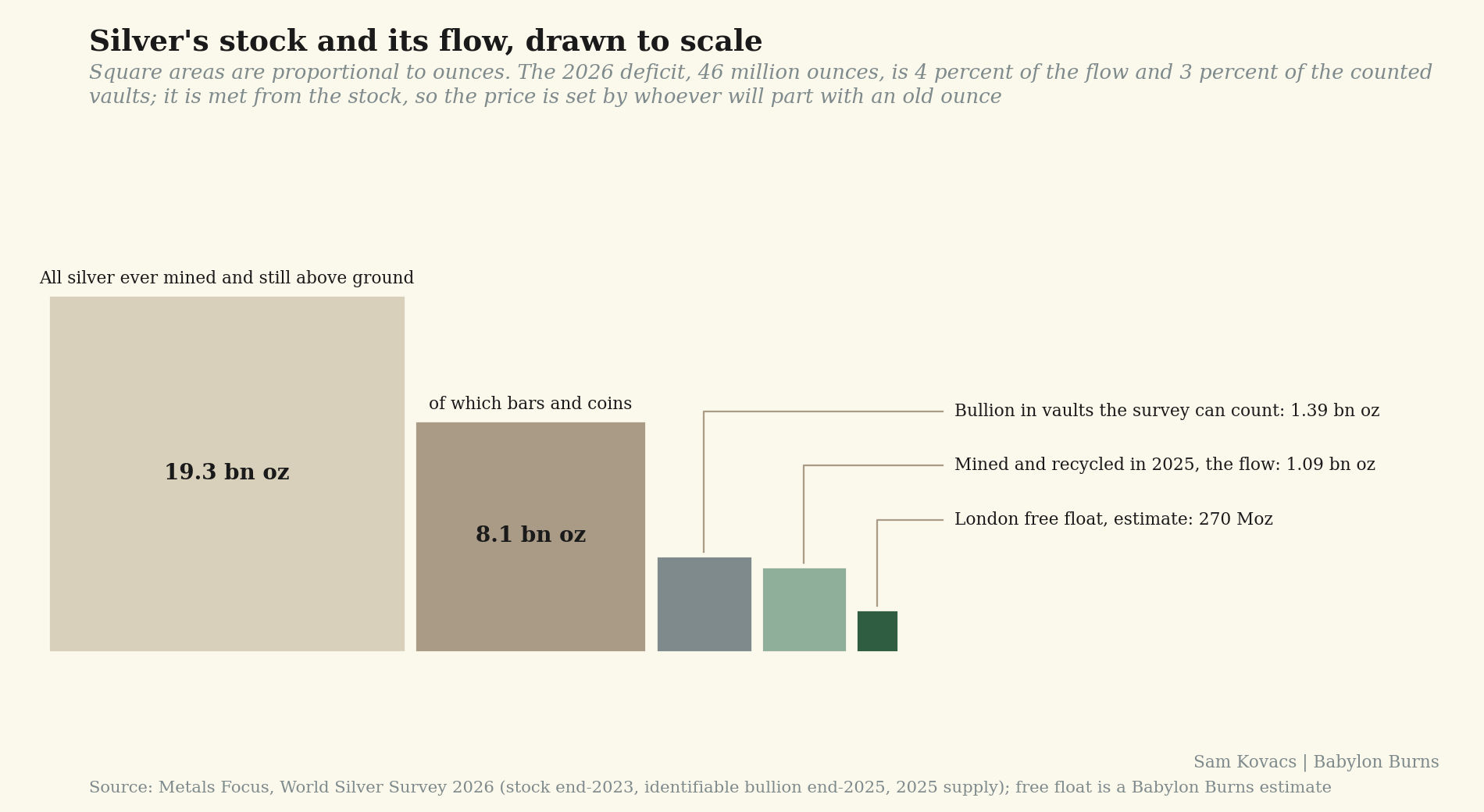
The World Silver Survey, which is issued every April, counts 19.3bn ounces of silver above the ground, of which 8.1bn are in bars and coins, of which 1.4bn are sitting in vaults.
A 46mn ounce deficit is 4% of one year’s flow of 1.09bn ounces, or 3% of the stock that is visible in vaults.
Given the massive stock, it is the nature of the silver holders which impacts the clearing price much more than the miners and producers.
Understanding who were and are the holders of silver is the foundational level of our analysis.
Who the sellers were
To understand how we accumulated such a large stock of silver, we need to take a little trip down history lane.
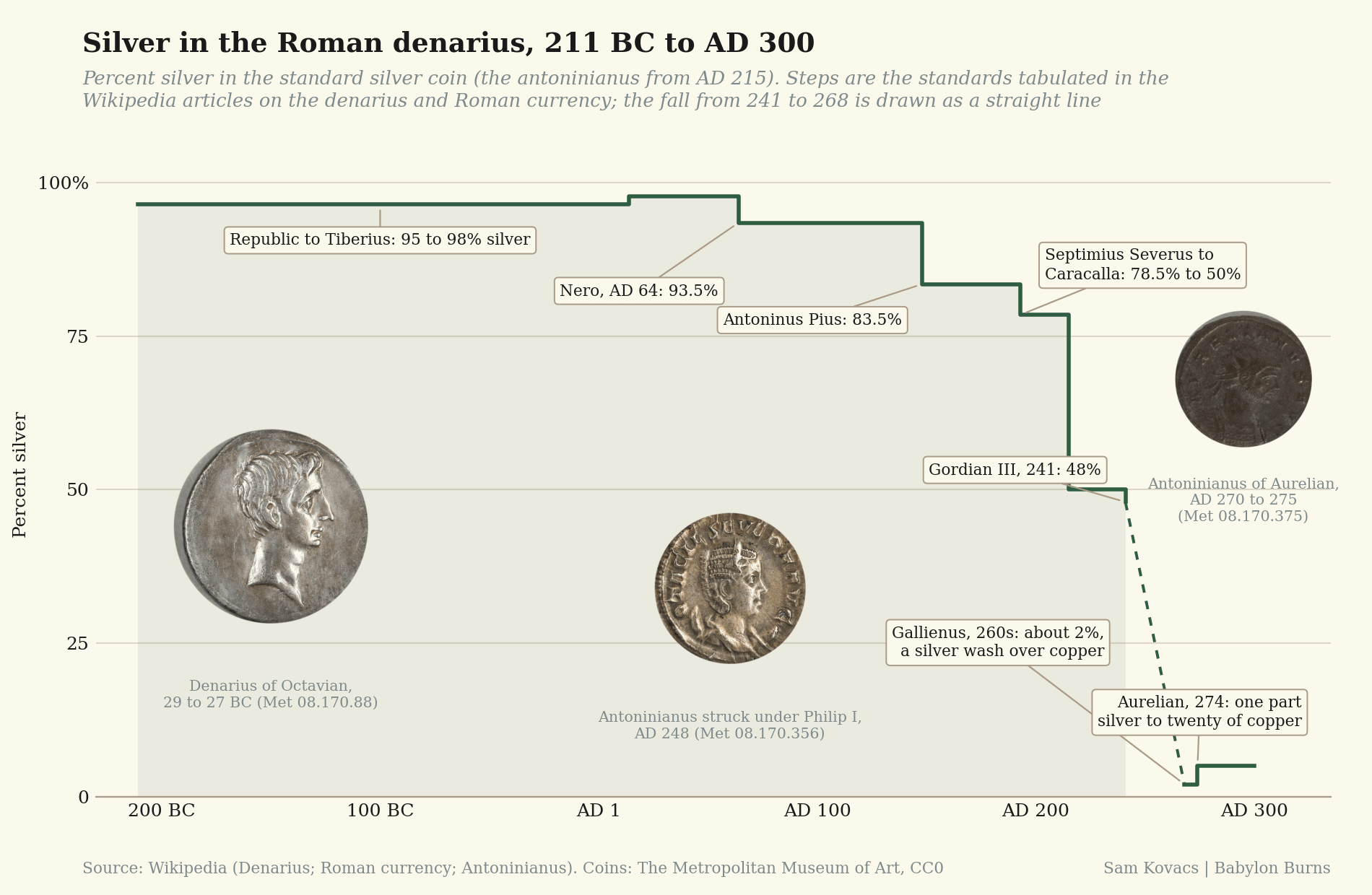
For a very, very long time, silver was money. Rome ran its empire on the denarius, before undergoing 250 years of debasement, gradually taking silver content out of its coinage and replacing it with copper washers.
Spain plundered Bolivia’s Potosi mine in 1545 and minted the silver into the “piece of eight”. It shipped so much of it to China, that the Ming rebuilt their entire tax system around it.
When the United States created their dollar in 1792, Congress defined it as 371.25 grains of silver and set gold at 15x the value of silver. (As a reference it was around 12x in Rome).
Over the world, and for over 2000 years, the ratio between gold and silver was set by law. Everyone held silver as savings.
Then, in no time at all, the world decided it was done with silver. After defeating France in 1871, Bismark’s unified Germany moved away from silver backed coinage and bought gold for its new Gold Mark.
The US dropped its silver dollar in 1873, India closed its mints to silver in 1893, and China was forced off of it in 1935 after the US bought silver at an sbove market price and drained China’s coinage out through its ports.
By then, every major country had demonetised silver, which left the world holding a monetary quantity of a metal which happened to no longer be a money.
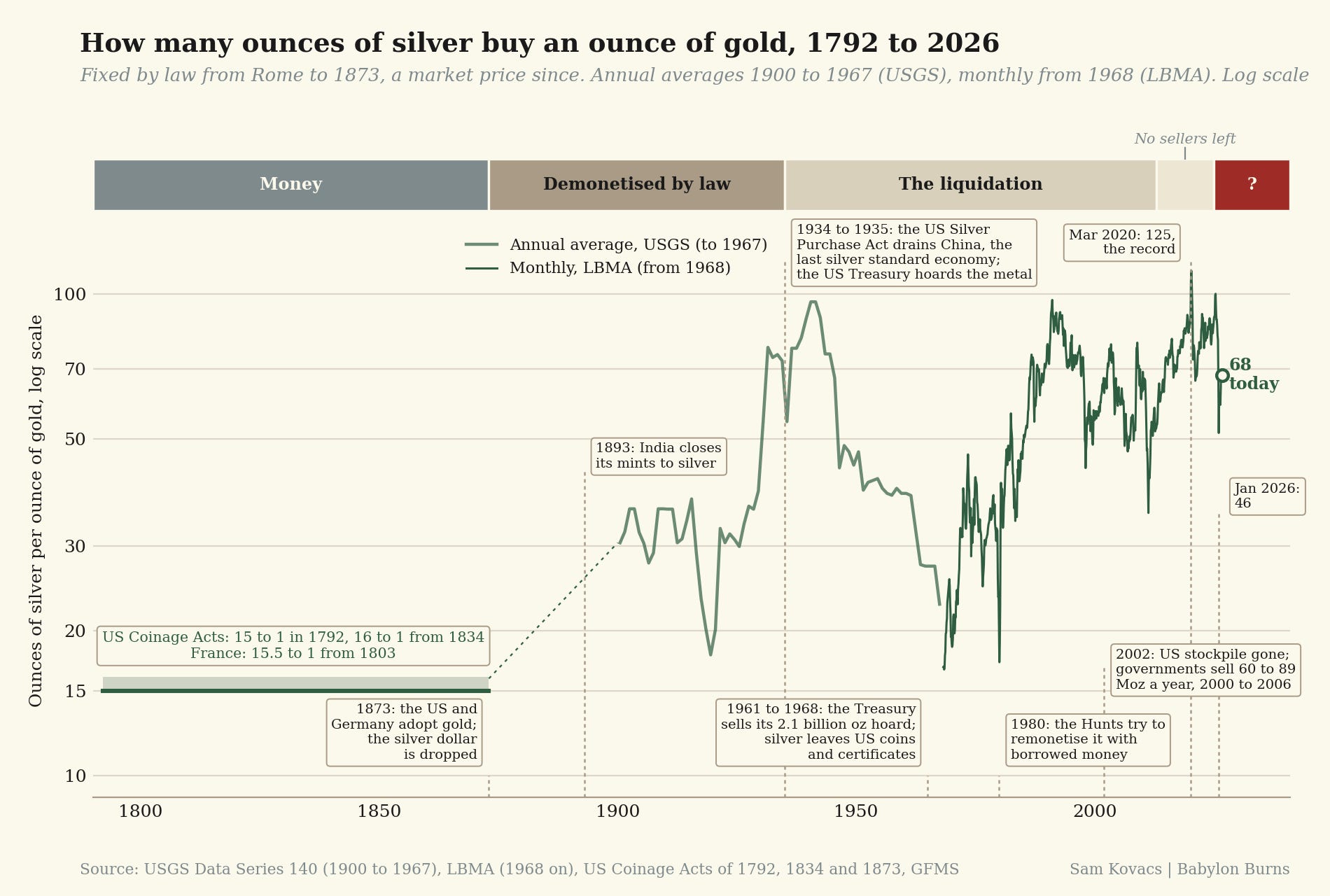
Demonetizing silver pushed the gold to silver ratio from 15 to 30 by 1900, and nearly 100 by 1940.
We effectively witnessed the market repricing something which had lost its use. For the next 90 years, by and far, the supply of silver was institutions getting rid of a metal they no longer wanted.
The US Treasury, which had bought the world’s silver at above market prices, held 2.1bn ounces of it in 1958, and started selling from 1961. They took silver out of the coins in 1965, and stopped redeeming certificates in 1968. They emptied their stockpiles, until it was empty in 2002. By the time it, and other governments were done pressuring the price of silver, one of the largest industrial source of silver demand was disappearing: photography.
In 2000, photography demand for silver was a quarter of all silver fabricated that year, or 218mn ounces. Today the industry only uses 24mn ounces. The drop of 194mn ounces in demand is equivalent to adding a country larger than Mexico, the largest producer on earth.
So silver remained cheap: It underwent decades of governments liquidating their stock, and then of demand being curtailed.
In many ways, the marginal seller was indifferent to the price, they just needed to get rid of it.
But these sellers are gone. Government sales were 1.5mn ounces last year, down from 89mn in 2003. The demand destruction of photography has flatlined for years and won’t drop any further.
The stockpiles of indifferent sellers are now empty. Those who still hold silver today absolutely do care about the price.
Who is selling now
As you might remember, there is 19bn ounces of silver above ground, of which 8bn is in bar and coin form, and less of that still is in vaults.
So we can use the World Silver Survey’s market balance, subtract what went into exchange traded products, and we can infer the amountt the market had to draw from the non visible stocks on earth.
And we know more or less what price was paid to acquire this silver.
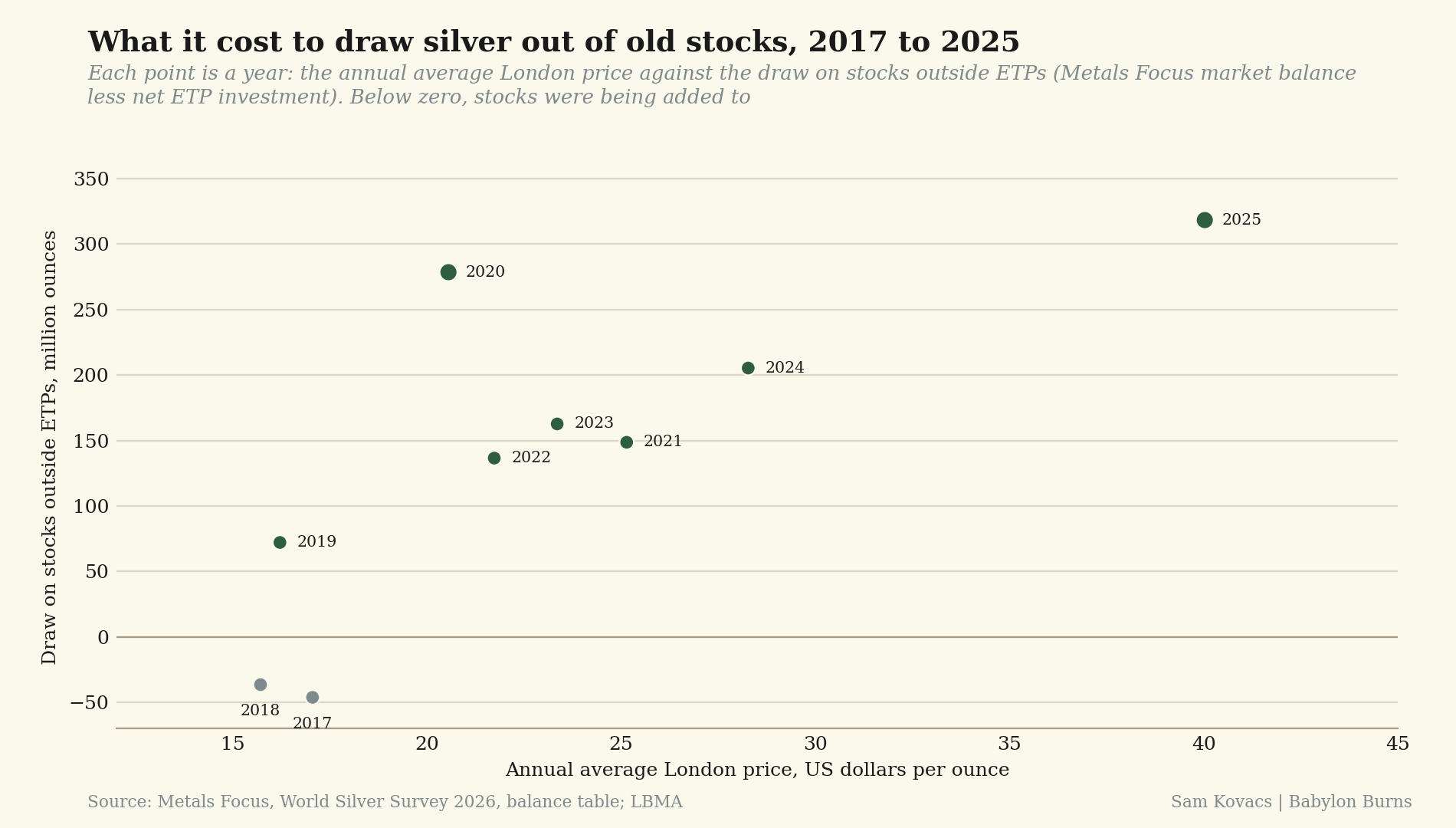
In 2020, the market drew 279Moz at an average price of $21. From 2021 to 2024 it drew between 137Moz to 205Moz a year, at a price of $22-$28.
In 2025, it drew 318Moz and paid $40 for it.
We can infer from this that the supply curve of silver holders has changed, from the indiscriminate sellers, to those who are interested in the price they get for their asset.
The mines aren’t stepping up.
Usually when a price goes up like it did between 2024 and 2025, new supply comes online to absorb the higher prices.
When it comes to silver though, the market doesn’t respond so cleanly because 3 quarters of the silver which is dug up is a byproduct of lead, zinc, copper, and gold mines.
These mines are making decision of what to dig based on the price of those metals, and silver is just a credit to their business. For example, Chile, which is one of the largest producers of silver on earth , gets nearly none of its silver from mines that were actively mining for silver.
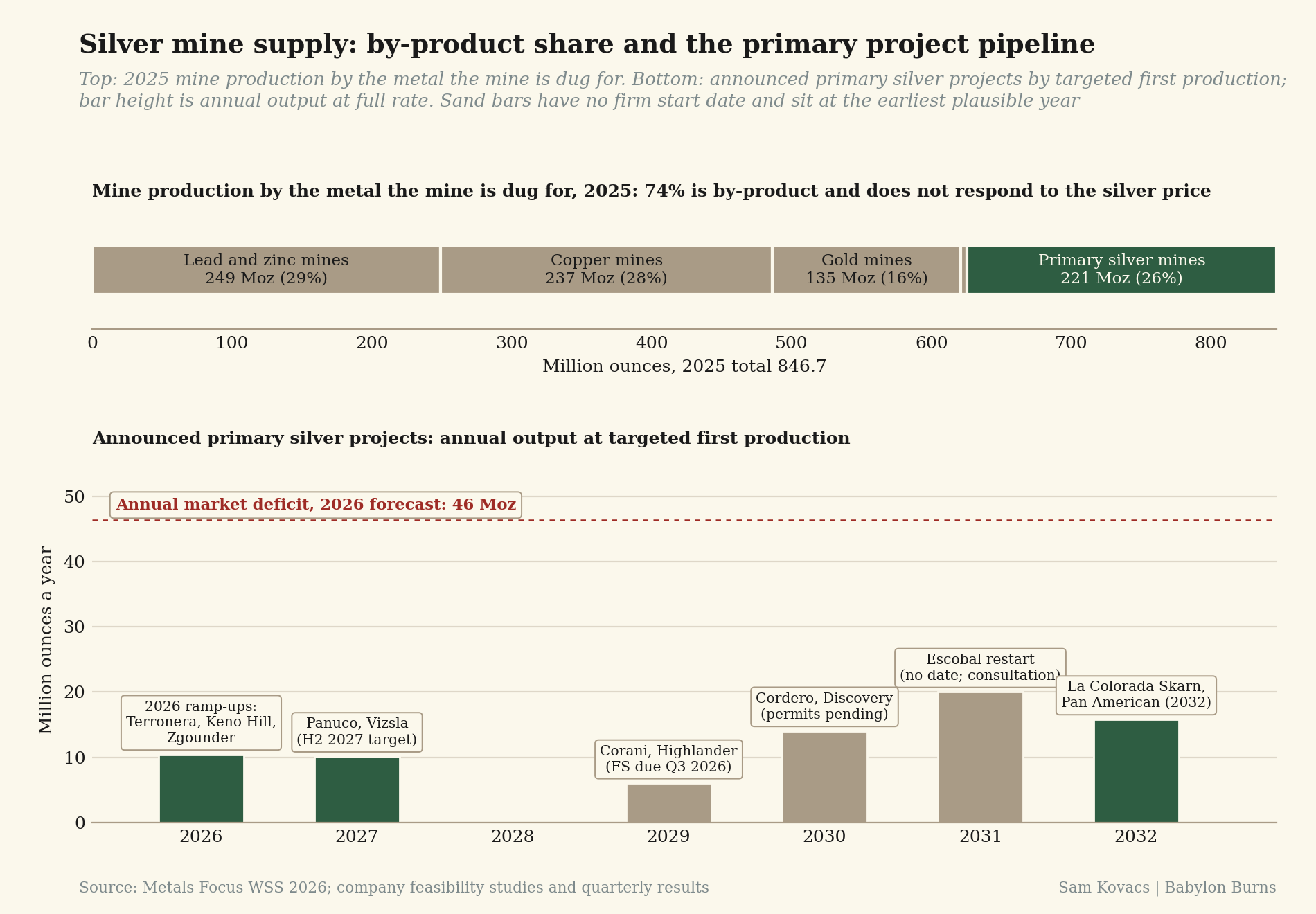
The quarter of production which is primarily silver hasn’t responded either. Primary miners all in cost was $12.21 in 2025, which at the current prices is a 81% margin, yet their output still fell for the third year running.
Fresnillo, the largest silver miner in the world, cut its guidance in January and reported first-half output down 11% on thinner ore; the grade at South32's Cannington mine in Australia fell 18%; the biggest byproduct channel, lead and zinc, was forecast to grow 2% this year but instead shrank 3% in the first half.
The pipeline is thin and late: Panuco in Mexico, 10 million ounces a year from late 2027, is the only large primary project with a firm date before 2030, and Pan American's La Colorada Skarn will produce 16 million ounces a year from 2032 at a cost of minus $22.67 an ounce after its lead and zinc credits. The best new silver mine in the world will produce silver for less than nothing and cannot deliver an ounce for six years
And the cushion for pricing is thinning.
What’s more, the float of silver which gets traded to price the metal is thin and only a third of what it was a few years ago.
London Vaults hold about 907 million ounces, but two thirds of it belongs to ETPs. The market that sets the price every day runs on the rest, the free float.
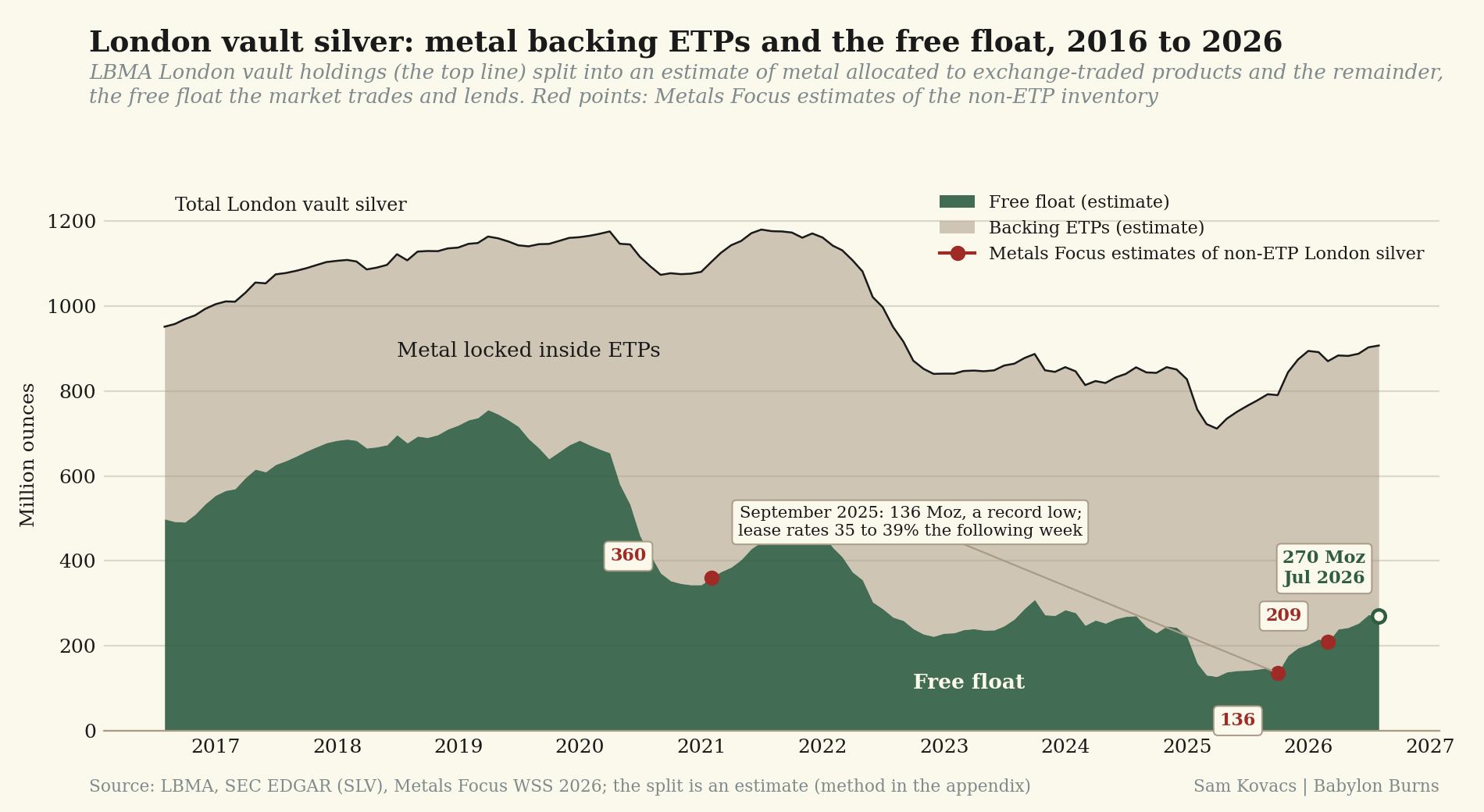
It was nearly 700 million ounces in 2019. Then 331 million went into ETPs in 2020 and the deficits began, and by early 2021 Metals Focus put it at 360 million.
Every ounce that goes into an ETP is removed from the float without leaving the building, so investment demand does not just consume the deficit; it consumes the cushion that lets the deficit go unpriced.
By September 2025 the float was 136 million ounces, and the market found out what that means: lease rates, the cost of borrowing silver, went from under 1% to 35%-39% in a week.
When mining supply won’t move, indiscriminate sellers have left, and the float is thin (1.5 days of turnover today), then you have a market where a return of buyers set the price.
January was the perfect example of this.
By the end of 2025, Silver had doubled from the year before, and this drew in the speculative crowd. And it caught a bid. The retail crowd came in, and they came in big. They used leverage, and micro silver futures set volume records. The exchange launched a 100-ounce contract “to meet record retail demand”.
Options positioning reached 4 or 5 standard deviations above normal. India, which is the largest physical silver market on earth, purchased 147Moz of investment silver in 2025, of which half was through domestic ETFs which didn’t exist a few years earlier.
Silver went from $50 in October to $121 on January 29th.
The silver market is thin enough that it can be squeezed by retail investors only.
Of course, Kevin Warsh was named Chair of the Federal Reserve on the 30th of January, COMEX raised margin requirements, and SLV, the largest silver ETF, witnessed $3.5bn of forced selling in a day.
Silver fell 30% in a single session and 54% in under six months.
An interesting aspect of the crash in January, is how the physical market in SHanghai has adapted since.
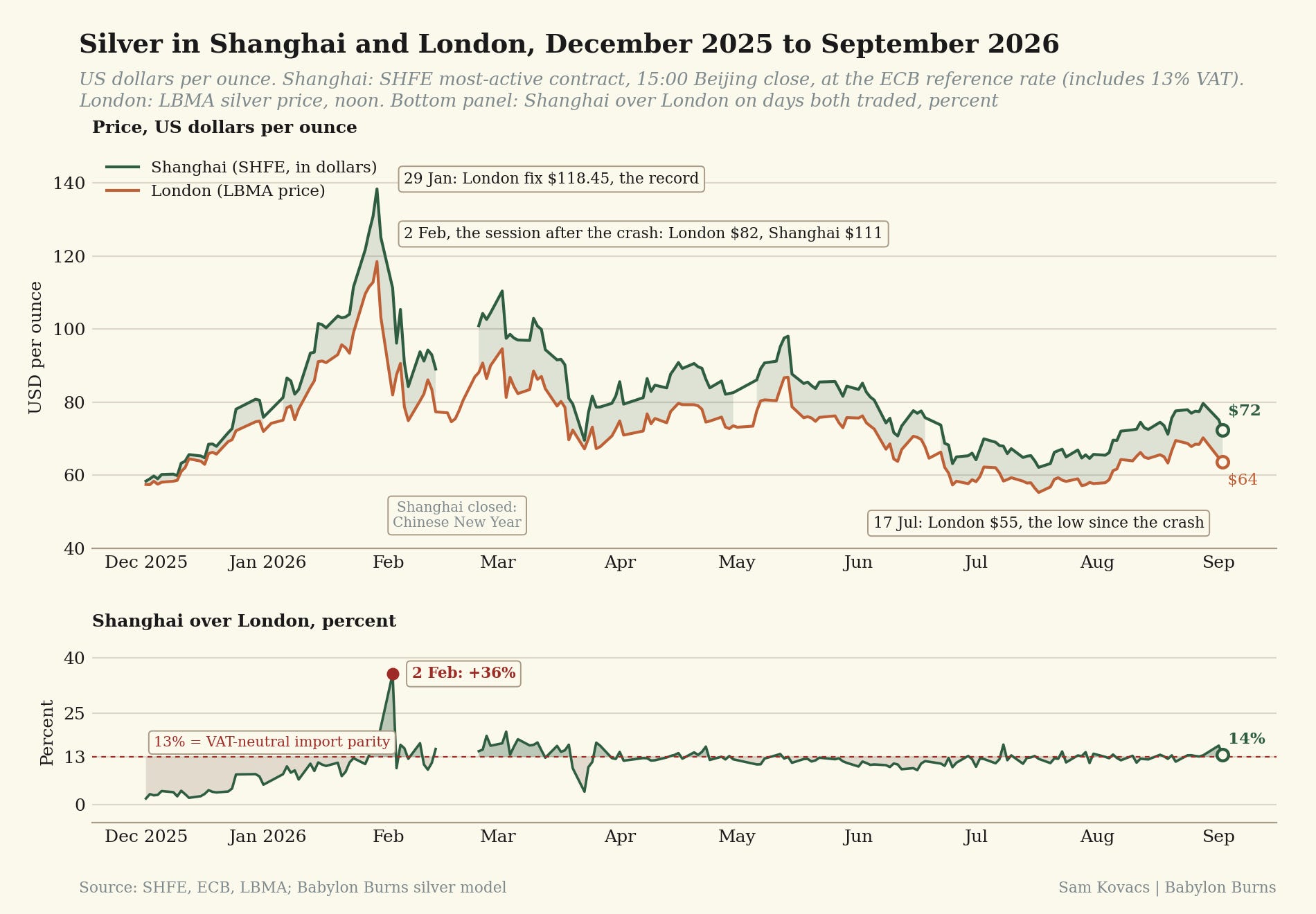
Shanghai is relevant because its price is the one which refiners and households trade actual physical silver at. There is a 13% VAT which is a structural added cost to the London contract.
Prior to the paper squeeze, Shanghai was trading at a net discount to London when the VAT parity is considered. After the squeeze, it has remained within a 10-14% band, which is to say trading fairly. This is also a suggestion that the market is physically tighter than it was, as it is the buyer and not the seller who is eating the VAT.
Another way to think about it, is that below a 13% premium, nothing is being imported into China, as its not worth it. Into the crash and after it, there has been a marginal economic case to import Silver into China.
At the time of the crash, Managed money (think hedge funds trading futures), was net long only 38Moz in the weak of the peak, which was nearly nothing against the 500Moz at the 2017 high.
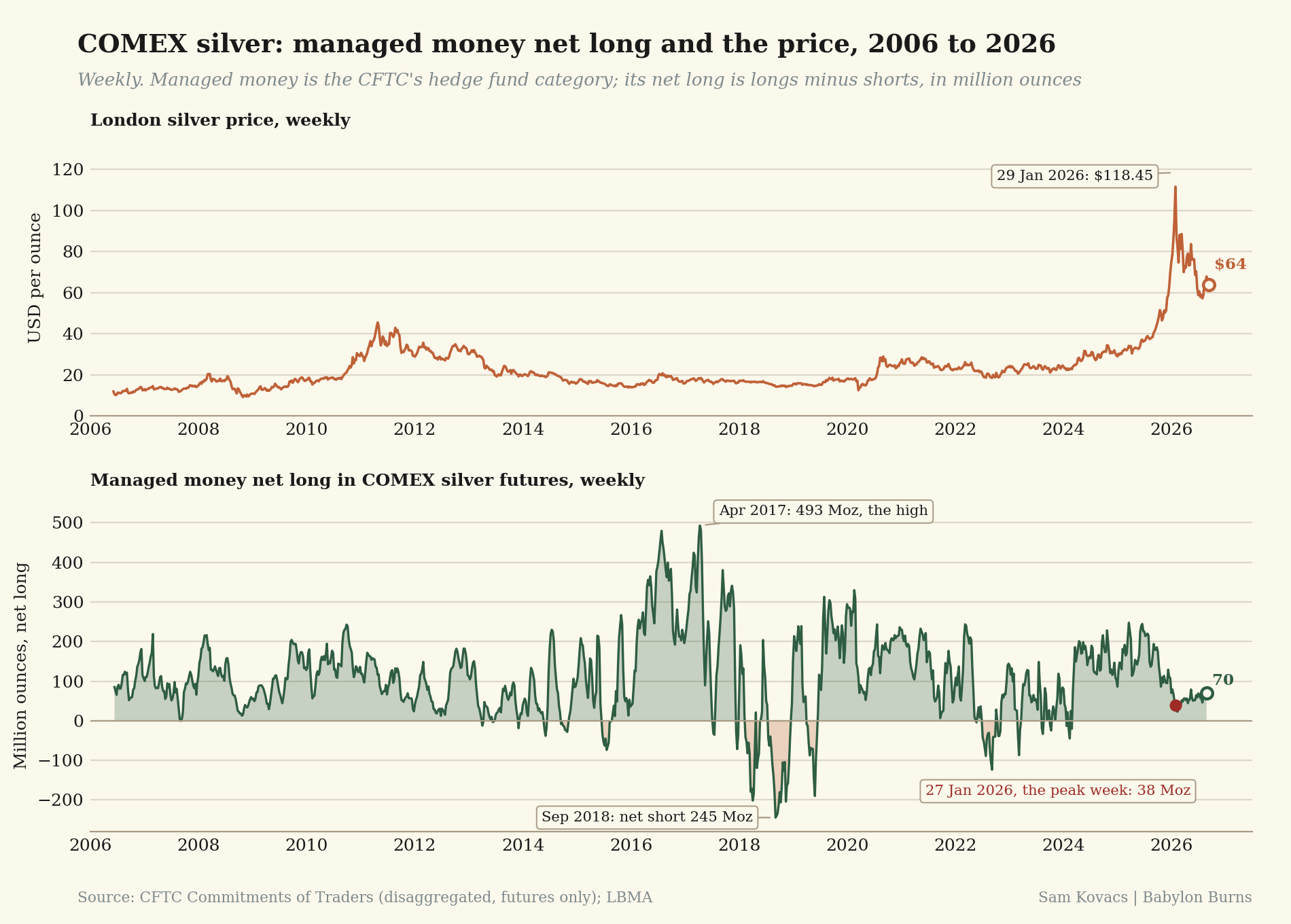
The speculative bid has mostly left the scene now. Open interest is down a quarter from January, and the non-US banks, who carry the structural short against the physical market, have cut their shorts from 262Moz to 132Moz in a year.
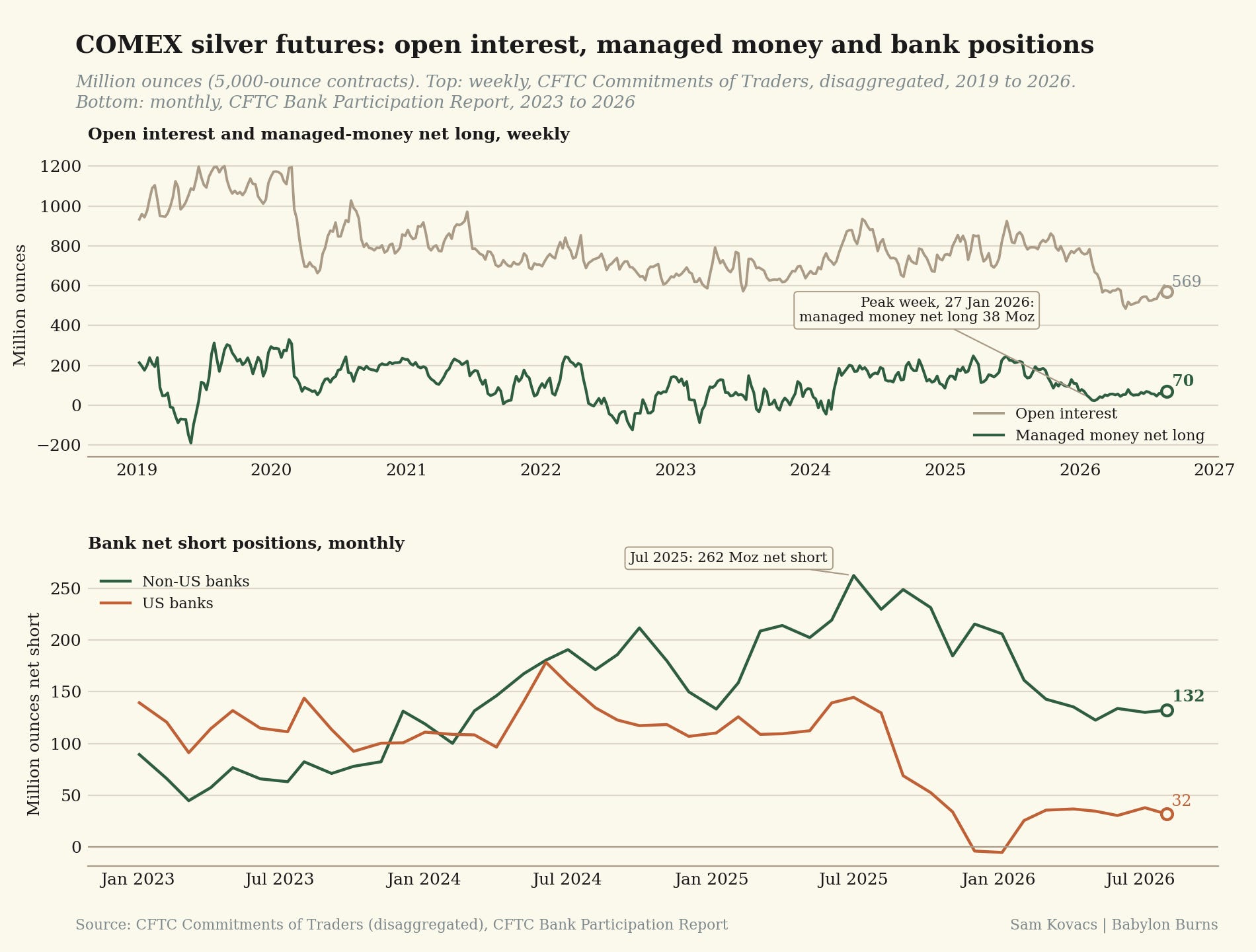
Bullion banks own silver that is sold to them by the miners the day it leaves the refinery. Now the bank owns silver, and it is happy to run a trading desk and earn a spread buying and selling silver, but it generally has no interest in participating in the direction of silver, so will sell futures against their metal positions.
So when the net short is drained, it is because it is silver which is leaving the visible system altogether.
The squeeze came when we added leverage to a market which was just too tight, and resulted in a distribution from the system, making the structural sell on silver suppressed further.
Where do we go from here?
This is a very good question, which I attempted first to answer with a model, which only ended up being indicative rather than prescriptive.
I attempted to model the price of silver based on the aforementioned survey. I used 2025 data of silver mined, recycled and used in the previous year as the baseline, and then improved their forecasts for 2026, based on data that was now available.
Then I had to consider how each category of silver supply and demand responded to price. What the data suggests is that scrap supply rises 0.16% for every 1% rise in price, jewellery falls 0.08% and silverware 0.44%, for solar I assume 0.3%.
What is impossible to be modelled is investor behaviour. The data shows that investors buy more on the way up, and then they buy more on the way down, as a different category of investor comes in at different stages. There is little prediction value in going back in the data here. It is not so obviously responsive to price as the other categories.
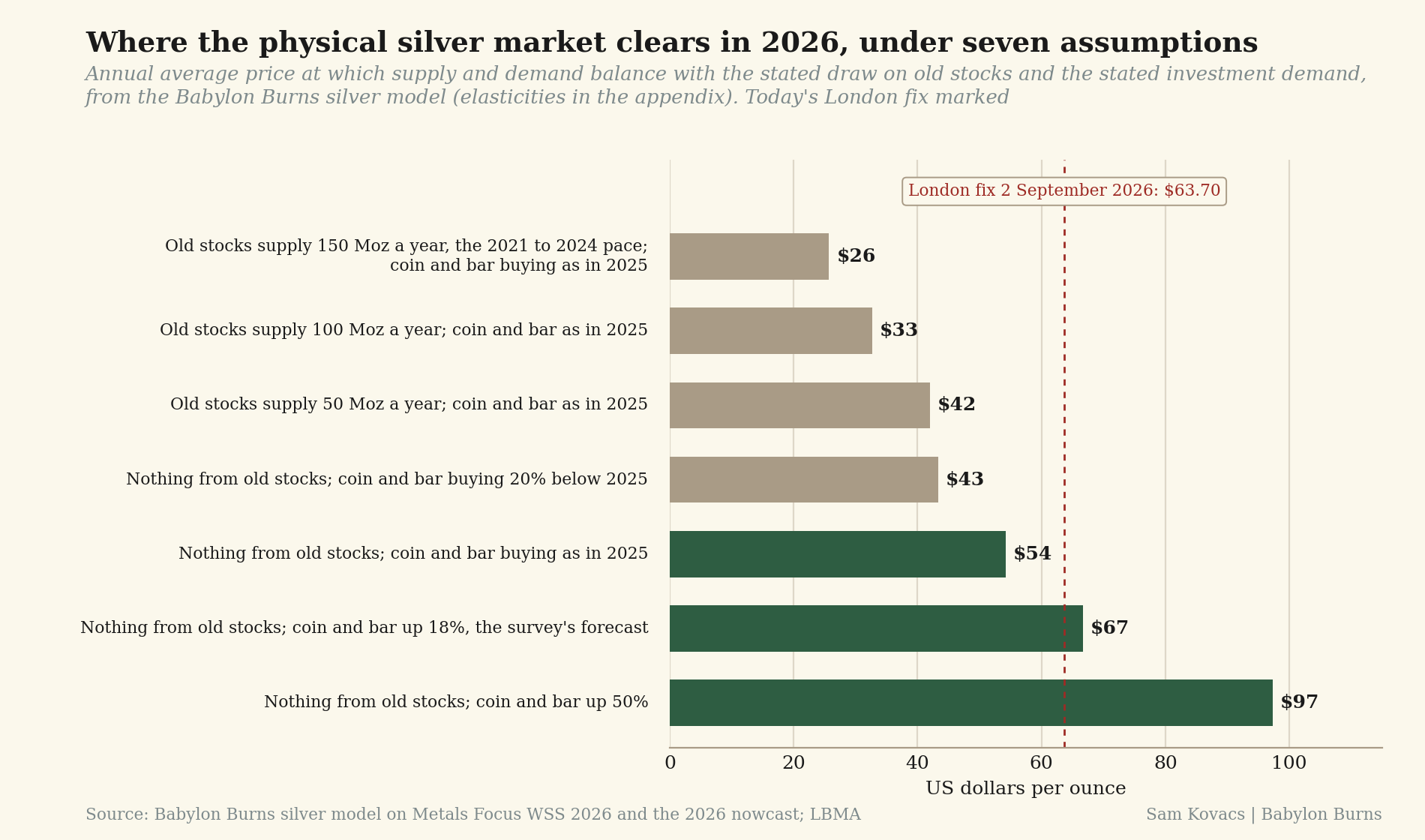
So what I can do instead is a guess and check: take a price level, scale the responsive categories from the 2025 level, assume a certain level of investment demand, and see whether the supply minus demand that results would equal the amount of stored metal which the scenario should allow out of storage.
If that doesn’t fit, we move the price until we find the equilibrium.
This gives us a few clear scenarios:
If nothing is released from old stocks, and that coin and bar demand is up 18%, as the survey forecasts, then we get a price of $67, in line with where we are today. If old stocks empty as they did in the past, the clearing price is considerably lower than it is today.
So the whole thesis hinges on:
The indiscriminate sellers have been depleted, and demand for silver will return from either institutional or retail crowds.
Let’s not forget that silver is the retail crowds way of playing gold, as it is still in the mind of many (mine included) a valid currency which has been demonetized. Silver has a beta to gold of about 1.4x. In many ways, silver is the leveraged gold trade. Nothing new there.
If the investors never return, the bear case is concentrated in the $42-$54 range. That’s 20% to 38% below today’s price, and is the shape of the downside.
But if the investor does return, it walks through an extremely small door, which can squeeze the price violently to the upside.
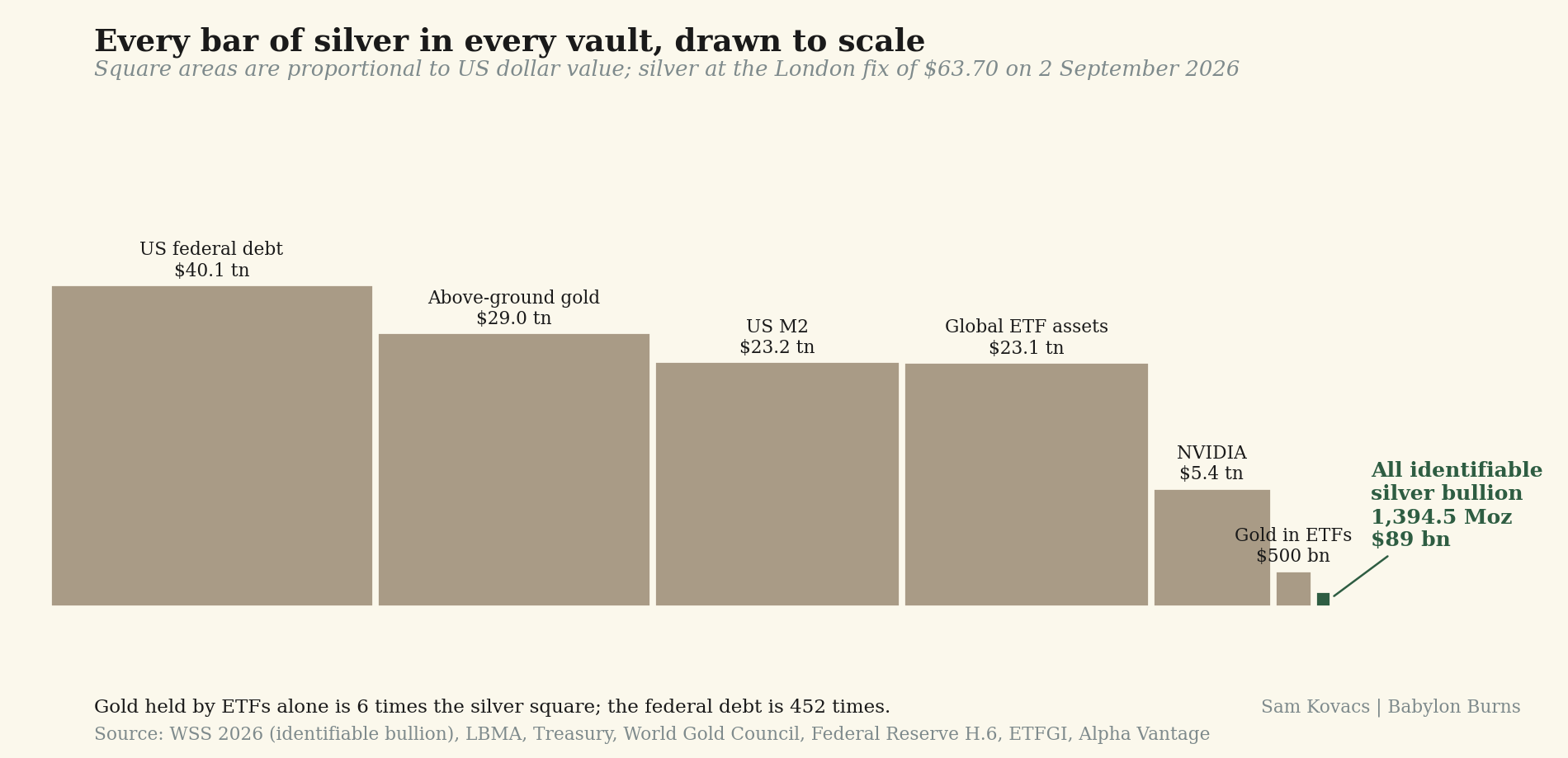
Every identifiable bar of silver bullion in London, New York and Shanghai is worth $89 billion at today's price: 0.38% of US M2, 0.22% of the federal debt, 1/326th of the gold stock, less than 2% of NVIDIA. The gold held by ETFs alone is 6x larger.
So the case for silver is effectively that it is gold’s little cousin, and that gold is being remonetized.
Gold is being remonetized
Silver will always be the cheap, retail oriented way to own the exact same trade.
Central banks have bought roughly 9,700 tonnes of gold since 2010, a quarter to a third of every year's mine output for four years running, and in the second quarter of this year they bought a record 289 tonnes into a 16% price fall.
I made the call on August 15th when we launched the paid version of Babylon Burns, that it was a good time to pick up gold miners, and our pick is up 21% in the past 3 weeks
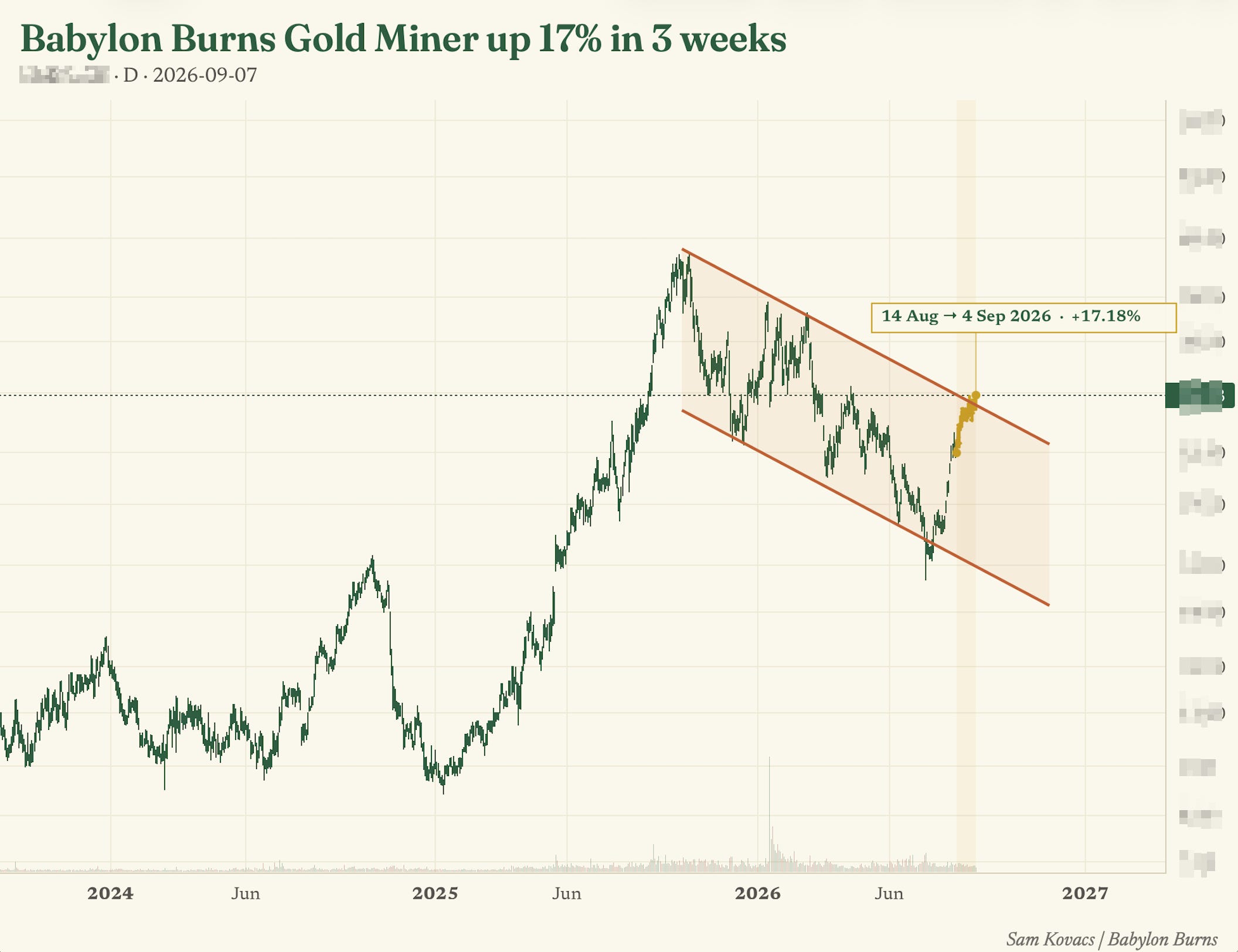
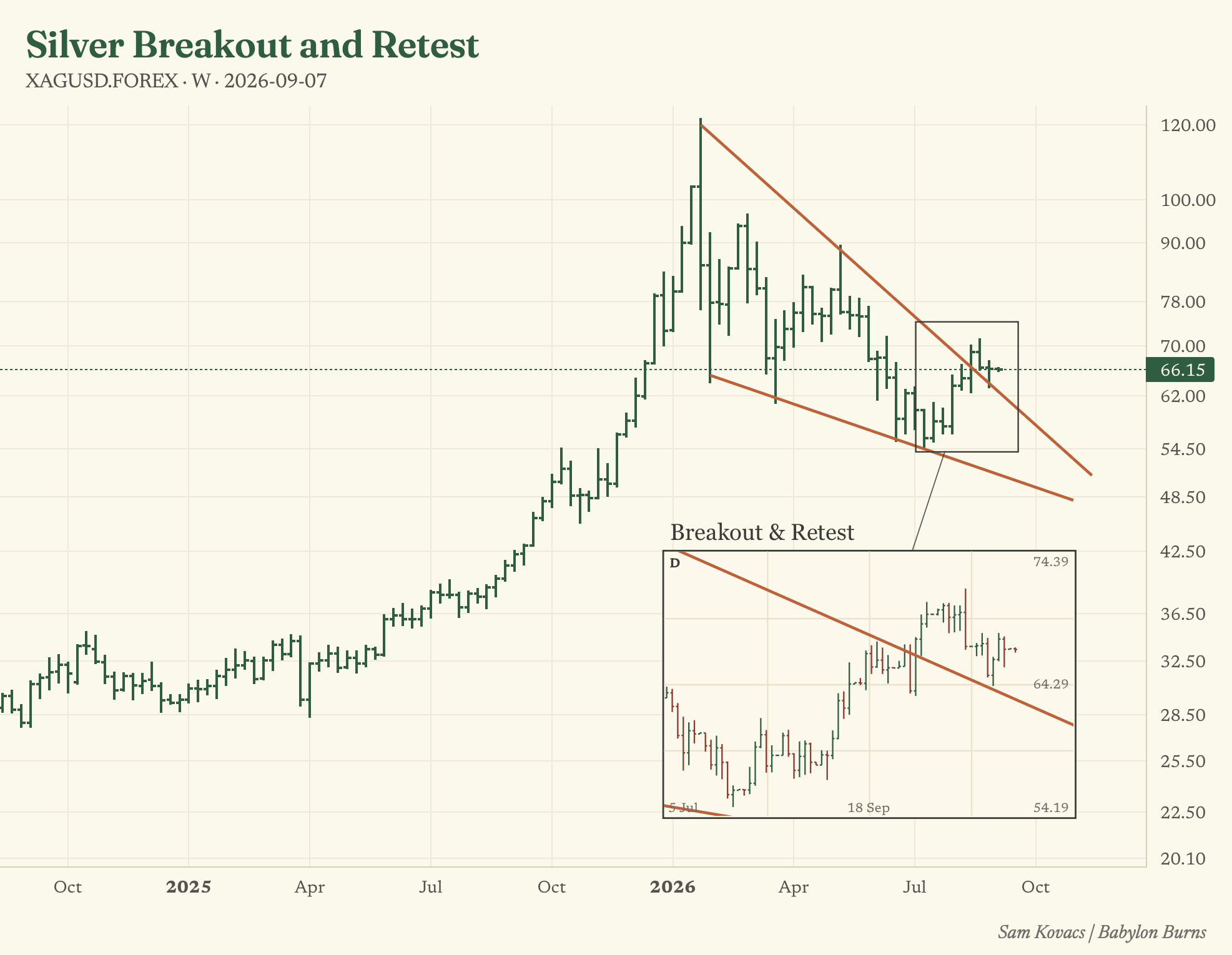
I had previously written that I was waiting for the breakout, and it has happened.
I believe there is a good chance silver is next.
Silver's investor is not a central bank. It is the household in India and China, and the ETF buyer in the West, and both usually arrive after gold has moved, looking for the monetary metal they can still afford.
It happened in 2010 and 2011, when gold's run pulled silver to $48; in 2020, when 331 million ounces went into ETPs; and in 2025 and January 2026, when gold's rise to $5,600 pulled silver from $50 to $121.
To think we can have a gold run without a silver run, is to ignore 2,000+ years of human history.
Measured against the money supply silver sits at 11% of its 1980 level while gold has recovered to 42%.
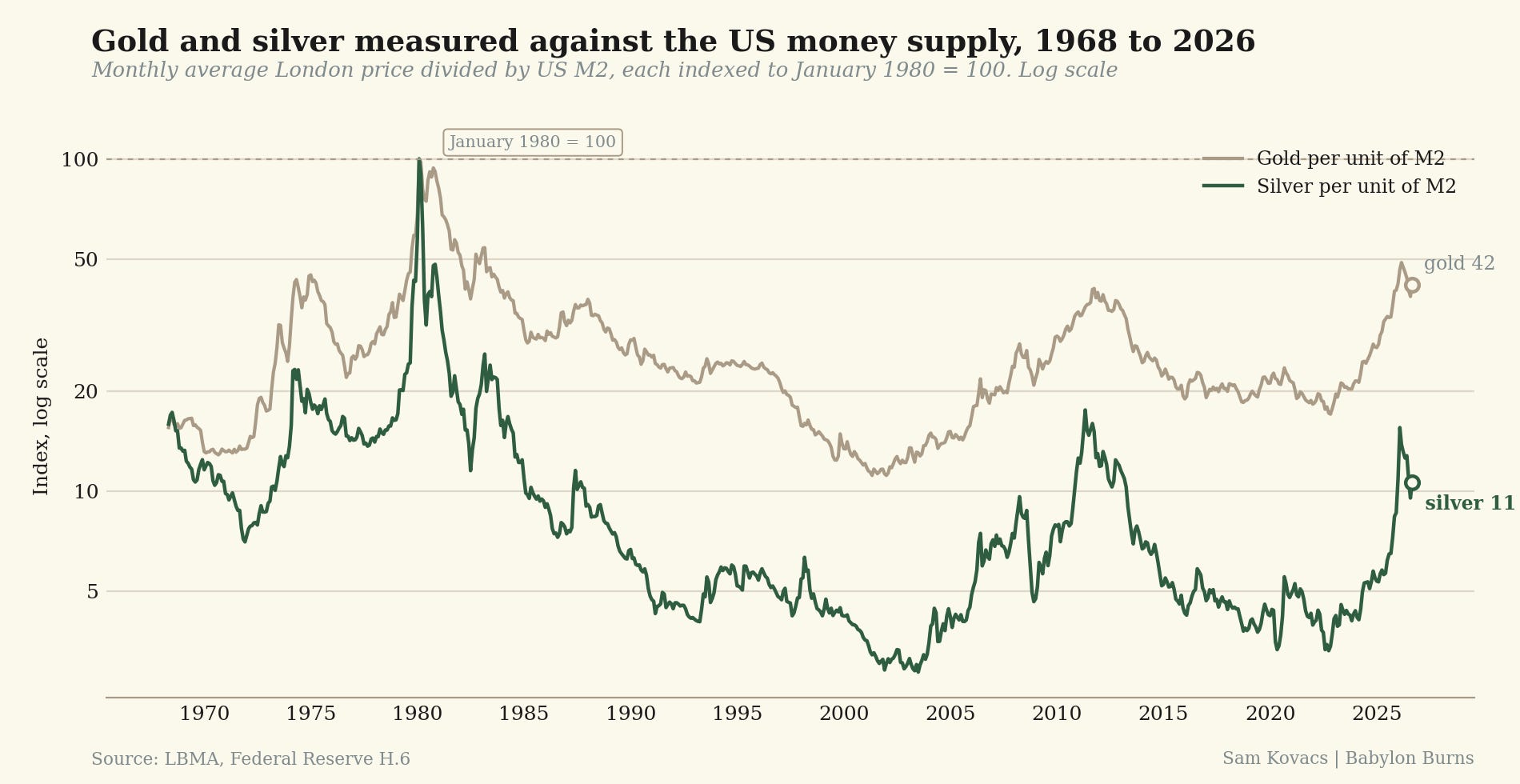
Gold has been remonetized, but silver hasn’t.
The buyers are already in position. China is at import parity and rising. India is locked out by a duty and every previous Indian duty episode has ended the same way, with pent-up demand, grey imports and a reopening.
Western ETPs are 70 million ounces lighter than in January and hold none of the leverage they held then.
This is like timber waiting for a spark.
So how do we play this?
Of course you can buy physical silver.
Long term I think that’s a good idea. Silver coins are relatively cheap individually and make for a fun collectible. In a true shit hits the fan situation where our global currency goes tits up, having small denominations of precious metals will be a real edge.
But if we’re optimizing a portfolio of financial assets as a trade, something we can go in and out of quickly based on a change of winds, then what we want is pure play silver miners.
And if we’re playing a derivative of the price of silver, we don’t want a low cost silver miner.
We want the highest cost miner, that will give us the most torque on the movement.
Think about it, from today’s price, if silver moves back up to $122, that’s a 7.7x on margins for a producer with a cost of $55. For a producer with a cost of $12, the margin only goes up by 2.1x.
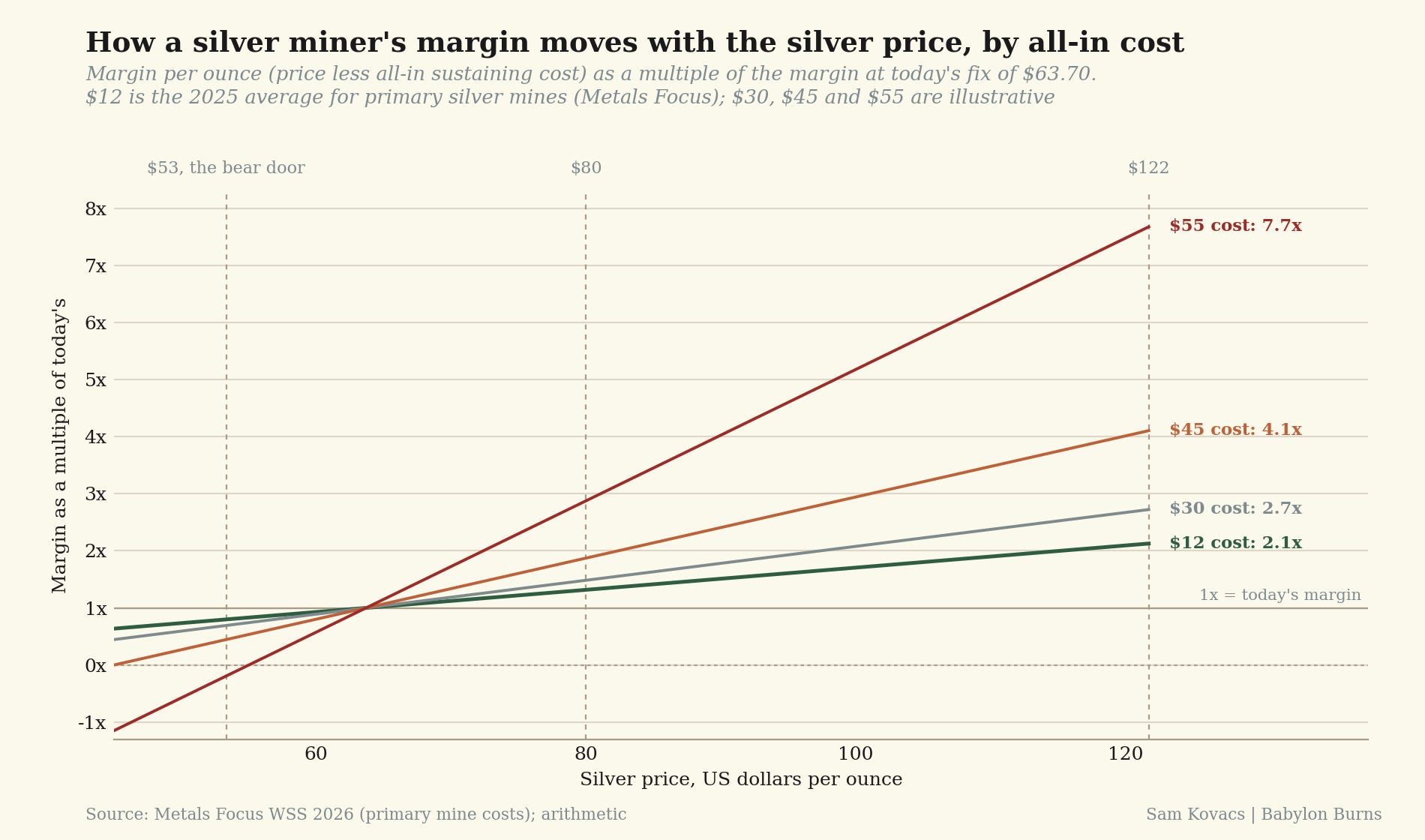
The clear caveat is that this then becomes a trade and not an investment, as we are building positions in companies we know are only viable if the price of silver pumps.
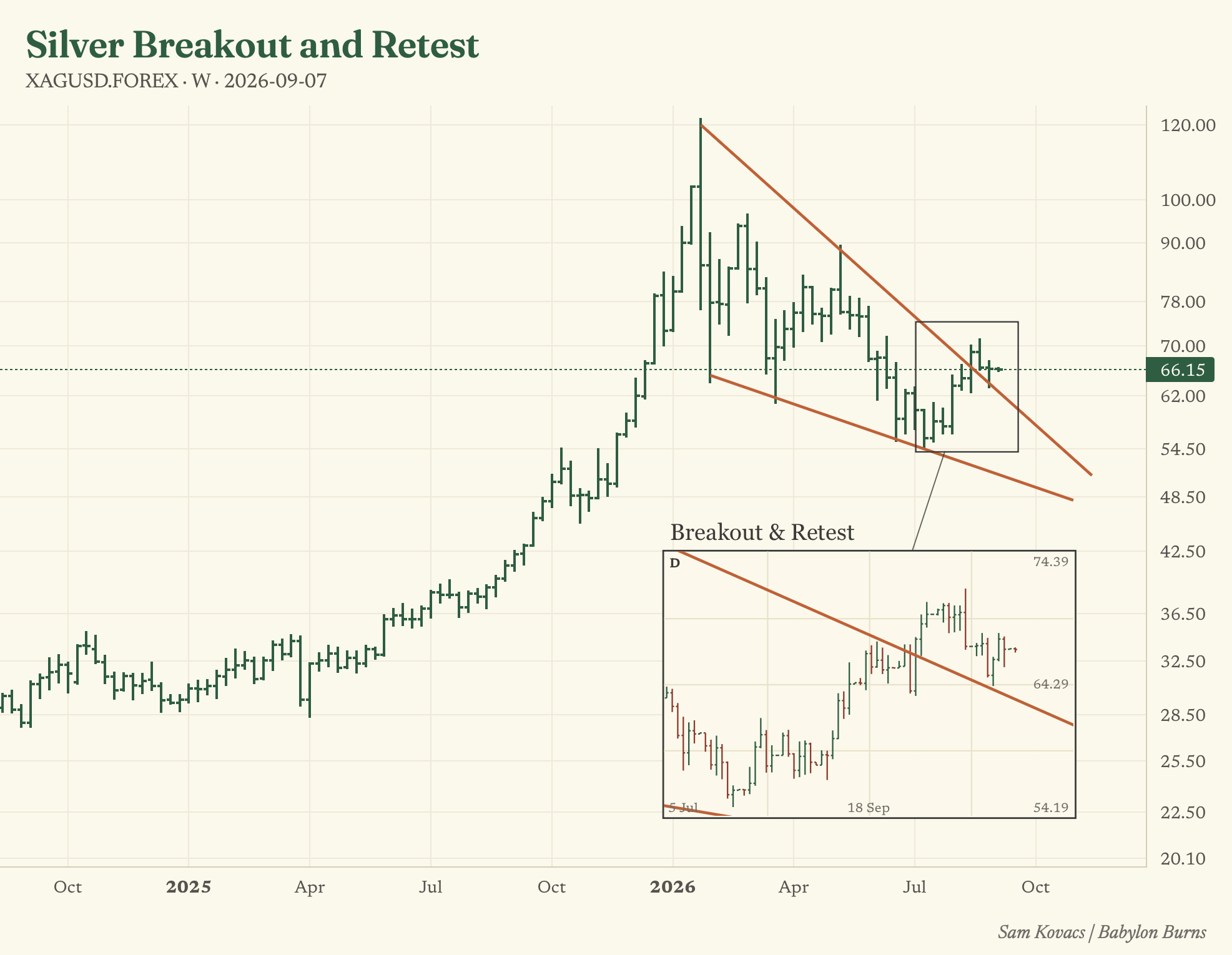
Why is fine, this is exactly what I’m looking for. Silver is breaking out and has retested the prior resistance line, if a run is going to happen, the downside is more protected now than it has been all year.
Later this week I will publish a standalone report on our current gold and silver investments along with new tickers we are adding to the portfolio.
As Babylon Burns, we’ll light the cigars.
If you want to receive my precious miner picks…
I highly encourage you to join Babylon Burns today.
Babylon Burns is $399 a year or $100 a month, and every member gets everything: every pick with its size, stop and exit, plus the web app with the live portfolio, trade alerts by email, monthly tear sheets and the Studio charting tool. Annual works out to about $1.10 a day, a third of what twelve monthly payments cost. Substack gives you seven days to read everything and take your money back.
Members get access to the Babylon Burns web app, which gives them:
a live traded portfolio with position sizes, stop losses, and targets
notifications whenever I make a trade, so you can move as fast as I do.
Monthly tear sheets of the portfolio performance. 100% transparency, no hiding or burying loser picks (we all know the BS artists who do that!!)
My entire chart library, so you can follow the charts with my setups as they play out.
And of course you unlock all of the research which I have already published, and all the research which is yet to come.
If you don’t like it, Substack gives you a default 7 day refund period, no questions asked, I won’t even know why you cancelled.
If you enjoy my research, if you feel like it can help you make sense of markets and become a better investor, then I highly suggest you subscribe today.
Silver Is Consumed, Not Hoarded—And That Changes Everything!
Silver prices haven’t changed in 30 yrs…Everybody always thinks it’s going to be the next 5-10X. Buy GOLD!