

"Markets are never wrong; opinions often are." - Jesse Livermore
What I’ve learned from a decade and a half of daily obsession with financial markets, is that you can be right about almost everything and still lose money.
Conversely, you can be wrong way more than most would be willing to admit on X or Substack, and still win big.
From the very first stock I bought, (some piece of sh*t Canadian oil stock that increased 50% in two weeks on news that had nothing to do with my thesis), I was consumed by the idea of beating the markets.
I launched one of the most popular newsletters on SeekingAlpha helping individuals build dividend retirement portfolios. Our dividend portfolios have beaten the market with less volatility with widows-and-orphans stocks.

I run a hedge fund which has rotated through quant and discretionary strategies as the market conditions have moved. Our (KPMG audited) returns have trumped the market, although with more volatility.
It is my intent that I will continue to do quite ok with investing over the next few decades. Not because I never will have a losing stint. Not because I think my ideas are better than others. Not because I’ve figured out the secret sauce to special returns.
But rather because, as the late Yankees manager Casey Stengel would say “most ball games are lost, not won”.
If you can avoid losing, you can end up winning.
You see, I’ve come to believe that beating the markets is not unlike getting physically shredded: it is simple, but it isn’t easy.
Eat less calories than you expend, lift heavy objects, get 8 hours of sleep, drink lots of water.
Overcoming and transcending your base level humanity is a function of having a system, a discipline, and sticking to it.
This report will set out the rules of how I will build the live portfolio which will accompany the Babylon Burns publication when the paid version launches on August 15th.
Most of the “analysts” you’ll encounter online will never discuss these matters because they have never managed money professionally and they care more about being right than truly generating alpha.
(By the way it’s not too late yet to get in at the discounted pledge price before we launch.)
I’m quite content giving the portfolio management system away for free. As Richard Dennis told Jack Schwager in an interview for his famous book:
You could publish my trading rules in the newspaper and no one would follow them.
I will be using more quotes than usual in this report, as I want to drive home that these concepts are not unique, they are mainly common sense which most investors just ignore.
Why not just index?
After more than 25 years of investing professionally and after 9 years of teaching at an Ivy League business school, I am convinced of at least two things: 1. If you really want to “beat the market,” most professionals and academics can’t help you, and 2. That leaves only one real alternative: You must do it yourself. - Joel Greenblatt
The results of index investing seem to be rather good when you look at history.
Warren Buffett suggested that for most investors, buying an ETF was the way to go.
And that might be true if the following conditions are true:
You have no knowledge or interest in the markets.
You are ok delegating your risk taking to the markets.
You are content being merely average.
For large stints of time, be it from 1929 to 1940, 1966 to 1982, or 2000 to 2009, being an index investor has been an awful proposition.
As Mark Twain, one of America’s finest thinkers once said:
Whenever you find yourself on the side of the majority, it is time to pause and reflect.
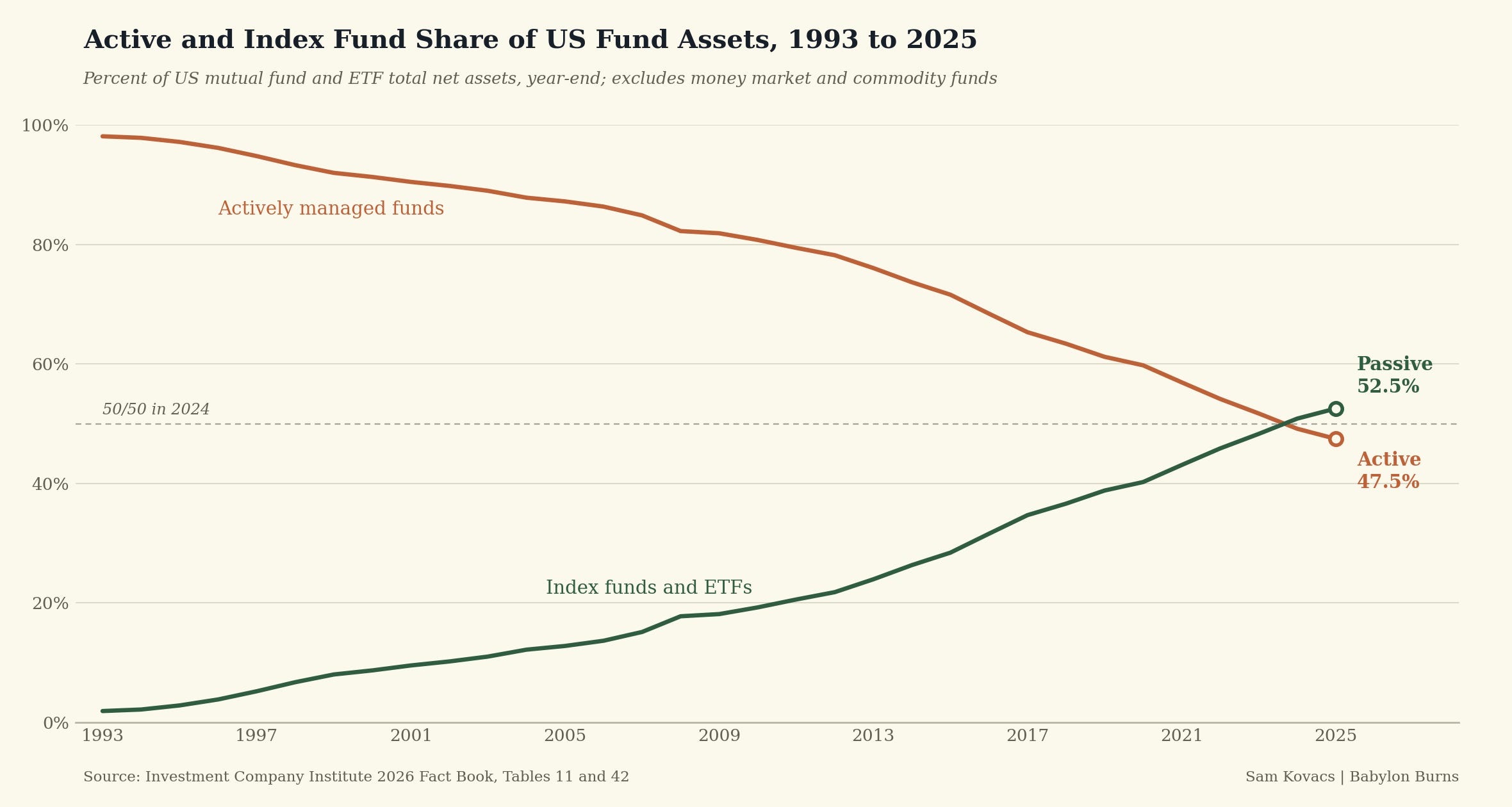
And you must realize that when Buffett recommended this in 1993, it was a variant view, with just 2% of assets in passive vehicles. When he reiterated this in 2002, it was once again a variant view with still just 10% of total assets in passive strategies.
Today, the majority of money is in passive strategies. If you include the number of active managers that hug the index and have no real views, then the number is even higher.
Being passive was novel in the 90s and 2000s. Today, at the very least, you should pause and reflect.
A market-cap weighted index like the S&P 500 works very well in prosperous times, and puts money on fire in difficult times.
There is no discussion of whether or not we are in an AI bubble. We are. The question isn’t when it ends, but what happens when it does.
There is no discussion of whether or not the US is in serious fiscal trouble. It is. The question isn’t whether it will debase its currency to try and fudge the numbers, only how it will do it.
There is no discussion of whether or not the world is fracturing into a multi-polar setup which we haven’t truly experienced in over 80 years. The question isn’t where the next conflict breaks out, but what it means for the supply chains we have come to depend upon.
You may believe whatever you want, but I believe that this is not an environment which is particularly favorable to passive funds over the next decade or two.
You must ask yourself, do you think there is more chance that the next decade looks more like 1966-1982 and 2000-2009 or more like 2009-2020 and 1983-2000?
Indexing is putting everything on autopilot. It works fine in fair weather, but when a storm hits it pays to have a steady hand at the helm.
Not unlike the little red hen, if we want to do better, we’ll have to do it ourselves.
So where do we start?
“It’s not whether you’re right or wrong, but how much money you make when you’re right and how much you lose when you’re wrong.” - George Soros
One of the biggest fallacies of investors is to listen to what successful investors say they should do, rather than doing what successful investors actually do.
I dug into my history of investing and uncovered something which I expected directionally, although not so precisely:
20% of the stocks I bought accounted for 80% of the portfolio’s gains.
Buffett, Druckenmiller, Soros, all share the same footprint, sometimes even more dramatic and concentrated.
We all have a few good ideas. We all have many so-so ideas. We all have some very bad ideas.
Investors tend to believe that their primary job is to find good investments. Finding good investments is necessary, but it is not sufficient.
Your primary job is to build a portfolio with a shape which allows you to have many small losses or underperforming investments that never matter and a few large wins which you allow to grow with no limit.
Over any ten-year stretch, a handful of positions will produce almost all of your profit. You cannot know in advance which ones. What you can control, completely, is the other side: that nothing ever hurts you badly.
Buffett would say that rule number one is to “never lose money”.
Yes. But the way you do that is by losing a little often, and winning big sometimes.
Human nature goes the other way, we are tempted to stick to our guns, double down on our false narratives, as our egos get in the way and we want to be “right” more than we want to make money.
So we want to give ourselves a system that allows us to express the power laws that occur in investing.
I have 3 big lessons when building a portfolio.
Lesson 1: Lay a seedbed
Nobody knows anything. Not one person in the entire motion picture field knows for a certainty what's going to work - William Goldman
William Goldman was a screenwriter, and a successful one. His insight applies just as much to investing as it does to writing a blockbuster movie script.
While only a few of our investments will generate superior returns, it is very hard at first to know which ones will.
So you cannot go around waiting for a jolt of lightning to give you insight into the 2 or 3 big ideas you should buy.
You need a discipline, a process, a way of getting into the good ideas to start with.
You should try out many positions, all while being willing to kill most within a few months.
The mechanism is simple. When something catches your interest, buy a starter position of half a percent to one percent of your portfolio. Its purpose is not profit.
Its purpose is attention: real money, even a little, forces you to actually watch a thing, read about it, and form a view, in a way a watchlist never does.
I like the metaphor of laying a seedbed. Only a few will become saplings, and of those even less will grow into beautiful trees.
Of course you don’t pick stocks randomly (although I’m half convinced some industry professionals do just that).
You need a solid process of research and ideation which must start with curiosity. I get ideas from unrelated discussions with my wife, from X, from stock screeners, from reading the FT, and sometimes I even have ideas of my own.
My philosophy is to leave no rock unturned. Yes I have certain views on macro, yes I have certain tilts on sectors. Yes I have certain tilts on narratives and possible scenarios.
I’m generally looking for investments where the tape, the theme and the tale are satisfying. I’m projecting the future 6-30 months out, and investing based on my world views over those time frames.
I need some conviction to start a position but not heaps.
You need to be willing to have strong views, held loosely.
Lesson 2: Love to lose money, hate to make money
Like Mark Spitznagel’s mentor, Everett Klipp (also known as the Babe Ruth of the CBOT) would say.
You’ve got to love to lose money, hate to make money, love to lose money, hate to make money... but we are human beings, we love to make money, hate to lose money. So we must overcome that humanness about us.
Now of course, we are in this to make money, but the most direct path to doing so is one which is roundabout psychologically.
If you love to lose money, you’re willing to crystallize small losses. If you hate to make money, you’re late to crystallize wins, and adding to your winning positions.
Peter Lynch used to say that:
Selling your winners and holding your losers is like cutting the flowers and watering the weeds.
If you can kill your ego and allow yourself to be wrong time and time again, and if you can kill your ego and not be too fast to sell your best ideas, then you will be setting yourself up for success.
The best equity investment I’ve made was Broadcom($AVGO) . I bought Broadcom at a split adjusted price of $43, then added at $47, $53, and $57 until it reached 7% of my portfolio.
My average cost is about $48 making the position a 9 bagger.
But there were two, very obvious mistakes I made: The first is, I sold many of the shares too early.
I’d exited over 70% of my position by the time it had 4xed.
The second is I stopped adding to the position despite absolute conviction in the trade.
On January 19th 2023, when i wrote that ChatGPT marked a turning point in the AI revolution, I said when the stock was at $57:
AVGO remains very attractively priced. The market is wrong about AVGO, and it is easy to buy, buy and buy, until you hit a full allocation for the position.
My mistake, was that this was such a big fat pitch, on which everything was aligning, that I should have made it 20% of the portfolio.
As Stanley Druckenmiller said reflecting on his time with Soros:
“The few times that Soros has ever criticized me was when I was really right on a market and didn’t maximize the opportunity.”
Which leads us to the next lesson:
Lesson 3: Get out of your own way
“Good ideas are rare, when the odds are greatly in your favor, bet heavily.” - Charles Munger
Every good investor has a sob story like mine on AVGO where they made money but not nearly enough.
You need a mechanism to allow yourself to double down on positions when you have conviction in the setup.
Ironically, the rule which has most empowered me to let a trade grow big is always knowing when I would get out.
In starter positions I often see an emerging narrative that I like with a chart that looks supportive, and will have a stop loss set at a level dictated by the chart.
As I add to a position when my conviction increases (from more information, refining the thesis, or confirmation from price action), I always update mentally where I would get out.
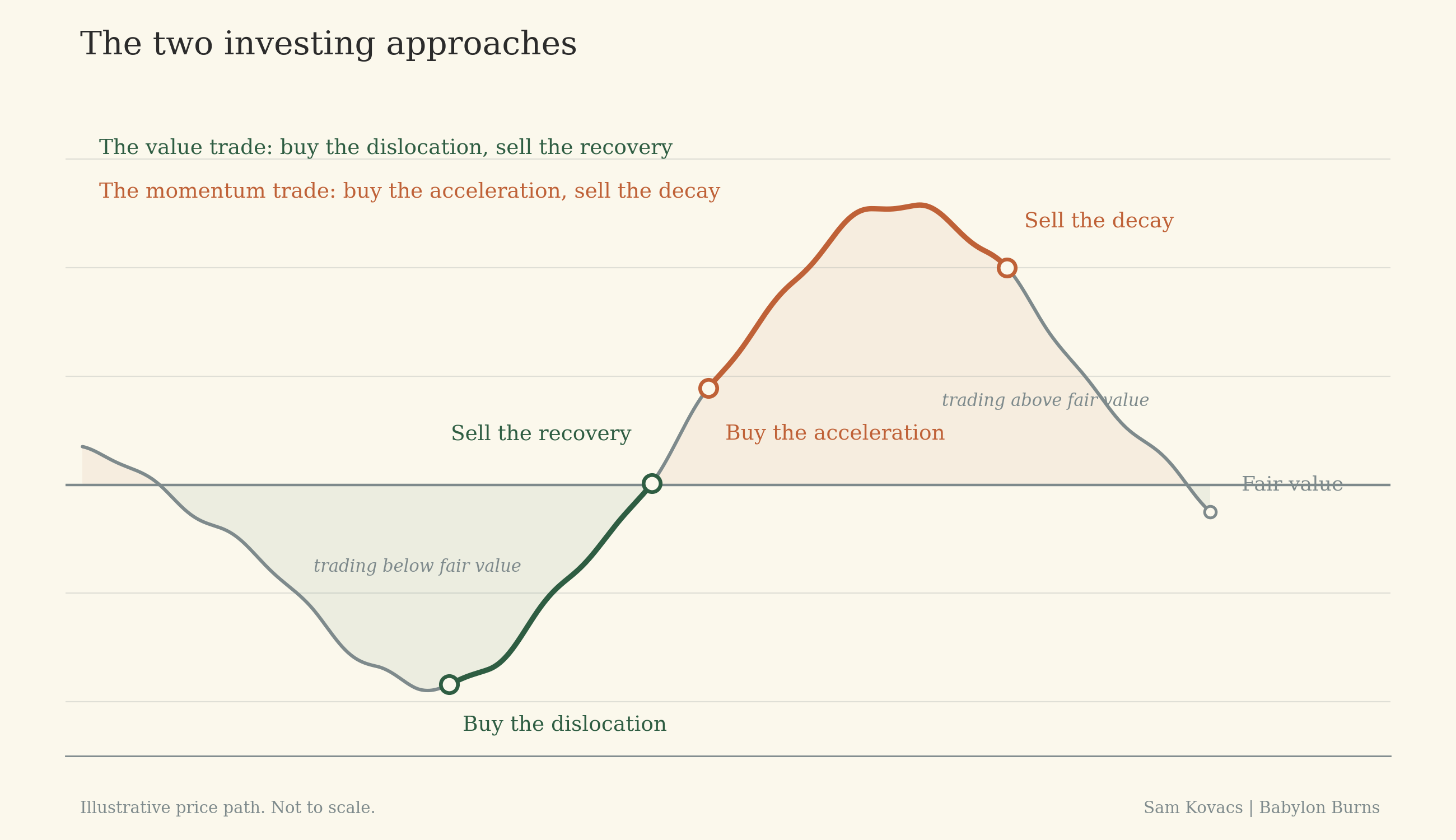
Generally there are 3 types of positions that I might take: the value trade and the momentum trade, and event based trades.
Sometimes the former turns into the latter, as was the case with AVGO, and my failure to identify that shift is what got me to sell a large slab too early.
In the value trade, you are buying the recovery of some fundamental dislocation you have identified, so you set trip wires which are closely tied to that thesis not playing out.
In the momentum trade you are looking for increased velocity so it’s more about the narrative and the guidance than the actual results.
Then there is the event based trade.
You buy something because you think something is going to happen.
Here, the rule is quite simple: If you buy an asset because you think something is going to happen, and that thing doesn’t happen, you sell the asset.
So you want some easy fundamental trip wires which will help you get out. You can also have trailing stops, or other lines in the sand you can use to get out.
Selling is one of the most difficult decisions in markets. When you don’t know what should get you to sell, I like to follow Paul Tudor Jones general rule of “nothing good happens below the 200 day moving average”.
My metric for everything I look at is the 200-day moving average of closing prices. I’ve seen too many things go to zero, stocks and commodities. The whole trick in investing is: “How do I keep from losing everything?” If you use the 200-day moving average rule, then you get out. You play defense, and you get out. - Paul Tudor Jones
Once you know when you’re going to get out, as long as what you believed would happen continues happening you can confidently add to a position. Your best positions should be added to with cash harvested from positions which aren’t working out, and from capital gains as the positions proves it works out.
You are allowed to set a cap on concentration to meet your risk profile. In dividend portfolios I would cap positions at 7% on cost, and let them ride to 10-15 before trimming.
In an alpha maximizing portfolio, which Babylon Burns portfolio will be, there will be no price cap.
Turning the lessons into a system
I must confess that a lot of rules were used so far to effectively say:
Leave no rock unturned.
Take lots of bets.
Cut your losers, add to your winners.
Know when to bail.
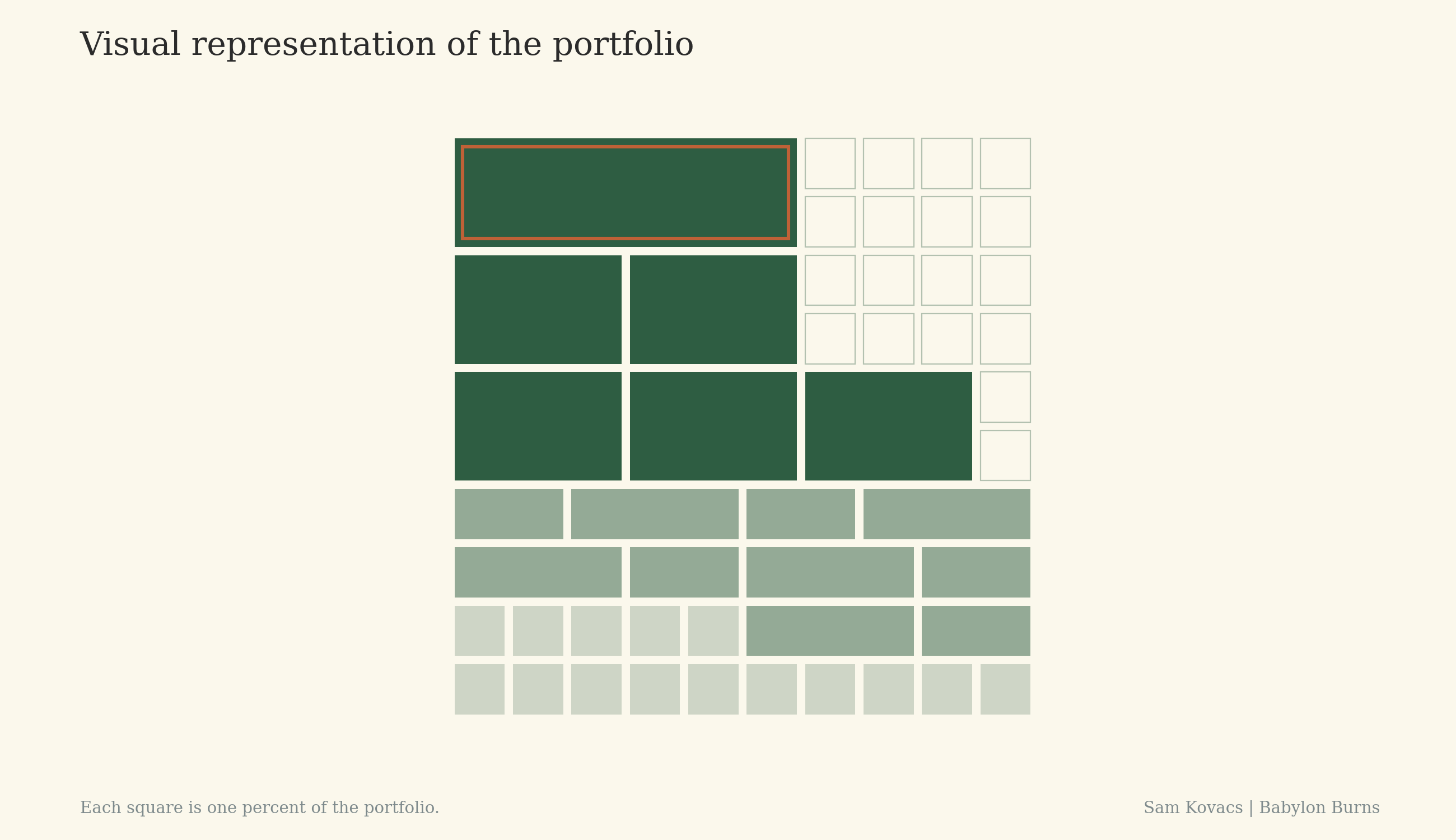
At any point in time the portfolio could look something like the above: a handful of small starter positions, a few slightly bigger ones, a few much bigger ones, and one or two very big positions, and some cash.
The portfolio will likely start from smaller positions in the 1% to 5% range, to truly mimic how I’d go about starting a new book from scratch.
Once again, I want you to understand that if you were expecting a magic pill, I won’t sell it because I don’t have it.
What I do expect, is that Babylon Burns will help you implement a simple but hard system.
Here are the rules the portfolio will follow:
The Babylon Burns Portfolio Management Rules
Leave no rock unturned. Ideas come from anywhere: a conversation with your wife, X, a screener, the FT.
Start small. Half a percent to one percent. You’re buying attention at this point.
Know your exit before your entry.
Kill fast. Most starters should be dead within a few months, and dying should cost pocket change.
Strong views, held loosely. Enough conviction to start a position, never enough to marry it.
Add on evidence: new information, a sharper thesis, or price confirming the story. Every add comes with an updated exit.
Doubling down on a loser is your ego. Doubling up on a winner is the system.
Sell when the reason is gone, not when it feels right.
When you don’t know what would make you sell, the 200-day decides. Nothing good happens below it.
Pull the weeds, water the flowers. Cash from what isn’t working funds what is.
No cap on winners. Trimming your best idea to feel prudent is how 9-baggers become 2-baggers.
You will be wrong constantly and it won’t matter. You’ll be right occasionally and it must matter enormously.
Simple, not easy. The rules are free. Following them through distress is something else.
The way it will work is quite simple.
On August 15th, when we launch Babylon Burns, everyone who signs up for an annual subscription will get access to our companion web application, which will include all positions which we will open on the following Monday. (monthly subscribers get the research only, when they’re ready to go for a year they can)
I will also be publishing following the launch the quickfire rationale for every position. It will include the stocks I’ve highlighted so far in my research on Babylon Burns, as well as many more ideas.
In the web application, everyone will have access to stop-loss targets, and a quick rationale of why it’s included in the portfolio along with stock charts organized per theme for you to consult.
When transactions are initiated, you’ll get an email notification. We will upgrade this to a mobile app in short order.
My intent with Babylon Burns is that with a subscription you will get access to:
My global macro research which will be focused on whatever is of value. (so far we’ve covered oil, gold, tech, and the fiscal backdrop).
Single stock write-ups of idiosyncratic opportunities you won’t see elsewhere (so far we’ve covered engine maintenance, healthcare, and oil rig opportunities.)
A live portfolio with trade-alerts, targets, charts, and everything described above.
Like Muhammad Ali reminds us:
The fight is won or lost far away from witnesses, long before I dance under those lights.
If we build our portfolios the right way, then I’m quite confident that…
…as Babylon burns, we’ll light the cigars.
PS: Another friendly reminder that it is not too late to pledge a subscription at a discounted pre-launch price by clicking on the button below.
Hi Sam - does the $299 annual subscription provide me with access to everything that launches on Aug 15? or is that a separate subscription?
lets go Laszlo. as Firesign said.