

People hate to think about bad things happening, so they always underestimate their likelihood.
The Strait of Hormuz used to see 1/5th of the world’s crude oil and liquified natural gas move through it.
As we all know, since the end of February, that’s not been the case.
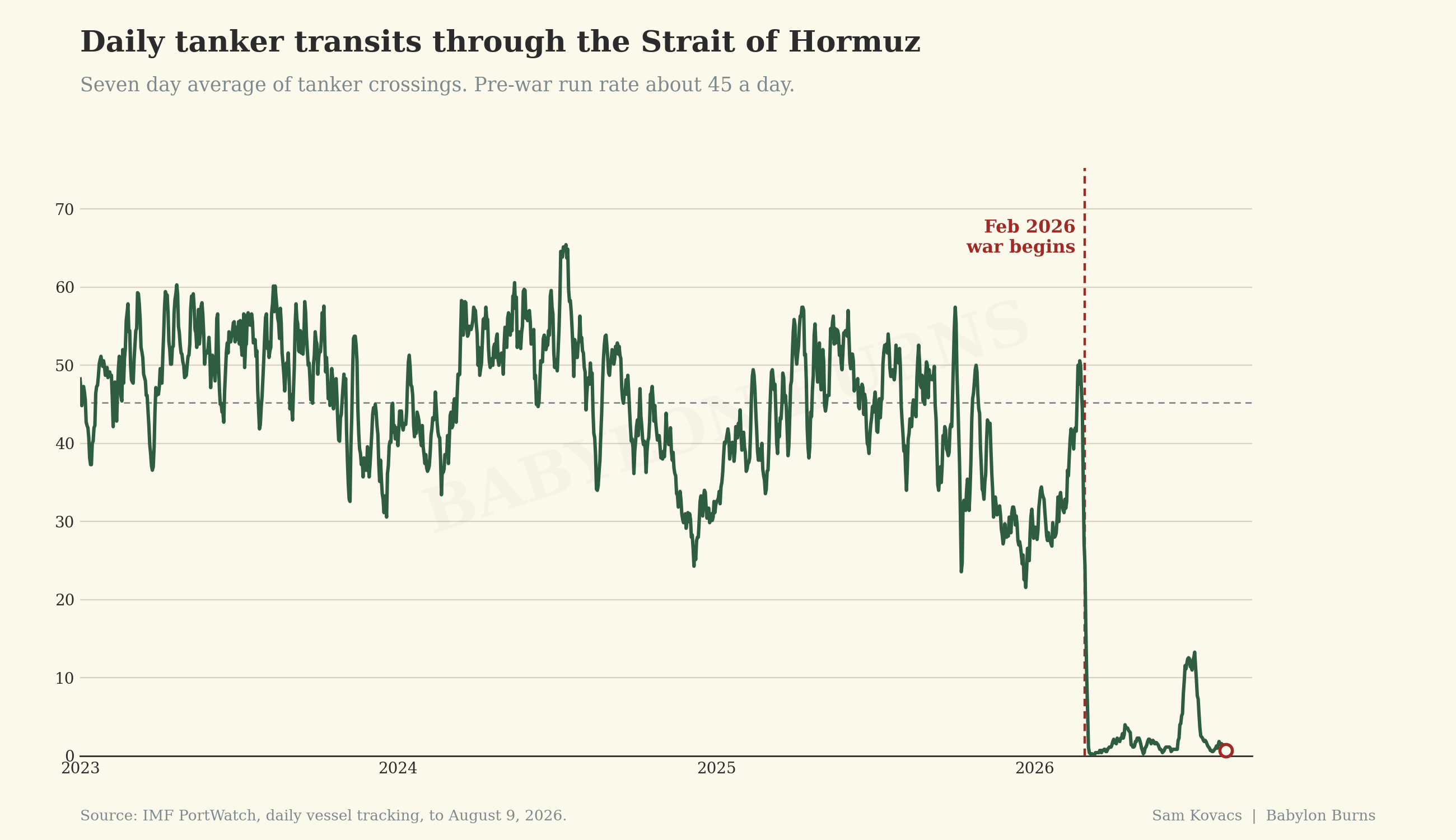
The strait is on fire daily, and Bab el Mandab is under stress since the conflict has expanded to the Red Sea with the Houthis harassing the Saudis, which has reversed the temporary increase in BAM crossings we saw in April.
Libya oil depots are catching fire. Ukraine is blowing up loading docks in Russia. A tanker a day is catching fire in the strait.
The world as it is, is in fact, very, very concerning.
But the market is not trading the world as it is. It’s trading a LaLa-Land version of the world which looks something like this: It has decided the war ends soon, the strait reopens, and the price of oil goes back to where it was last autumn.
You can see that straight from the forward curve.
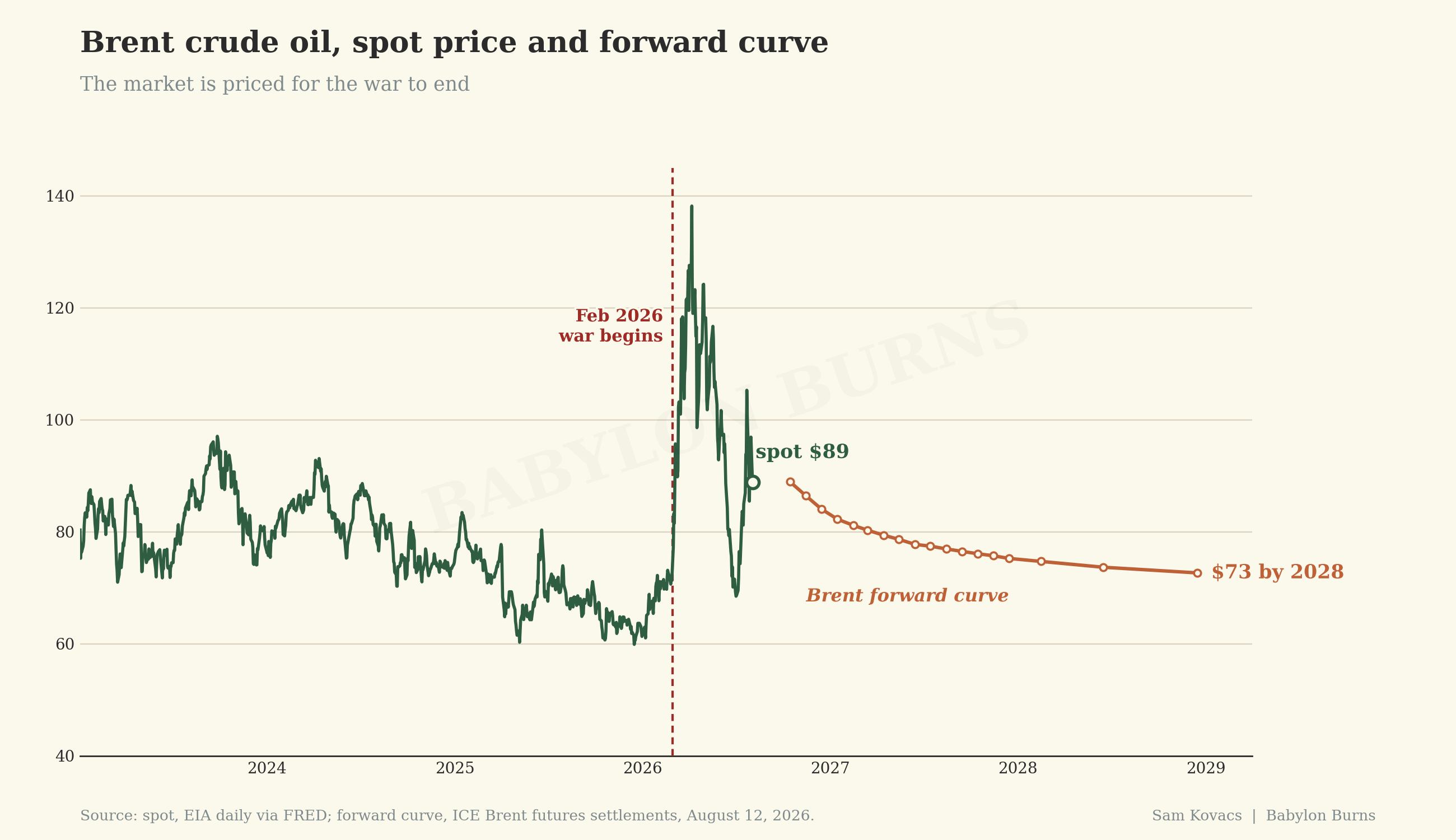
If you ask the EIA, they’ll tell you it’s going back to $65 once the Strait goes back to normal in September. It seems, to me at least, there is no world in which that happens.
Everybody is asleep at the wheel.
Long crude was the trade for about a week in March. Brent ran to $138, and then the reversion trade took the wheel.
I was long through the whole thing, and I gritted my teeth as I had to give back a lot of the gains. The jawboning, the media manipulation, the constant messaging from the administration and their pawns caused me to doubt the data that I was seeing right in front of my eyes.
I nearly got shook out of the position and had to endure a few sleepless nights where I flipped mentally from taking the long to the short side of the trade to consider what I might have gotten wrong.
The obvious move came and it went. Since the MoU broke down, I’ve been focusing on the physical, logical chain of events which do not need a $150 oil to do extremely well.
Because from now, what lasts is what I and a handful of others have been saying: This conflict continues, inventories draw down further, and you cannot print molecules.
Sooner or later the music stops, and we burnt all the chairs ‘cause we were out of heating oil.
You’ve watched the movie “The Big Short” (maybe you even read the book!). Well ladies and gentlemen, this, is “THE BIG LONG”.

By the way, I just launched the Babylon Burns portfolio which is included with the paid version of this newsletter. We’re running a launch special where you can join us for just $299 instead of $399 per year. You can learn more about the launch by clicking here. You can also skip ahead and sign up using the button below.
Refined products are tighter than they ever have been.
The 3-2-1 crack, which is the spread a refiner earns turning one barrel of crude into gasoline and diesel, is at record levels.
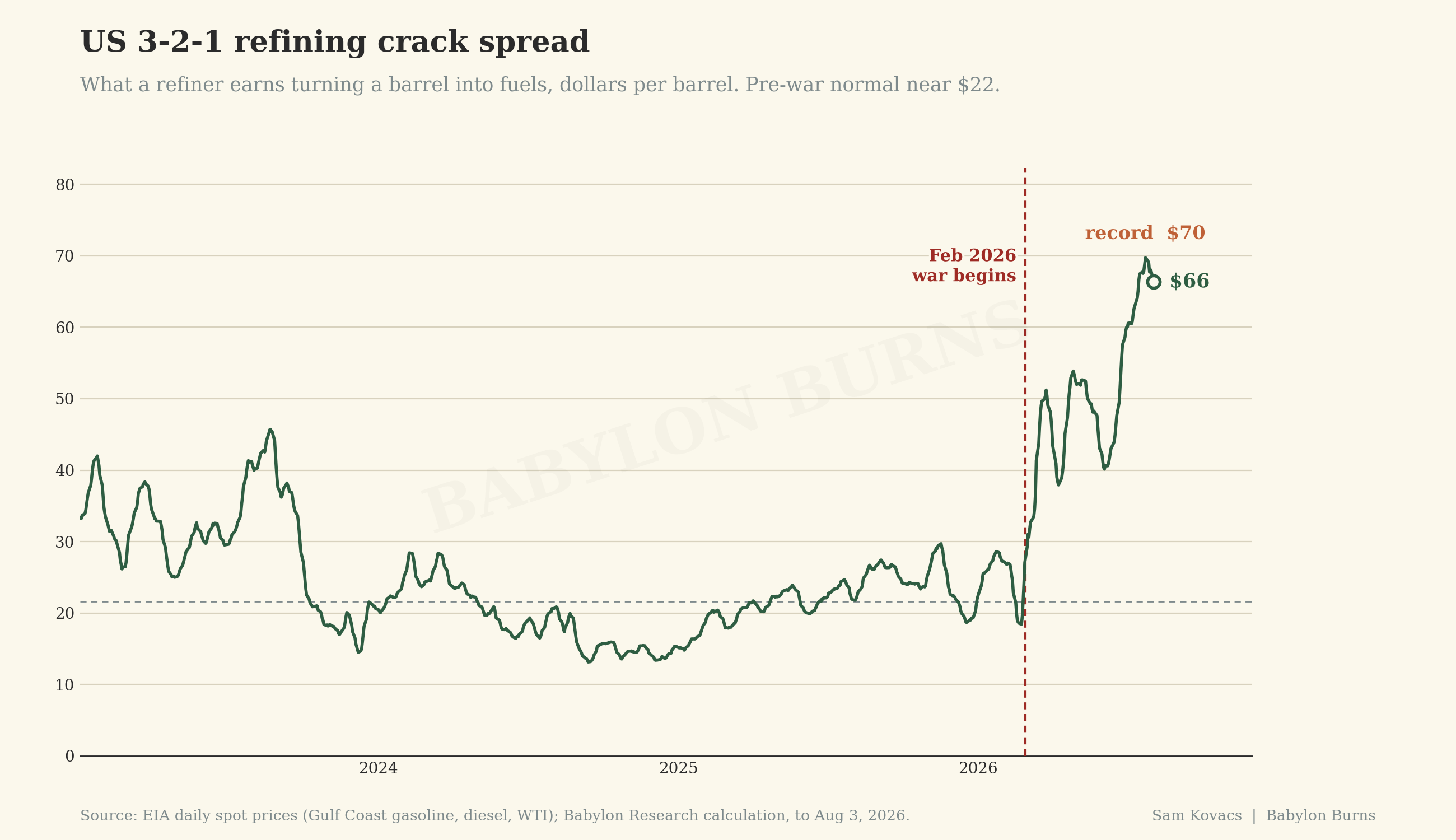
Think about what that spread is telling you.
A refiner doesn’t really care about the price of crude oil, it does care about the spread between what it pays for the barrel and what it sells the fuels for.
When the spread 3x and stays that high, it means that fuels are tight, and there is no denying it.
Products cannot lie about how tight the market is. There is no strategic reserve of diesel that a government can drain to push the price down.
Crude is different. The price can be suppressed. I explained exactly how in this report.
They are verbally, physically, and possibly through flows, manipulating the price of crude oil.
A consequence of this has been draining the Strategic Petroleum Reserve to keep the crude flowing, and the SPR is currently at 305 million barrels, the lowest level since 1983.
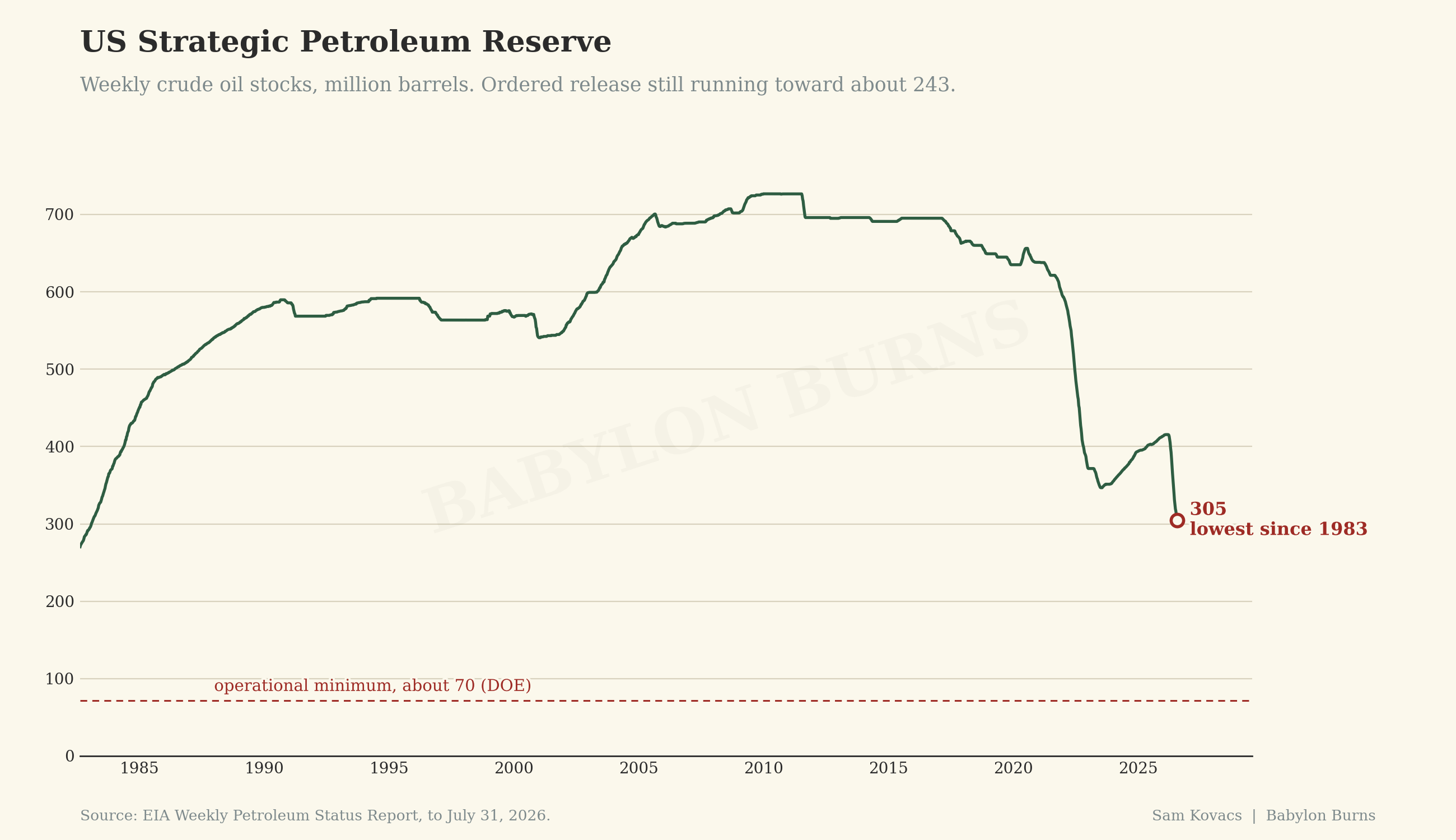
Crude is held artificially low by policy and jawboning, and products are clearing at a record because the physical market cannot be talked down.
Some say that it is because with all the refineries going offline, there is a glut of crude.
This doesn’t add up. As tight as products are, global supply of oil is tighter.
The speculative bid has just been beaten out of crude. Longs are nowhere to be seen.
The refiners are at record highs. Marathon, Valero, Phillips 66 have performed wonderfully.
They are those who capture the spread directly, have amazing businesses, and that is the obvious version of the trade. It’s the version with the worst risk-reward today, as it has been priced and the rallies have extended.
Not saying it can’t run a little more, I just don’t like the risk reward on these names. We’ll get to my picks in just a bit.
The biggest argument against all of this is demand. China, the story goes, is buying less oil, the world is slowing, and a slowing world does not need a war premium.
The Chinese import number that everybody quoted as a collapse was mostly inventory draws and refinery discipline, and it has already turned, with imports climbing back between June and July.
There isn’t a demand problem. The reduced demand in Japan was mostly its chemical industry being rationed because oil was not available and Japan preferring to supply them to its citizens instead.
The bears also say that “way more oil is slipping through Hormuz”, because vessels are turning off their transponders and going dark.
Yes, there is some of this, but since it is unfalsifiable, the bears get to inflate the numbers to match their narratives.
But it’s not just oil…
The market has spent a lot of time focused on oil, but LNG and the whole chemical complex are potentially MORE impaired.
Natural Gas prices adjusted dramatically to the war, and have since given back some tightness, although we’ll be entering European winter at all time low inventories.
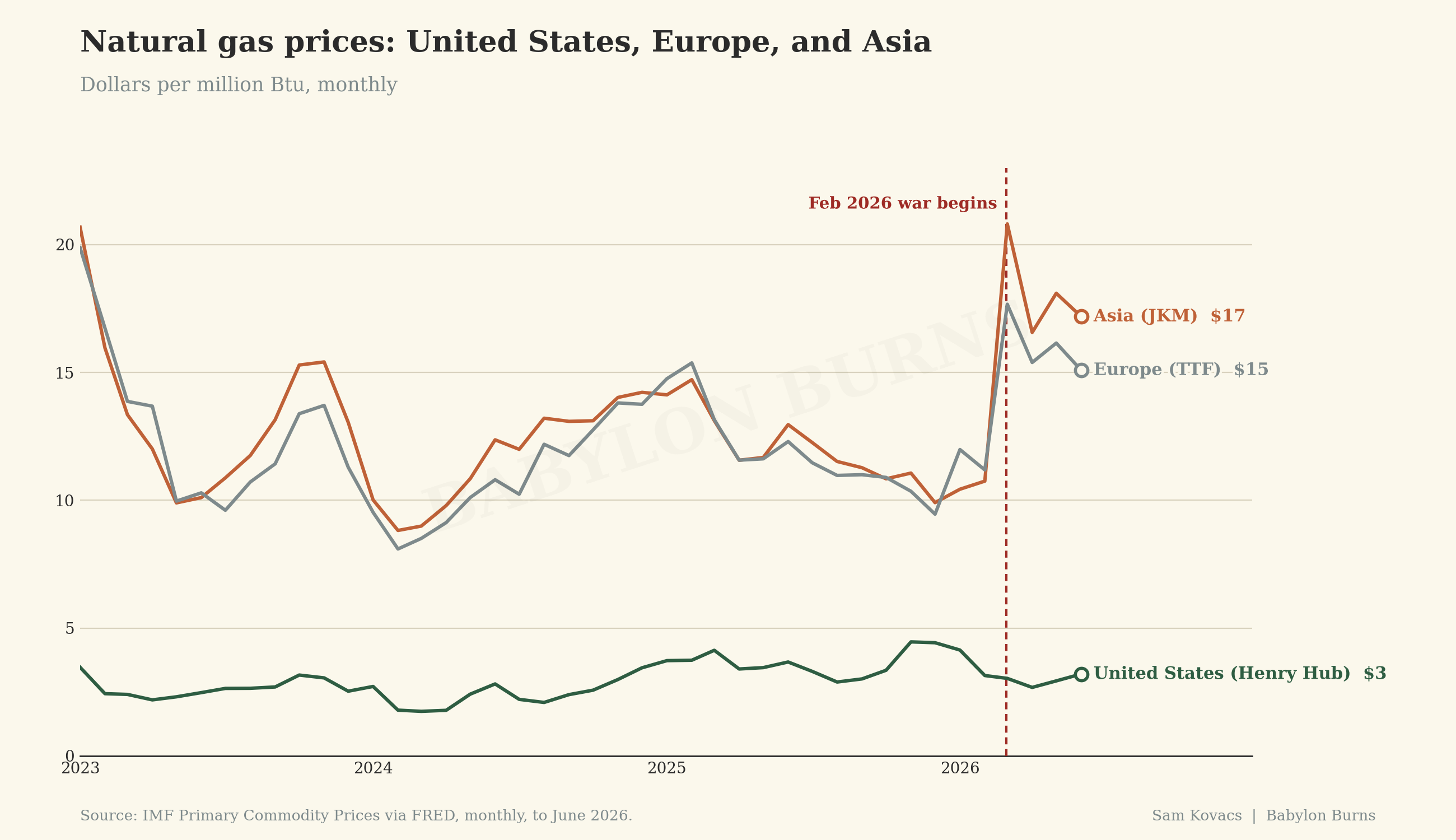
American gas is around $3. European gas is near $15. Asian gas has run to $17 and even spiked above $20 during the peak.
Natural gas is in the primary input of half the chemical industry.
The US has a 5-6x cost advantage, vs a 3x differential before the conflict.
Anyone who turns cheap American gas into something the world needs has seen their margin get structurally better. The market has ignored this nearly entirely.
The trade exists because it’s grim.
Making the case I’m making today isn’t popular for one reason: the trade is distasteful.
My motto is to Find Alpha or die trying, and I will do that for you if you subscribe to Babylon Burns. If you enjoy this research, I strongly advise you to consider joining while we have our launch price of $299 going. (Goes up to $399 if you miss it).
To own this trade you have to be comfortable betting that the war does not resolve quickly or cleanly, that the Middle East stays dangerous. You need to take the view that the world stays fractured and that the global equilibrium which we took for granted is now a thing of the past.
That is a bet against progress, and most portfolio managers do not want to make this bet even when they think it is right, because it looks bad in a quarterly letter and it feels bad to hold.
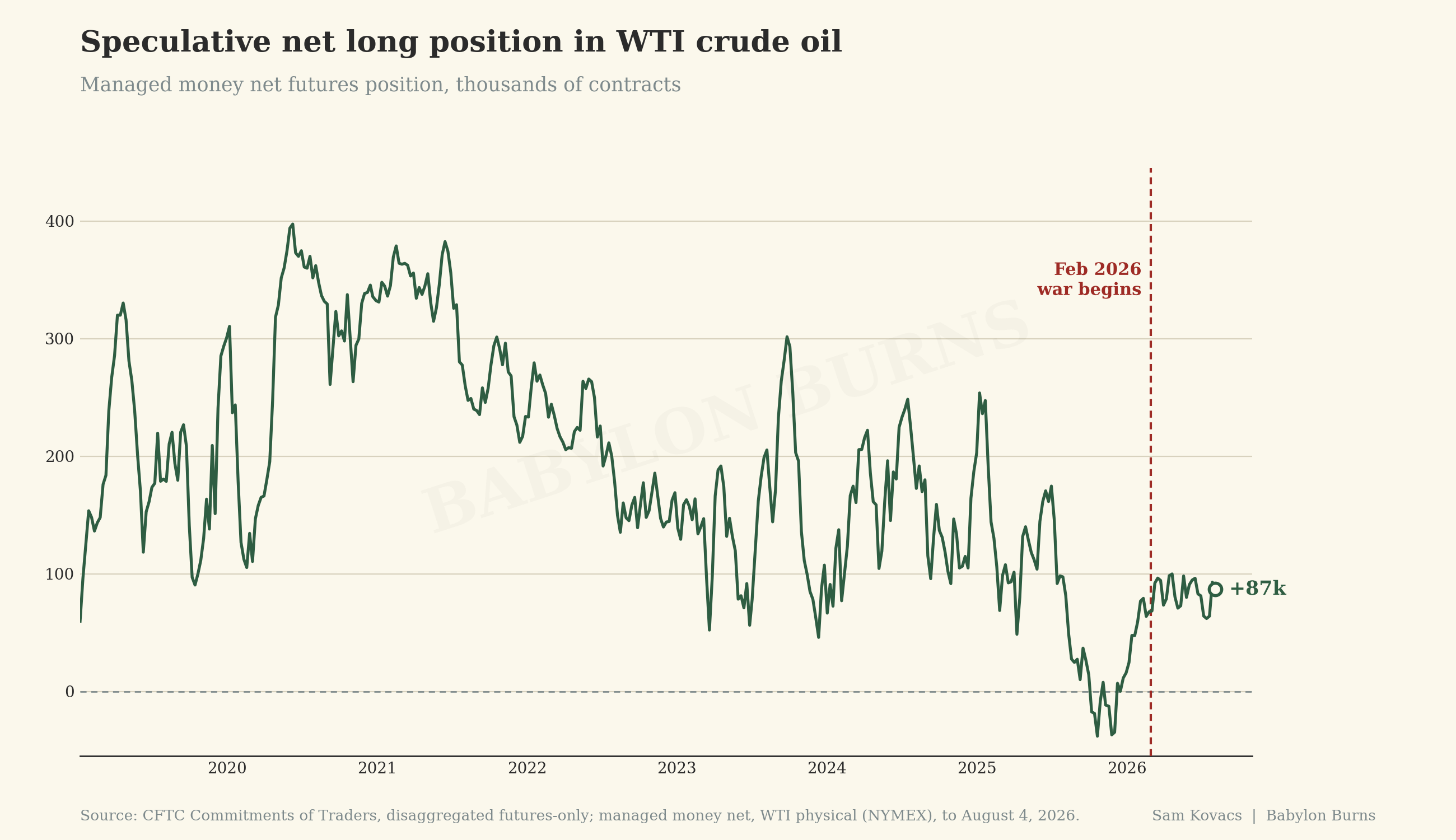
The speculative net longs are extremely low given the current setup. Nobody wants to be in this trade.
You’re betting against Donald Trump, against Scott Bessent, against the USA being able to finish a war it started.
And that’s not for everyone. It bursts their Lala-land fantasy.
The disruption is real, and the clock is running
Tankers are getting bombed on a daily basis.
The June reopening produced a small bump and then we were straight back to trouble. The conflict has expanded. The IRGC has hardened. The conflict is setting up for a gargantuan, dragged out war.
You do not take a fifth of world supply off the water for six months and call it a slowdown. oil on the water is now back to where it was just before the MoU was signed. We’re in big trouble if there is no resolution.
We’re draining inventories and hoping for the best. But even this has second order consequences that nobody is talking about.
Some estimates suggest we are likely to see a 1mb/d of excess demand for 2-3 years when this thing is said and done as countries build back their strategic reserves beyond what they were before the conflict.
Reserve draws are not an unlimited tool.
There is an operational floor, below which you can’t get any more out. Every barrel closer to your floors gives your enemies more leverage: you eventually get to a tipping point.
The only thing that kills this trade is reopening the strait, or a global recession coming before it pays off. Nothing is pointing that way.
If I were you though, I wouldn’t play this through Brent futures or options.
It is much better to get a working picture of the flows, the chokepoints, the logical next steps. Of course we do this with imperfect information, but it allows us to make educated directional bets on the market.
One of my favorite picks is trading at 4.5x cash flows on a superior business with catalysts. a rerating to its peer average alone would bring it up 43%, with oil simply staying where it is. It returns all of its free cashflow to shareholders, and we likely get a windfall.
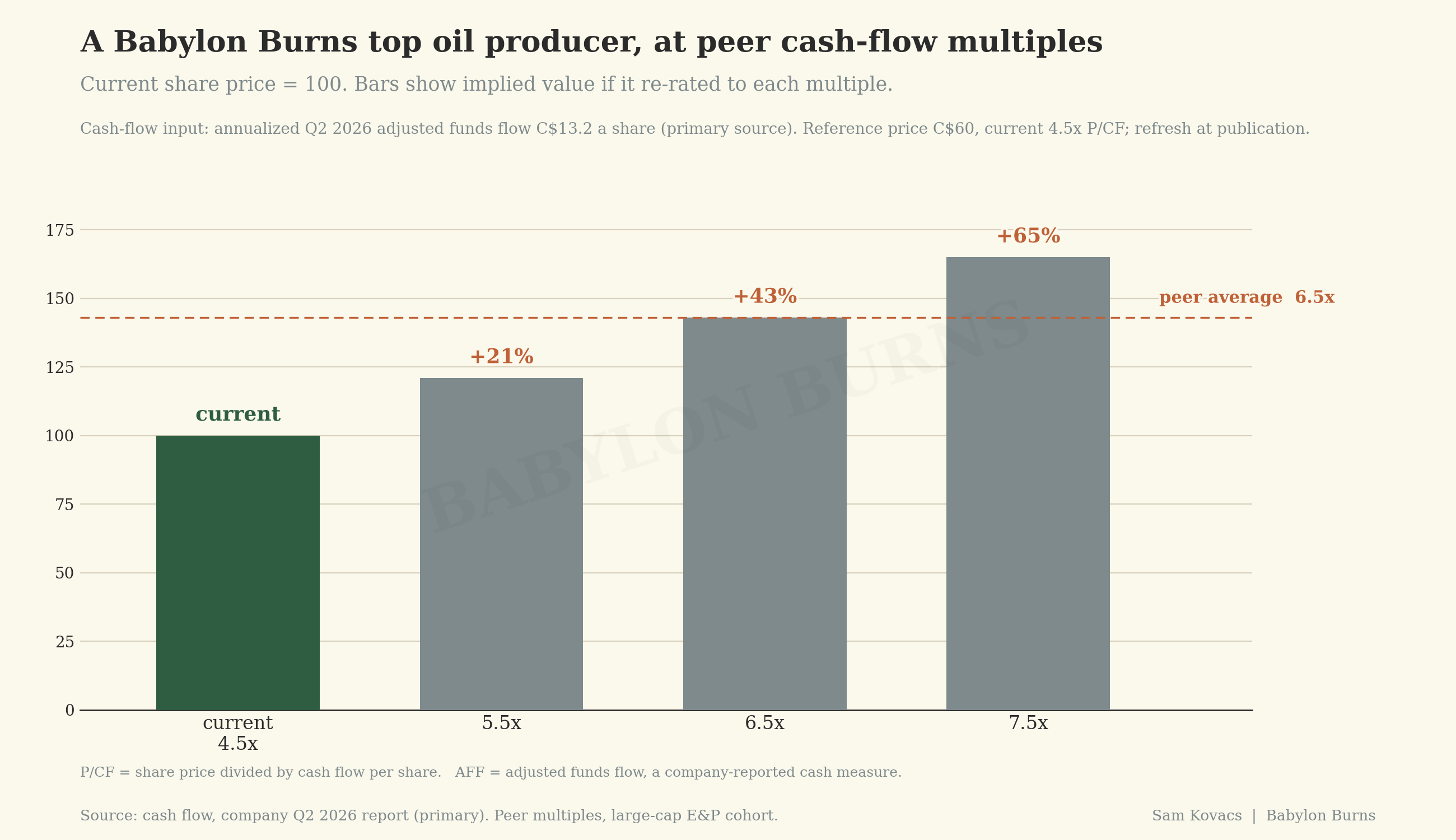
Below i will reveal it to you along with 12 (!) other names that make up our “THE BIG LONG” book.
Of course I cannot do full deep dives of 13 names in one article and be expected to publish the same again on tomorrow’s “The Boomers strike back” piece, and again on Wednesday, and Thursday, and Friday.
So I’ll be giving you the quick thesis and positioning, with alarm bells and stop losses, and we’ll double down with some in depth reports in the coming weeks.
