

There are some Substacks you read for entertainment, and some you read for education.
And then there are the ones you read because they’ll make you money.
Babylon Burns is meant to be the third kind. Since 19 June I’ve published 34 pieces here, more than 86,000 words, and about two thirds of them are free. That’s the equivalent of a short book, and until today nobody had told you where to start.
This page fixes that. I promised it in the Saudi piece on 12 October, so grab a coffee.
I’ll tell you who I am in one paragraph, give you the whole thesis in two minutes, explain how I run money, hand you a reading path for whatever brought you here, and then show you every call I’ve made in front of free readers, with the losers left in.
Before you go any further, put your email in. It helps me in more ways than you know, and I help you out too: every free report lands in your inbox the day it’s published. It’s a pretty good deal.
Who’s writing this
I’m Sam Kovacs. I’m Franco-British, Dubai is home base, although I live a rather nomadic life, and I’ve published equity and macro research publicly since 2015.
I did my undergrad at HEC Montréal and my Masters in Economics at Sciences Po Paris, and I launched my first investment newsletter on Seeking Alpha while I was still a student. With my father Robert, I run the Dividend Freedom Tribe on Seeking Alpha, where the three portfolios I’ve managed have beaten the S&P 500 while invested in conservative dividend stocks. I was CIO of Havelet Bay Capital, a macro hedge fund, and I’ve advised sovereigns on economic policy, most recently in São Tomé and Príncipe and Madagascar.
On 21 February 2026, with oil at $66 to $72, I sent a note to a short list of associates and clients saying the market wasn’t pricing the risk of US military action against Iran, and that the asymmetry favored long energy, defense and shipping. A week later the war started. The note is reproduced, dated, in the first piece I published here.
My good friend George Noble convinced me to start writing in public. And one commitment up front: everything recommended in these letters is mirrored with my own capital. I eat my own cooking.
The thesis in two minutes
Everything I publish is downstream of two ideas: debasement and multipolar fracture.
Growth runs on three fuels: demographics, productivity and debt. The first two have been sputtering for decades, so the West kept pressing the debt button until it went numb. US federal debt has gone from 37% of the economy in 1970 to over 120% today.
When debt gets this big there are only a few ways out. Austerity loses elections. Default is unthinkable for the issuer of the world’s reserve currency. So debasement gets chosen again and again, government after government, in every heavily indebted democracy on earth.
At the same time, the post-1990 order is splitting into blocs that no longer trust each other. A fractured world builds two or three of everything it used to build once: chip supply chains, payment systems, munitions factories. That duplication is staggeringly expensive, and expensive means inflationary.
Based on my research, money has a half-life of about fourteen years. Save a dollar at twenty and by your seventieth birthday it buys an eighth of what it did. If the currency loses 8% of its real value in a year and your portfolio gains 8%, you didn’t make money. Only the return above the rate of debasement is real.
If you’re running as fast as the other guy, you’re on a treadmill and going nowhere.
That logic narrows the field to five themes: hard money, resource scarcity, global rearmament, the demographic dilemma and restructured rails. The themes tell me where to look first. They don’t fence me in, and some of the best ideas in the book fit none of them. We also need flexibility as the market conditions evolve. There are times when I don’t want to touch some of the themes above.
In investing as in comedy, timing is of the essence.
If you read one thing after this page, make it They sold you a dream and you bought it wholesale.... Every other piece hangs off it.
How I run the book
Knowing what to own is half the job.
The gold bugs have been telling you to buy gold for decades. The oil bulls want you in oil, the tech bros want you in semis, and the warmongers want you in defense. They’re all right at times and wrong at others, because themes don’t pay out in straight lines. A theme can be completely correct and still spend eighteen months going nowhere.
So the portfolio runs on a system, and I gave the whole system away for free in How I’ll Run the Babylon Burns Portfolio (and the 9-Bagger I Fumbled). Here’s the short version.
I lay a seedbed. New ideas go in as starters of about 1% of the book. Their purpose isn’t profit. Their purpose is attention: real money, even a little, forces you to watch a thing in a way a watchlist never does.
I know my exit before my entry. Every position comes with a stop, a chart level or a dated event that ends it.
I love to lose and hate to win. Most starters die within a few months, and dying costs pocket change. For instance, a position in Leonardo DRS was stopped out at $42 on a 1% position, a 0.05% hit to the portfolio, and the stock later traded down to $36.
I add on evidence: new information, a sharper thesis, or price confirming the story. Doubling down on a loser is your ego. Doubling up on a winner is the system. And there’s no cap on winners, because trimming your best idea to feel prudent is how 9-baggers become 2-baggers.
The reason for all those starters is arithmetic. Say one idea in ten becomes the kind of winner that carries a year. Five ideas gives you a 41% chance you caught one. Thirty ideas gives you 96%. Cut twenty-seven failures at a 10% loss on 1% starters and they cost 2.7% of the book. One survivor that triples pays for all of them twice over. I laid out the full math in the free opening of 4 new hot stock picks added to the Babylon Burns portfolio.
Everyone wants the tenth idea. Nobody wants the nine that bought it.
The charts come in at the last mile. I look at daily and weekly candles in the Richard Schabacker tradition to time entries and set stops, once the fundamentals and the catalysts have done their work. If you’ve wondered why there are so many triangles in my reports, read “Sam, Why are you so reliant on technical analysis?” (SPOILER: I’m not). Almost all of it is free.
Where to start, depending on why you’re here
Pick one path and read it in order. You’ll know within an afternoon whether this letter is for you.
If you’re here for oil and Hormuz. This is the biggest opportunity I see, and it dominates my positioning right now. Start with How the US manipulates oil prices (30 July), which explains why crude was being held down into the midterms and why suppression always ends discontinuously. Then read Why I’m buying a Norwegian microcap to play the Permian (14 July) for why the Permian is the only supply on earth that can respond within a year. Why haven’t my oil stocks MOONED yet? (15 September) explains why producers trade on the strip and not the front month, and it’s the piece to reread whenever the stocks lag the barrel. Exposing CENTCOM’s 1 Billion Barrel Lie (21 September) does the arithmetic on the official flow numbers, and Why I Expect the Hormuz War to Escalate Again (26 September) lays out where this goes next. The macro half of Why you never raise rates into an oil shock (17 September) is free. Then watch my hour with Trader Ferg in What’s the most asymmetric energy setup right now? (7 October), and finish with Short Idea: Saudi Arabia, the country priced for peace (12 October), which I opened up in full.
If you’re here for hard money. Start with Why I’m not touching gold miners with a 10ft pole (yet) (10 July). I like gold. I don’t like miners as a structural holding, and Newmont’s production per share falling 48% since 2011 tells you why. Then read EVERYTHING you need to know about silver (7 September), which is free from top to bottom: why the indiscriminate sellers are gone, why mine supply can’t respond, and where my model puts fair value. The free half of the launch post (15 August) tells the story of gold since Nixon closed the window. I then subsequently closed Silver and Gold positions. Thesis is right, timing not yet.
If you’re here for ageing America and healthcare. Start with From $12 to $0.67 and back: You can’t unplug your nephew (26 July). An ageing electorate guarantees the spending, and the money flows to the one segment of Medicaid nobody can cut. Then I’m up 20% in 2 weeks on this unknown pharma stock (11 August), built on a hand-collected dataset of 21 FDA human-factors rejections since 2010. After that, the free industry openings of four paid pieces give you the whole map: The Boomers Strike Back (18 August) on senior housing, where the industry would need about 13 times the current build rate; Left for dead (20 August) on healthcare sitting at 7.3% of the US market, near a thirty-year low; “There’s Violence in the Streets Over These Issues” (28 August) on claim denials; and Anxiety is a growth industry with 15% margins (19 September) on outpatient mental health.
If you’re here for rearmament and aerospace. Read There’s a 50%-margin monopoly hiding inside the airline industry (26 June), on the oldest global fleet on record and the engine shops that service it, then the free opening of The Only Bull Market Politicians Will Guarantee (19 August). Fair warning: this has been my worst theme so far, and the record below shows it.
If you’re here for tech and the AI cycle. Read Meta Just Exposed the Biggest Problem in the AI Trade (3 July), the most-liked piece I’ve written here. It follows the unwind from GPU rental rates through the neoclouds, the memory makers and the hyperscalers, with the levels I was watching on each.
If you want to get better at this. Read Find Alpha or Die Tryin’ (21 August) on the misfits and on PayPal, then Wall Street left this ex-market darling for dead (26 August), whose free section tells my Nexstar trade in full: bought around $80 in 2020, sold around $180 in 2026, about 2.6 times my money including dividends. Finish with Explosive setup (30 September), which uses Spotify’s 2022 to 2024 recovery as a template for spotting the moment the market changes its mind about a loss-making business.
If you’ve read this far, you’re the kind of reader I write for. Put your email in so the next one finds you.
The public record
Plenty of newsletters will show you the winners. This one shows you EVERYTHING.
Below is every position call I’ve made where a free reader could see it, measured from the level I published, with prices as of 13 October. Where a pick’s name sits behind the paywall, I’ve kept it there, but I’ll still tell you how it ended. The losers stay in.
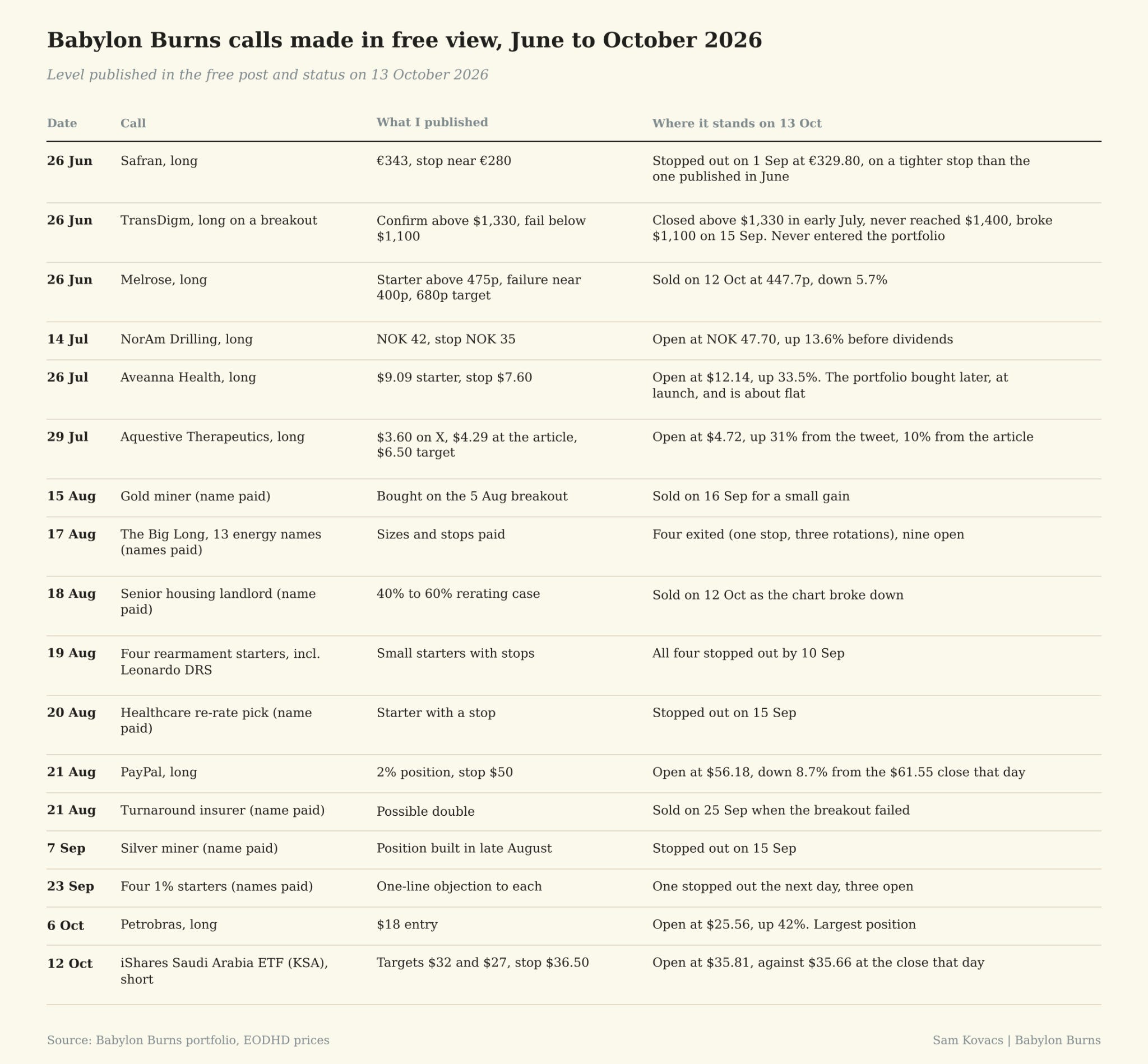
The other picks I teased in free view (28 August, 13 September, 19 September and 30 September) are all still open, and members have the names and the numbers.
As a whole (as of October 13th), the Babylon Burns portfolio is up 2.1% since it started trading on 17 August, against 0.2% for the S&P 500, with about a fifth of the book in cash.
On 6 October I told you it was flat, and I’ll keep telling you where it stands whether it’s flattering or not.
Count the exits in that table. Most of them are losses, and none of them cost the book more than about 0.75%. That’s the seedbed working as designed: lose a little often, and let a handful of winners pay for everything else. Petrobras alone has made back most of what the stops cost.
It’s early. Two months tells you how a system behaves, and very little about what it’ll return. But you can check every line above against what I published at the time, and that’s the point.
What free gets you, and what paying adds
Free gets you the macro essays, the industry thesis that opens most paid posts, full reports whenever I decide to open one up (like the silver report and the Saudi short), the videos, and this record. That’s a lot, and I’m happy to give it away.
What free can’t give you is timing. A free write-up always reaches you after I’ve already put the position on. That’s the reality of a weekly newsletter, and it’s why the stock picks, the sizing, the stops and the exits sit behind the paywall.
Babylon Burns is $399 a year or $100 a month, and every member gets everything: every pick with its size, stop and exit, plus the web app with the live portfolio, trade alerts by email, monthly tear sheets and the Studio charting tool. Annual works out to about $1.10 a day, a third of what twelve monthly payments cost. Substack gives you seven days to read everything and take your money back.
It’s not the ideas, it never was the ideas. It’s what you do with them.
How to get the most out of the free tier
Put your email in, so the reports come to you instead of you hunting for them. If you read on your phone, the Substack app is the cleanest way to do it.
Read the founding essay first, then one reading path from above. Don’t try to read all 34 pieces in a weekend.
Comment. I read the comments and I answer them. The technical analysis piece started as a reply to a member’s question that got too long for the comment box.
And follow me on Notes and on X at @SamKovX, where I think out loud between reports. The dated calls with levels stay here.
That’s it. Welcome to Babylon Burns.
Babylon is burning. My promise is that as it burns, we’ll be the ones lighting the cigars.
As Babylon burns, we light the cigars.
Sam Kovacs
Babylon Burns is written for informational purposes and not to be construed as investment advice. I write about what I own and how I think. Your decisions are your own; do your own work before acting on anything here.